Top Social

Image Slider

Agatha is NOT a Fan of Hipsters: Third Girl | 1966

11.29.2016
Image from here
"It's the way girls like living now. Better than P.G.s or a hostel. The main girl takes a furnished flat, and then shares out the rent. Second girl is usually a friend. Then they find a third girl by advertising, if they don't know one." - Third Girl, p. 16

The Sum of It: 
Elderly Poirot is relaxing at home of an evening when his butler, George, comes in to let him know that there's a young lady at the door who thinks she might have killed somebody. Normally, Poirot doesn't take walk-ins at midnight, but he is intrigued so George ushers her in. Once she gets there, though, Poirot internally judges her mini-skirt and long, stringy hair and tries to get her to tell him more about this maybe-murder, but then she's like "Sorry, you're too old" (literally) and leaves. 

Given that one of Poirot's chief characteristics is vanity, he sulks about this for a good while, and eventually confesses about it to his bff Ariadne Oliver over hot chocolate, and they decide they should find out who this girl is, because she definitely seemed messed up about something, and after a description, Ariadne realizes she just met this same girl a country house, and moreover that she's the "third girl" in an apartment leased by someone else she is familiar with. 

She and Poirot spend time tracking her down, as well as her "decorative" painter boyfriend who has long hair and skinny velvet pants #HIPSTERS, constantly judging every young person they come across for their dirty appearance. All along, Poirot keeps being like "what we need is a #MURDER" because what he can't figure out is who this girl thinks she killed, exactly. Even once they find her, she seems pretty confused about it, other than a recent maybe-poisoning that happened to her stepmother. Ariadne practices her tracking skills (and gets coshed on the head in the process), Poirot mulls over the same set of facts three or four separate times without result, and they all discover the power of a good hair-do before the mystery is solved. 

The YOA Treatment: 
In this book, Agatha laments the unseemly fashion and grooming habits of the Beat Generation - at one point even referencing the Beatles - while also lamenting how out of time and fashion her own generation (rep. by Poirot, presumably) were becoming. It must have been pretty baffling for someone who grew up in the Victorian era to see kids running around with long, unstyled hair and mini-skirts. Even while she's judging it, she tries to use the lingo of the times, particularly in regards to recreational drugs of the day, allowing several characters to run through long lists of silly-sounding drug names, which feels kind of like hearing your grandmother say "jiggy" #awkward. Also, by the pacing and repetition of much of the narrative, particularly as pertains to Poirot's ongoing internal monologue as we works through the details of the crime, we start to see a bit of the weakness of some of Agatha's later works. 

Though this book isn't bad, it's a bit circular, and takes kind of too long to reach the conclusion, which in the end seems somewhat unrealistic (more so than usual), thought some critics have said that some of the more heavy-handed elements of this novel are purposeful, kind of meta-fiction. Additionally, this book made me really miss Hastings. While Ariadne Oliver has since often been inserted as a bit of a comic foil to Poirot's methodical nature, it's just not the same as the credulous and constantly misguided Hastings. I don't really know why Agatha took him away, other than the fact that we know she got quite over Poirot long before she stopped writing him, and maybe she thought getting rid of Hastings would help put a stop to him. Either way, while Poirot is of course a great creation, I think his character is most fully rounded with Hastings by his side, and his old pal is truly missed in this book. 

- E. 

Miss Marple Hits the Beach: A Caribbean Mystery | 1964

11.22.2016
Image from here
"Do you think a murderer ought to be a happy man?"
Miss Marple coughed. "Well, they usually have been, in my experience." 
"I don't suppose your experience has gone very far," said Mr. Rafiel. 
In this assumption, as Miss Marple could have told him, he was wrong. But she forbore to contest his statement. Gentlemen, she knew, did not like to be put right in their facts." 
- A Caribbean Mystery, p. 113

The Sum of It: 
Nephew Raymond really is so very generous to his Aunt Jane. In this book, one of Agatha's last few featuring Miss Marple, our little old lady of mystery is quite out of her element at a tropical Caribbean resort, where Nephew Raymond has dispatched her for her health. Back home, everybody from the ladies down the street to Scotland Yard know of her prowess as a detective, but here, she's just a "fluffy old lady" who knits and prattles on about the weather. 

That is, until another elderly visitor to the resort drops dead, presumably of heart failure, until Miss Marple and the resort's doctor figure out that he didn't actually have any heart problems, and the young lady who cleans his room points out that the heart pills on his bathroom sink that substantiated the "heart failure" diagnosis were never there before, and actually belonged to another guest. The day of his death, the old fella had been talking loudly to Miss Marple about a murderer he had a snapshot of, but just when he pulled it out of his wallet he saw someone behind Miss Marple and shoved it back in and changed the subject #MYSTERY. The old man's death, and subsequent murder investigation, put everyone on edge, especially the hotel's proprietress, Molly Kendal. 

When Molly, who's been having nightmares, finds another person connected to the case with a knife in her back, things go from bad to worse. At this point, despite people constantly dismissing her, only Miss Marple can figure out what's going on, and she enlists the island's other most senior resident, Mr. Rafiel, to add some credibility to her deductions. They do the math, and come down to the surprising fact of the real killer not a moment too soon!

The YOA Treatment: 
Part of the delight of a Miss Marple book is observing her in her element, the small town, country life, where her constant memory of the oddities of neighbors makes her crime solving ability unparalleled. So, this book, set in a random tropical setting, feels a bit out of the wheelhouse, like one of those newer Nancy Drew books written by Carolyn Keene's ghostwriter where Nancy and her pals zoom around a lake on jetskis. That said, this one was stronger than I was afraid it was going to be, in terms of the mystery! I thought I remembered the killer from seeing the television version of A Caribbean Mystery (which is actually pretty good!), but the book still held my interest and kept me turning the pages til my hunches were confirmed! 

There were a lot more aspects of this book that felt like callbacks to Miss Marple's Victorian upbringing than I remember in others, from her lamenting a woman on the island who doesn't present herself as well as she "ought to", and how she really ought to marry again, to some unfortunate lingo and characterization of the people of color who live on the island #CRINGEWORTHY. Both Agatha and Miss Marple were getting on up there in age by the time A Caribbean Mystery was published, so perhaps that explains some of it. 

While this isn't my favorite Miss Marple, I was pleased to see Agatha could still spin quite a yarn as we move into the later years of her career. 

Bon voyage!

- E. 

Beginnings & Ends: Poirot's Early Cases, Miss Marple's Final Cases, & Problem at Pollensa Bay | 1974, 1979, & 1991

11.20.2016
(image from here)
(image from here)
(image from here)

"Remember it, and if you think at any time that I am growing conceited - it is not likely, but it might arise."
I concealed a smile.
"Eh bien, my friend, you shall say to me, 'Chocolate box.' Is it agreed?"
"It's a bargain!" -Poirot & Hastings, "The Chocolate Box," Poirot's Early Cases, p. 139

The Sum of It:
We are getting deep into the land of We Have Read All These Short Stories Before In Other Collections...but never fear! The good thing about revisiting short story collections is coming across one you really enjoy. This time, that story for me was "The Chocolate Box." 

The story begins with Poirot and Hastings having a cozy night in, sipping warm drinks (Poirot has what sounds like a truly tasty cup of hot chocolate, and yet Hastings observes he would basically rather poke his own eye out than drink the stuff #sillyhastings) and reminiscing on Poirot's old cases. Poirot says uh, you know there was this one time when I actually got the case WRONG. And Hastings is like GASP, tell me everything. 

Back when Poirot was in the Belgian detective force, there was a big old row going on in France between the Catholic church and the state. One true anti-Catholic baddie guy named Paul Deroulard was a French politician with a Belgian wife who died from falling down a flight of stairs (#yikes #handrailsplz.) After her death, Paul inherited all her money and her house in Brussels. While living there, old Paul ALSO dies rather suddenly. Poirot recalls that he was about to go on vacay, and, being a "bon catholique," was not too devastated by this guy's death. However, he received a visit from a beautiful young woman named Virginie, a cousin of the late Mrs. Deroulard, who requested Poirot's assistance in solving the death of Paul. For all Poirot makes fun of Hastings being star-struck by the beautiful ladies, Poirot himself really can't say no when they ask him for help.

Poirot's investigations lead him to the Deroulard home, where he poses as a journalist to get some answers from the household, which includes several servants, Paul's elderly mother, an English friend named Wilson, and a French neighbor named Saint Alard. Paul Deroulard died suddenly as he had retired to smoke and drink with his guests after dinner. Dinner seemed to have been partaken by all and untampered, same with the after-dinner refreshments. However, the case takes a turn when Poirot discovers that Paul Deroulard alone was a major chocoholic, and always had some after dinner. A quick pose as a plumber, and a rifle through some medicine cabinets make the whole case clear to Poirot. However, as he returns to the Deroulard home to announce the murderer, he finds that he was completely wrong! Poirot has oddly fond memories of the case, as he imagines it keeps him humble. But we all know that Hercule Poirot will never be as humble as he imagines, and that is precisely why we love him.

Miss Marple's Final Cases is made up of several short stories, nearly all of which we have already discussed here on the blog. However, I do heartily recommend giving it a read, especially if you want to read more about Miss Marple in her St. Mary Mead everyday life!

And speaking of St. Mary Mead, it was intriguing to read what smacks of a first run at The Murder at the Vicarage in "The Love Detectives" from Problem at Pollensa Bay & Other Stories. Mr. Satterthwaite & Mr. Quin team up with Colonel Melrose to discover who has coshed cranky old Sir James Dwighton over the head in his library. Of course the initial likely suspect is his beautiful young wife and the Dwighton's houseguest turned Mrs. D.'s boyfriend turned ex-houseguest, Paul. However, additional injured parties come out of the woodwork as the investigation continues, and it seems like there is no end of motives for the murder of Sir James. Do Satterthwaite and Quin work it out in the end? You'll just have to pick up a copy to find out!

The YOA Treatment:
We have several exciting things coming up over the next few weeks as #PHASEONE of The Year of Agatha comes to a close! We are very much looking forward to a guest blog post by the delightful Sophia from Main Street & Maple book blog, as well as a little Cyber Monday deal in our Etsy shop #AgathashirtsforChristmas #Poirotpresents! Be sure to stay tuned in the next few weeks for more details.

Have a wonderful weekend!

-A.
SaveSave
SaveSave

Memory Lane: Elephants Can Remember | 1972

11.13.2016
(image from here)

"So I thought that what we've really got to do is to get at the people who are like elephants. Because elephants, so they say, don't forget." -Mrs. Ariadne Oliver, Elephants Can Remember, p. 31

The Sum of It:
Elephants Can Remember reunites two of our favorite sleuth besties: Poirot and Mrs. Ariadne Oliver. Mrs. Oliver is paying her famous author dues and attending a literary luncheon with the masses. She has some initial fun chatting with other writers and eating salad and whatnot, but then it gets to the point in the event where everyone gets coffee and is expected to mingle and she is pounced upon by a rather detestable fan. A Mrs. Burton-Cox gushes about her adoration of Mrs. Oliver's books, and then moves on to something unexpected. Mrs. Burton-Cox nonchalantly asks, Oh hey, you have a goddaughter named Celia, right? Mrs. Oliver is taken aback by the question and then has kind of a legit hard time remembering if she actually DOES have a goddaughter named Celia. In the end she decides, yes she does, although she hasn't seen Celia in a long time. Mrs. Burton-Cox goes on to say Hey Celia is supposed to marry my son, but there's a bit of #MYSTERY surrounding the death of her parents, specifically WHICH ONE KILLED THE OTHER. It would appear that Mrs. Oliver has somehow completely forgotten (or maybe suppressed the memory of) the rather gruesome murder/suicide of her old friend (and Celia's mother), Molly Ravenscroft and her husband, General Alistair Ravenscroft. The pair was found near their home many years prior, shot dead, with only their fingerprints on the gun at the scene. It was assumed that either some terrible accident had occurred (#unlikely), or that one had killed the other and then themselves...but which had done the deed?

Mrs. Oliver is kind of frustrated Mrs. Burton-Cox is bringing up these painful memories and can't really understand why it matters to the marriage of Celia and Mrs. B-C's son, Desmond (neither can I, to be honest.) Mrs. Burton-Cox is insisting that she needs to know what happened to give her blessing to Celia and Desmond's union. Mrs. Oliver finally escapes the horrid lady, determined to not think on the matter any further because it's none of her business. But Mrs. Burton-Cox has laid some nagging seeds of curiosity, and before she knows it, Mrs. Oliver is heading over to see Poirot to get his advice on the matter. Elephants, they decide, are the way to go about solving the matter. Elephants, meaning people who were close to the Ravenscrofts back in the weeks leading up to their deaths. These "elephants" will transport them back in time and tell them everything they need to know to solve Ravenscroft tragedy.

The YOA Treatment: 
When Agatha Christie wrote Elephants Can Remember, she was in her early 80s and nearing the end of her career. This is actually the last novel she wrote featuring Poirot and Mrs. Oliver (Curtain was actually written much earlier, though published in 1975.) She received some criticism for this novel (not unlike many from these later years), and I will say some of the reviews are justified. While the premise is intriguing, the solving of a murder committed much earlier is not unlike many of her other novels, many of which are referenced in the book (Five Little Pigs, Mrs. McGinty's Dead, Sad Cypress, or Hallowe'en Party) and are better reads. The language is not as snappy, and at times a bit muddled. Elephants Can Remember was included in a 2009 study comparing Agatha's early and later works, and it is thought that, due to the at times confusing and repeated language in this book, she may have been suffering from Alzheimer's disease.

I get a little pang of sadness when I think of aging Agatha, remembering along with Poirot in this book of their former glory days. However, despite its flaws, Elephants Can Remember is still a mystery, and a rather good one at that. I was surprised at the ending, and I think you will be too. You can tell Agatha was still doing what she loved, and was determined to keep writing for as long as she could #resilience #queen.

- A.

Star Struck: The Mirror Crack'd | 1962

11.12.2016
(image from here)
"I don't think," he said gently, "that anything that you or I could say about murders is likely unduly to excite or shock Miss Marple. I can assure you, my dear Miss Knight, that Miss Marple can contemplate murder and sudden death and indeed crime of all kinds with the utmost equanimity." - The Mirror Crack'd, p. 203

The Sum of It:
Times, they are a'changin' (ain't that the truth, AGH) in St. Mary Mead, and Miss Marple is trying to come to terms with it. There's a new "development" with lots of brand new houses built all close together, a new supermarket (where they expect you to shop for your own groceries #ew), and even Miss Marple's friend Mrs. Dolly Bantry has sold her old estate, Gossington Hall, and is living in the lodge at the gates. Gossington has been purchased by an American film star, Marina Gregg, on the waning end of her fame, and her husband, which has the town all a-twitter with celebrity gossip. After a recent bout of illness, and getting quite on in years, Miss Marple is constantly frustrated with the limitations she finds on herself, from her inability to tend her own garden to dropped stitches in her knitting, and worst of all, to her new live-in help, Miss Knight, insisted upon by nephew Raymond and Miss Marple's doctor. Miss Knight is always up in Miss Marple's grill and treats her like a senile child (does that make sense? well, she does). What Miss Marple needs is a good murder to consider, and soon a party at Gossington Hall provides her with just that!

Dolly gets invited to the party, since it's her own former house, and she's just about to meet the movie star, Marina Gregg, when Ms. Gregg's face freezes with what appears to be "dread" during a conversation with the woman in line in front of Dolly, Heather Badcock. The book's title comes from Dolly's description of Ms. Gregg's face at this time, like Tennyson's Lady of Shalott when the curse has come upon her. Just a few minutes later at the party, Heather Badcock drops dead, #MURDERED with poison in her daquiri! Turns out she had switched drinks with Ms. Gregg so everyone is like uh oh, looks like someone's got it out for you, Marina! While Miss Marple tries to work out what exactly happened, a few more people die (or disappear!) before she's able to work out just what it was that came upon Marina Gregg that day at the party. 

The YOA Treatment:
Honestly this is a rough week here in the states, and it feels a bit difficult to be cheerful and creative. Even so, it was nice to have a visit from one of our favorites, Miss Marple, who like a certain candidate we know, simply refuses to acknowledge anyone underestimating her, and just continues to do her thing like a boss #WEREWITHHER. 

At this point, Miss Marple is quite an old lady, which she was a bit when Agatha first started writing about her, but now she's been poking around solving mysteries for quite some time, and people are starting to reference her as "about 100 years old" and telling her she needs to take midday naps and try easier knitting patterns. While she's quite aware of her physical capabilities, she's also quite aware that mentally she's still sharp as a tack, so she has to do a bit of sneaking to let her detective flag fly, especially behind the back of her live-in help, Miss Knight, who is just #theworst. 

By the end of the book, though, Miss Marple has gathered about her some new allies, from police to her bright young housekeeper, Cherry, and has proved yet again that she's got what it takes to do her own thing, even if she needs a bit of help around the house now and then. I really enjoyed seeing her continue to hold her own, while being perfectly frank with herself about what she was and was not capable of. Sometimes that type of thing is depicted sadly, and with frustration, but the way Agatha wrote it came across as refreshing and encouraging, especially in a week when the ladies of the world could use a bit of encouragement. 

- E. 

Short Story Honesty & The Occult: Double Sin + The Golden Ball | 1961 & 1971

10.29.2016
(image from here)

(image from here)
"Suddenly the child stirred. His eyes opened. He looked past his mother towards the open door. He tried to speak and she bent down to catch the half-breathed words. 'All right, I'm comin,' he whispered, then sank back. The mother felt suddenly terrified; she crossed the room to her father. Somewhere near them the other child was laughing. Joyful, contented, triumphant, the silvery laughter echoed through the room. 'I'm frightened, I'm frightened,' she moaned.

He put his arm around her protectingly. A sudden gust of wind made them both start, but it passed swiftly and left the air quiet as before.The laughter had ceased and there crept to them a faint sound, so faint as hardly to be heard, but growing louder till they could distinguish it. Footsteps -- light footsteps swiftly departing.

Pitter-patter, pitter-patter, they ran -- those well-known halting little feet. Yet -- surely -- now other footsteps suddenly mingled with them, moving with a quicker and lighter tread."
  - The Golden Ball and Other Stories, p. 166

The Sum of It:
More short stories for the both of us this week! We are kind of reaching our limit of clever-ish things to say about dear Agatha's short stories, so we decided to combine our two book posts this week and offer a little Halloween weekend twist on our latest reads.

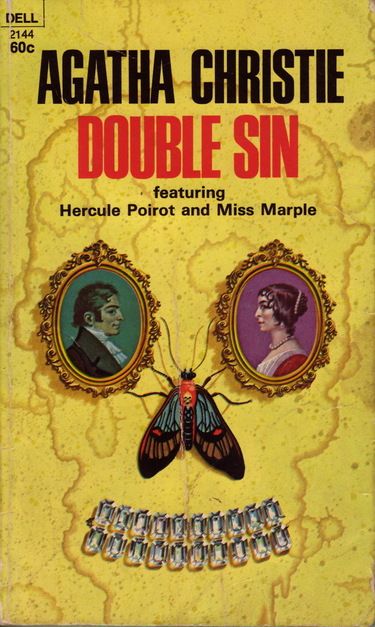
But first, a little spotlight on some of the stories we read in Double Sin & Golden Ball. These two collections are both a smattering of all of Agatha's sleuths and styles. We have Poirot and Marple and James Bond (no, not THAT James Bond) and little romantic couples and CREEEPYYYY couples and cat people (yes, CAT PEOPLE) and the list goes on and on! The title story from Double Sin and Other Stories is a fun one. Poor over-worked Poirot (he just CAN'T say no to trivial cases because his little grey cells need stimulation!) agrees to go on a bus holiday with Hastings to get some R&R. Along the way they meet a nice girl named Mary who works in the antiques business with her kind aunt. Mary is on her way to meet up with an American collector who wants to buy a set of "valuable miniatures." When the group stops for lunch, Mary is sure she sees a man trying to steal her suitcase with the miniatures! She runs outside to confront the guy and he's like whoa, settle down, we just have the same suitcase (aka, my airport baggage claim nightmare.) Mary's like whoops, my bad, kind sir! HOWEVER, when they arrive at the hotel later that day, Mary is devastated to find out that her miniatures WERE STOLEN AFTER ALL! Have no fear, Poirot is here! (sayeth Poirot) and the vacationing sleuth gets to work finding his poor friend's treasures.

Double Sin is a rather fun collection if you want to have a bit of Poirot and a bit of Marple in your life. Some other fun stories from the book are Sanctuary (Miss Marple's vicar's wife pal, Bunch, heads into church to do some stuff and stumbles across a man DYING on the church floor. His mysterious last words are "sanctuary!" and something about jewels. Bunch gets in touch with Miss Marple straight away to help discover what happened to the poor man), and The Theft of the Royal Ruby (aka The Adventure of the Christmas Pudding - one of our favorites!)

The Golden Ball and Other Stories is a bit disappointing, to be honest. It's a mix of the not-so-great romantic mystery vignette stories from The Listerdale Mystery (some of them are seriously like, moralistic tales, it's weird) and some straight up #DARK ghost stories from The Hound of Death. We have had a running text conversation about our thoughts and feelings on these short stories and the stretches concerning Golden Ball were almost all Emily giving Audrey the basic creepy plot followed by exclamations of "WHAA?!?!" (Spoilery example: "One with a ghost gypsy who tries to save someone from a terrible fate by marrying him then turns out terrible fate is that he accidentally kills ghost gypsy then he dies too and they both are ghosts!" "WHAT. AGATHA STOP IT.") - essentially, if you're looking for some ghosty reads for Halloween, definitely give this a crack, because it's got all the haunted houses and ghost children your Halloween heart might desire (starting about midway through the book, with The Hound of Death). If you're looking for your typical Agatha short story gems, give this one a pass, and get yourself to Poirot Investigates.

The YOA Treatment:
In her Autobiography, Agatha discusses her mother's dabbling in the occult (in addition to several other religions, including Catholicism and Buddhism #wellrounded). Agatha talks about Mother Clara having a sense about danger and even sensing people's thoughts, and this interest transferred a bit to the daughter, as many of Agatha's early stories and some of her subsequent work followed her interest in spiritualism and paranormal activity.

Many of the tales in The Golden Ball (which was not published in the UK), which were pulled from the alternate collection The Hound of Death, concern the terrible mysteries of the paranormal world. Compared to Agatha's novels, these stories feel totally unusual, intentionally scary, as opposed to a who-dunnit style mystery. If you're in the market for a quick spooky tale to read aloud to your pals over the light of a flickering Jack-o-lantern this weekend, we can recommend The Lamp, or The Hound of Death.

- A. & E.

P.s. Don't forget to sign up for Booktrack and try out a fun way to experience Agatha, for free! Go back to our post from a few days ago to find the link for signup.

Double, double, toil and trouble: The Pale Horse | 1961

10.22.2016
(image from here)
"There are two methods, it seems to me, of approaching this strange business of the Pale Horse. In spite of the dictum of the White King, it is difficult to achieve simplicity. One cannot, that is to say, 'Begin at the beginning, go on to the end, and then stop.' For where is the beginning? To a historian, that is always the difficulty. At what point in history does one particular portion of history begin? 

In this case, you can begin at the moment when Father Gorman set forth from his presbytery to visit a dying woman. Or you can start before that, on a certain evening in Chelsea." 
- The Pale Horse, Forward

The Sum of It:
This tale of village witches and conspiracy to murder is narrated by a newcomer, an historian in his early thirties named Mark Easterbrook. He got mixed up in the tale somewhat by chance, and it all began for him when he stopped by a fashionably hip espresso bar in Chelsea for a break from his book about Mogul architecture. While he was there, he witnesses a cat fight between two ladies (Agatha uses the b-word! #gasp), one of whom has handfuls of her curly red hair pulled out by the roots, but bravely (so Mark thinks) proclaims it didn't really hurt. He's confused by the hipsters #beatniks, and also by the red-haired girl, whose name, it turns out, is Thomasina Tuckerton. He's even more confused a few days later when he sees her name in the obituaries! 

A bit later, Mark meets up with some friends after seeing Macbeth, and they start talking about whether or not village witches are a real thing, or just a handy scam by creepy old ladies to get free stuff and keep dogs from messing with their chickens #witchpriorities. One of the girls, apparently not the brightest bulb in the box, tries to explain about some folks who do murders for hire over at a place called the Pale Horse, but she gets confused and can't quite explain. Mark brushes off the oddness til this weirdness turns into a series of incidents: he bumps into an old friend who's now a medical examiner when he stops by Mark's recently deceased godmother's house to follow up on a lead. Turns out, the godmother's unique last name was among a list of names found on a murdered Catholic priest! Seems like the list was dictated to the priest by a woman dying of a sudden and mysterious illness. In the course of their conversation, Mark recognizes a couple of other names on the list, one of which is Tuckerton, and starts thinking something wicked this way comes...

Delightfully, Mark is a pal of Ariadne Oliver's, and when he stops by to talk to her about attending a fete' his cousin is putting on in Much Deeping, she has some classic Ariadne/Agatha rants about writing mysteries (ex: "Or drink," said Mrs. Oliver. "I wish I did. Like those American detectives that always have pints or rye conveniently in their desk drawers. It seems to solve all their problems. You know, Mark, I really can't think how anyone ever gets away with a murder in real life. It seems to me that the moment you've done a murder the whole thing is so terribly obvious.") and ultimately agrees to go to the fete' on the condition that she not be forced to go have drinks at a local pub in Much Deeping called The Pale Horse. Mark's curiosity grows, and ultimately he wrangles a visit there when they're in the village, finding it now a home occupied by three decidedly witchy women #Eaglesstyle, who seem more than happy to talk about mysterious ways of killing people. Ultimately, he and the vicar's wife decide he has enough facts to link these supposed witches to a string of mysterious deaths, and with the help of an affable red-headed cutie aptly nicknamed Ginger, he decides to set a trap for evil, never realizing how close he'll come to the real deal. 

The YOA Treatment:
This one is a great read! I keep worrying that the later we get in Agatha's career, the more likely her books will get a little weaker (for one thing, how could anyone be expected to come up with 86 original ideas?!) but I keep bumping into some of the strongest books yet, so once again am forced to conclude that Agatha is superhuman. 

Speaking of original ideas though, Agatha gave herself a good idea for a story in a throwaway anecdote shared by a character in this book as a means of explaining how creepy old ladies can seem like witches, and it turns up again in 1968 as the key premise of a Tommy & Tuppence tale, By the Pricking of My Thumbs! For kicks, here's the section in Pale Horse:

"But I remember being sent once with a message to a doctor at a mental home and I was shown into a room to wait, and there was a nice elderly lady there, sipping a glass of milk. She made some conventional remark about the weather and then suddenly she leaned forward and asked in a low voice: Is it your poor child who's buried there behind the fireplace? And then she nodded her head and said, Twenty-ten exactly. It's always at the same time every day. Pretend you don't notice the blood."

Clearly Agatha was well pleased with the creepiness of that premise, we can't wait to get to By the Pricking of My Thumbs #spineshivers! 

Part of the reason the premise of this book is so engaging is the way that it keeps building and building. Typically, something crazy or mysterious happens and right away the detectives and police are on the case! Agatha cleverly set this one up a little differently, in a way that we see reflected in many modern crime shows, such as Midsomer Murders or even Sherlock, where one crime seems straightforward but something is a little off, and the police are trying to decide whether to just leave it or tease out the loose thread. She pairs that with the series of odd coincidences that ultimately gets Mark Easterbrook involved in trying to solve the mystery, about halfway through the book, by allowing one thing after another to connect the dots for him until he realizes there really is something sketchy going on, and that he might be the only one (besides the Vicar's old wife in Much Deeping) who is willing to dig through the seemingly bogus witchy stuff to figure out where the real crime is. This seemed like a very realistic way for an everyday person to get involved in trying to solve a mystery of some kind, and I enjoyed the new way to approach the story. Well done, again, Dame!

- E.