Top Social

Image Slider

Showing posts with label #archiesux. Show all posts

Disappearing Agatha: A Talent for Murder | 2017

7.25.2017
(image by The Year of Agatha)
"'I am quite convinced that , had you not had the outlet of your books, books that are full of murder, poisonings, betrayals of the worst kind, you yourself may even have been tempted to commit a heinous crime.'
'That is the most ridiculous thing I've ever heard. Quite preposterous. Just because I make a small living out of writing about crime and its detection doesn't in the slightest mean I could possibly do it myself.'
'We will see about that, won't we?' Kurs smiled."
A Talent for Murder, p. 82-83

The Sum of It:
This week we are so excited to share our thoughts and feels about A Talent for Murder, a book that seems a bit full circle for us after having immersed ourselves in Agatha Christie's works last year as this novel features the Queen of Crime herself as the protagonist. We meet Agatha in the winter of 1926 in a really horrible time of her life. Not only is she mourning the loss of her beloved mother and suffering a bad case of writer's block, but her hubby, Archie, is turning out to be a real winner (#sarcasm #archiesux) and has told Agatha he plans to leave her for his new girlfriend, Nancy Neele. Agatha is, understandably, not in the best place emotionally. During a rather tumultuous errands run, she meets Dr. Kurs, a preeeetty gross guy with bad breath and a creepy amount of knowledge of Agatha's personal life (aka 100% not the guy you want to be your doctor). Dr. Kurs is like hey, so I totally know all about this affair your husband is having cause Homewrecker Nancy is my patient and she's told me everything and I need you to do something for me or I'm gonna make sure everyone knows about your private business. Agatha is like uh, I don't know you and you're weird so no. And then Dr. Kurs is like oh alsoooo I know you have a young daughter and I know some really psycho dangerous guys and I wouldn't want anything to happen to her or anyone else you love.

Emotionally vulnerable, Agatha feels backed in to a corner and very reluctantly decides she needs to comply with Dr. Kurs' demands. However, these demands get pretty intense when Dr. Kurs informs her that he needs Agatha to use her experience as a brilliant mystery author to commit a murder of her own (#thisescalatedquickly)! Now, as Agatha leaves her family and friends behind and literally disappears into the night to take on this #murderquest, she has to decide whether to go through with Dr. Kurs' wishes...or use her wits to figure out a way to out-manipulate him.

The YOA Treatment:
When we attended the "Agatha Christie: A Reappraisal" conference last month, we were delighted to meet A Talent for Murder's author, Andrew Wilson. Ironically we had JUST purchased his book before leaving for England, but had not had a chance to read it yet! After having a chance to get to know him and his immense love for Agatha, we hurried home to devour his latest novel. Andrew has done a wonderful job of providing a massively intriguing explanation for Agatha's real-life 1926 disappearance, while also creating a complex yet personable character in Mrs. Christie as she navigates her own suspenseful mystery. A Talent for Murder is a thoroughly wonderful read that Christie fans of all levels will enjoy! We can't wait to dive into his next Agatha Christie adventure, A Different Kind of Evil (out in March 2018!)

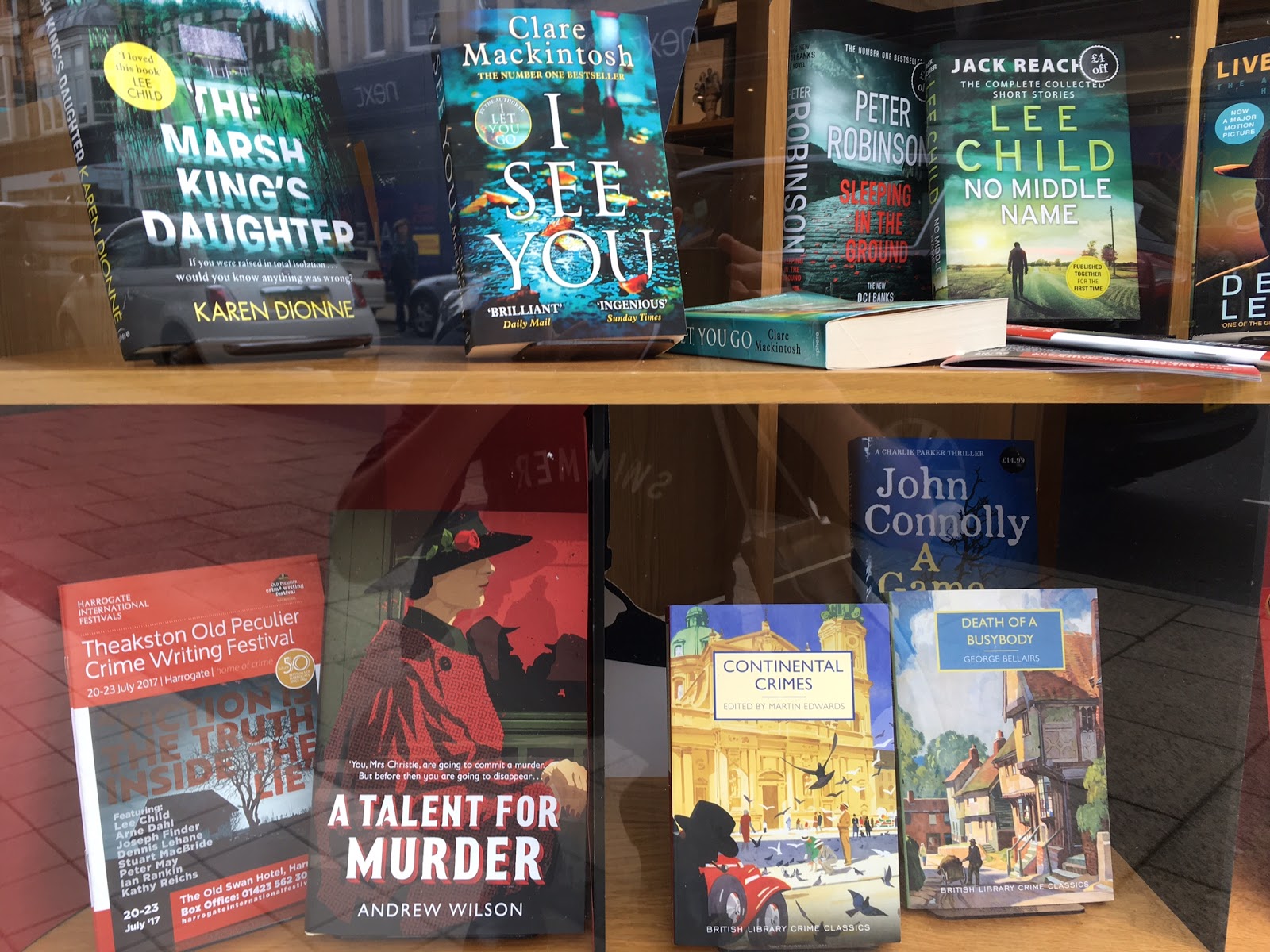
We are so honored to have had the chance to ask Andrew a few questions about his experience writing this book about the Queen of Crime - please enjoy his insights a bit further down, BUT FIRST! Andrew's bona-fide Agatha mega fan/expert status has also been bumped up a notch further as he is currently wrapping up speaking at the Theakston Old Peculiar Crime Writing Festival at THE hotel in Harrogate where Agatha stayed during her disappearance! This festival looks AMAZING and we are truly jealous we aren't in attendance - here's hoping we can next year. Andrew has also kindly shared some of his photos from the festival below, and they're followed by our super fun interview with him about A Talent for Murder!

(Harrogate!)


(We spy some EXCELLENT reading options here - congrats, Andrew!)

YOA asks:
 You mention in your Acknowledgements that you had the idea to write A Talent for Murder during a train ride, but we'd love to know the full story. As a long-time Christie fan, was this something you had been thinking about doing for a while and the pieces came together for you on your train ride? Or was there something about that particular trip that sparked the inspiration?

AW answers: I love train journeys, as Agatha did. This particular train journey was the Great Western Service from London down to Devon, where I now live. It’s a route that Agatha would have travelled many times, both when she lived in Torquay and then later, after buying Greenway, on the banks of the river Dart. There’s something about the rhythm, the movement, and then the continual changing view, that is good for the imagination. At at subconscious level, I’m sure I must have been thinking of Strangers on a Train, because of  course, there is something of Highsmith’s first novel in A Talent for Murder.

YOA asks: I have usually been skeptical about novelizations of Agatha's life because I didn't want to be drawn into a scenario that couldn't possibly be true. Your attention to research and strict adherence to the facts we have from Agatha's disappearance in 1926 made me a believer that this kind of novelization can be done and done well! Your presentation at the "Agatha Christie: A Reappraisal" conference referenced how factual inaccuracies in the portrayal of Christie can be very disappointing. As you set about writing A Talent for Murder, what were some pitfalls you wanted to avoid and how did this fit into your writing process? 

AW answers: I wanted to make the background of the book - the tone of the period, the “facts” of the case, the characterisation of the protagonists - to feel as authentic as possible. My first task was to construct a framework of what we know happened in real life. I drew on newspaper accounts, police statements and witness interviews to build up a picture of what Agatha was doing over the period of the disappearance. Then, using this blueprint, I injected a crime story to explain what could have happened. At the end of the book I list “the facts” to show readers what was true and what was a product of my imagination. 

YOA asks: You have done a marvelous job with your portrayal of Agatha Christie as a character. It was such fun to see the woman behind so many of my favorite books come to life! In your book you have listed many sources for the details of her disappearance and her life, including Christie's Autobiography, but I'm curious where you would say you found the greatest inspiration for Christie's character during this particular period of her life (her 1926 disappearance) since she talks so little of it in her Autobiography?

AW answers: I suppose the voice of Christie is something that came to me over time. After immersing myself in her work since the age of 11 or so I didn’t find it hard to strike the right note. But of course this was a huge gamble. Luckily, so far many readers have told me that the book sounds as though it could have been written by Agatha.  But here in this book, one must remember, Agatha is still a character - she is a product of my imagination. I didn’t want to write a pastiche or a parody. I hoped to give the reader a flavour of my vision of Agatha’s perspective, the way she saw the world.

YOA asks: In the book, Mr. Kurs proposes to Agatha that he is convinced that, "had you not had the outlet of your books, books that are full of murder, poisonings, betrayals of the worst kind, you yourself may even have been tempted to commit a heinous crime" and Mr. Davison suggests she may have a darker side beneath the surface as well. Agatha's character balks at this idea immediately in the pages, however, I'm curious about what clues you may have found through her work or your research that others or perhaps even she may have thought this as well?

AW answers: I think this is very much one of the demands of the story. In order for the plot to work we have to believe that Agatha is in a very vulnerable place. In 1926, we know her mother died, she discovered her husband’s infidelity and learned the news that he wanted a divorce, and she also seemed to be suffering from a period of writer’s block. Both Dr Kurs and Davison want something from Agatha - Kurs tries to manipulate her as a character and Davison would like her to work for a shady government organisation.Agatha fans know that she was not the cozy writer of the popular imagination. In many respects, many of the TV adaptations  have leached the work of its darker elements, reducing it to Cluedo-like whimsy. But one only has to read novels such as Crooked House and And Then There Were None to see that Christie was far from cozy.

YOA asks: As a massive Christie fan myself, it was an absolute delight to come across little references to her works throughout your book - you mention the phrase 'by the pricking of my thumbs", there is a reference to Mrs. Astor (an inspiration for a character in Appointment with Death), and near the end of the novel it seems as if Agatha has encountered characters resembling Poirot and Miss Marple. And yet A Talent for Murder is very approachable for readers who may not be as familiar with Agatha Christie. What did you want to share most about Agatha with your readers as you wrote this book?

AW answers: We know Agatha was highly intelligent and creative, she was expert at plotting and also had a deep knowledge of poisons. But the central question is a moral one: she could write about murder, but would she - under the right circumstances - ever commit one? I wanted to make the book just as readable and exciting for non-fans as for those with a greater knowledge of Agatha. So yes, there are a few clues dotted around, allusions and references that a Christie fan can pick up on. But no prior knowledge of Christie is needed!

YOA asks: You write that you have been a Christie fan since childhood - something that I can certainly relate to, as well as many of our blog readers and social media followers. Do you think being such a longtime fan and having a deep knowledge of her as an author created any barriers as you set about writing this book?

AW answer: Obviously, I didn’t want the narrative to be bogged down by too many facts about Agatha’s life or a flood of allusive references.  The key was to give the reader a taste, a hint of these things. The main challenge was to come up with a storyline which was gripping and full of suspense.

YOA asks: Agatha Christie's 1926 disappearance is utterly fascinating and her silence on the matter really does lend to letting the imagination run wild! What aspect of those missing days do you find the most intriguing?

AW answers: The central idea - a crime writer who went missing from her own crime scene - is a tantalising one. Also, the fact that - after an interview with the Daily Mail in 1928 - she decided not to to discuss it. There have been so many speculations over the years, so many scenarios. I like the ambiguity of it all, the fact that we don’t really know what happened during those ten or eleven days. It is this mysterious quality which still endures and which makes it such an irresistible subject for fictional exploration.

YOA asks: While Emily and I love the crime fiction of the Golden Age, we are also very fond of more contemporary mystery novels. As you've gone about writing a mystery in 2017 about events from the Golden Age, how do you see that the crime or mystery fiction genre has changed since Agatha and her contemporaries were writing between the Wars?

AW answers: One can only generalise here, of course. There is an accepted position that the Golden Age was all about restoring order within the pages of a book - so a killer is exposed/murdered/forced to commit suicide/imprisoned at the end. This is, in many respects, true, but there are exceptions, as any Agatha fan knows. Just look at Murder on the Orient ExpressI think the main trend postwar is the general exploration of moral ambiguity. Under what circumstances would force/tempt each of us commit a terrible crime like murder? How do “normal” people end up as killers? How does danger lurk within the domestic sphere? Of course, Patricia Highsmith is one of my great influences (I wrote the first biography, Beautiful Shadow) and I think she is expert at exploring themes such as guilt, moral ambiguity, and the banality of evil.

YOA asks: And, of course, we must ask about your personal Christie favorites! What would you say are your top three Christie novels?

AW answers: Always so difficult and, of course, these do change. But … The Murder of Roger Ackroyd, is always there in my top 3 - I love the cleverness of it, the technical challenge it presented Agatha and I always recommend it to people who have never read Christie’s novels. Then I would choose Sleeping Murder, because of its themes of repressed memory and its psychological intensity. And Five Little Pigs, for too many reasons to mention here!

Thanks for joining the YOA family, Andrew!

- A. & E.
SaveSave

Sunbathers Beware: Evil Under the Sun | 1940

7.11.2016
(image from here)
"It was, Hercule Poirot thought, like watching the needle of a compass. Patrick Redfern was deflected, his feet changed their direction. The needle, do what it will, must obey the law of magnetism and turn to the north. Patrick Redfern's feet brought him to Arlena Stuart."
-Evil Under the Sun, p. 15-16

The Sum of It:
Papa Poirot is on vacation again! But, like usual, he isn't even totally off the detective clock because wherever Poirot is, murder cannot be far behind. Poirot is enjoying a summer holiday on the English coast at a little island resort called The Jolly Roger Hotel (which Agatha goes to great pains to describe as fabulous but it sounds very #Daytona to us...). As always, he is surrounded by a smorgasbord of fellow vacationers, some of whom are quite boisterous and have wild theories about how sunbathing will LITERALLY put hair on your chest (Mrs. Gardner, we're lookin at you) or are constantly bragging about how rich they are (shut it, Mr. Blatt) or are famous and refined fashion designers with exotic perfume (yes ma'am, Rosamund Darnley). The most sensational guest at The Jolly Roger is Arlena Stuart: a gorgeous actress with a reputation for being a home wrecker and a pretty dull husband. Drama starts heating up big time when Arlena and young, handsome, and very married Patrick Redfern get their not-so-subtle flirt on. No stranger to hot mess #lovetriangles, Poirot steers clear of the drama (aside from eavesdropping on their alone time), hoping nothing deadly becomes of all this sexual tension. But sure enough, Patrick Redfern soon stumbles upon his summer fling #MURDERED on a secluded island beach, apparently strangled as she lay sunbathing!

Of course nearly the entire resort population had a death wish on Arlena: there was no love lost between Arlena and her husband Kenneth Marshall and stepdaughter, Linda, Patrick Redfern's timid wife Christine wasn't too thrilled about the hold Arlena had on her husband, and Rosamund Darnley would be very interested in becoming Mrs. Marshall #2…except Kenneth Marshall had no intention of ever divorcing his wife. Evil Under the Sun is a terrific example of straightforwardly enjoyable Agatha Christie: plenty of fun characters, juicy drama, and a solution that isn't necessarily her most clever, yet we dare say keeps you guessing until the last minute! We also highly recommend this as a beach read. Not only will you feel right at home with the waves crashing and sun shining as Agatha describes the pleasures of #beachlife, but this book goes by nice and fast if you have a few hours of uninterrupted time.

The YOA Treatment:
As with many of her books, infidelity plays a big part of Evil Under the Sun not only as a characteristic of arguably the two least likable characters, but also as a possible murder motive. Agatha Christie was sadly well acquainted with the heartache that comes from an adulterous marriage. Agatha's first husband, Archie, left her for another woman early in her writing career and it sent her into an understandable spiral of sadness. As described in her autobiography, Archie was generally super selfish and pretty straightforward about being in love with someone else and even kind of blamed Agatha for making him unhappy because she had to go take care of her sick mother (GOOD GRIEF, ARCHIE).

While Agatha went on to remarry and move past her first husband #TeamMax (who maybe also was a little unfaithful but we don't know that for sure and if it happened it didn't break her heart like Archie did so we're still #TeamMax), you can sense the feeling she puts into writing characters who have a cheating spouse. Christine Redfern's heartache feels very real in Evil Under the Sun as she watches her husband swooning over Arlena, and basically all the other characters have various reasons for disliking Arlena's homewrecking-self, and judging Patrick (although pretty much everyone blames Arlena for being a siren and gives Patrick the #Ulysses-style excuse of being helpless under her gaze #noexcusesforbeingadickguys #lookinatyouArchie). There's even a priest in this book who just goes with "that woman is straight up evil" for her siren-like ways.

Even though Agatha kind of sadly gives cheaters the benefit of the doubt in her autobiography (one of the only times we wanted to be like #LEANIN, girl, don't blame yourself for this!), she uses the behavior as a theme in many of her books, and in this one we hope she got a little satisfaction from giving a cheater their just desserts (disclaimer: no one is saying murder is appropriate retaliation, just sayin').

-A. & E.

On Site with Poirot: Murder in Mesopotamia | 1936

2.28.2016
(image from here)
"You would have made a good archaeologist, M. Poirot. You have the gift of re-creating the past." 
- Dr. Leidner, Murder in Mesopotamia, p. 226

The Sum of It:
With Murder in Mesopotamia, we are finally transported into the Middle Eastern world of archeological digs that was such a HUGE part of Agatha Christie's life. Set at a dig site in Hassanieh, Iraq, Murder in Mesopotamia is written from the point of view of straight-forward, but likable, Amy Leatheran, a nurse who has been hired to look after the wife of a famous archeologist, Dr. Eric Leidner. The "Lovely Louise" is beautiful and charming, but also a bit of a tease in every sense of the word: the ladies don't like her hitting on their men and the men don't like her poking fun at their insecurities. Louise also turns out to be a huge nervous wreck owing to the fact that she thinks her first husband (an American spy for the Germans in World War I, who she ended up turning in to the government, which led to him being shot as a traitor, but in fact he actually escaped and then maybe died in a train wreck? #oops) is actually alive and well and, according to the threatening letters he keeps sending her, is trying to track her down and kill her.

Nurse Leatheran has been around the dig site for basically a hot second when Louise is in fact MURDERED in her room during nap time, and it looks like the killer is one of the expedition team. Local law enforcement decide to bring in a big wig to solve the case, and the obvious candidate is our favorite Belgian, Hercule Poirot! Poirot appoints Nurse Leatheran as Hastings-Stand-In and the two of them commence their investigations. Was Louise killed by her first husband or his brother in disguise? Or did one of their group want her dead for a more personal reason?

The YOA Treatment:
A bit of background/Agatha personal life refresher: after divorcing her first husband, Archie (#booarchie #archiesux) Agatha visited a dig site in Ur with some friends and met Max Mallowan (#teammax), who would eventually become her second husband. Over the course of their marriage, Agatha traveled with Max to the Middle East to work together at his dig site. Agatha talks about how much she enjoyed these trips and how she was able to not only assist Max with his excavations, but also spend a good amount of time writing her mystery novels in her book on these excursions, Come, Tell Me How You Live. Her intimate knowledge of the life of an archeologist and ancient cultures clearly shows in the details of her novels Murder in Mesopotamia, Appointment with Death, and Death Comes as the End.

I have always liked this story - the Middle Eastern setting is an interesting change from her normal English Countryside and/or London, and the cast of characters is one of my favorites of all her books. You can see how her extensive stays on dig sites offered excellent ideas for the wide variety of personalities found in Murder in Mesopotamia: the hypochondriac, the jealous girly girl, the brooding hottie, the bumbling intern, the sketchy translator, and the mean girl from town who always has three or four dates to the dance. The female narration from Nurse Leatheran also offers a different perspective from other Agatha books, including the opportunity to wax eloquent about the expedition's resident total babe, Richard Carey:"I could see clearly a little pulse that beat in his temple. He looked simply splendid! So lean and so brown - and that wonderful jaw, hard and square. I don't wonder women fell for that man."

It's great to "see" through her writing how much Agatha was enjoying her new, happy married life and her new, lifelong hobby of Middle Eastern adventure.

-A.


Rubies and the Riviera: The Mystery of the Blue Train | 1928

2.22.2016

"Some day, who knows, you might be in the thick of things," he went on. "It is all chance." "I don't think it is likely," said Katherine. "Nothing of that kind ever happens to me." He leaned forward. "Would you like it to?" 
- Poirot and Katherine Grey in The Mystery of the Blue Train, p. 75

The Sum of It:
Even though this one says "A Hercule Poirot Novel" on the front, I found myself wondering if Poirot was ever going to turn up, because it's about 70 pages before Poirot comes into the tale. The seeming main character of this book, initially, are some rubies that used to belong to Catherine the Great. As the book begins, the glorious stones are purchased from Boris and Natasha (I'm pretty sure) by an American. Our American, Mr. Van Aldin, has bought them for his daughter, Ruth, the apple of his eyeballz. He gives them to her on the eve of her trip via the glamorous Blue Train to the French Riviera, along with a caution (put these priceless jewelz in the bank rather than risk having them stolen and you murdered on the train puh-lease) and a demand (divorce your good-for-nothing, money-grubbing, philandering husband Derek and don't do anything to jeopardize your case). 

We ALSO meet a bunch of other characters, including; 
  • Mirelle, the exotic dancer with whom said philandering husband Derek is doing his philandering 
  • Lady Katherine Grey (the actual main character, besides the rubies) who is a classy lady with beautiful grey eyes despite being elderly and decrepit at the beyond-her-prime-age of 33 and who has also just inherited loads of money from an actual elderly lady for whom she had hitherto served as companion (her family was apparently nobility of some kind but sans money to this point.) Fun fact: She lives in St. Mary Mead! No mention of Marple though.
  • Lady Tamplin, Katherine's cousin, who is wealthy (but not as wealthy as she'd like) and lives on the Riviera with;
  • her feisty daughter, Lenox, and Lady Tamplin's fourth husband, the young and dashing (if dense) Charles Evans (aka Chubby) #cougartown
  • Major Knighton, who is Mr. Van Aldin's secretary and a war veteran 
  • A Greek jewel dealer named Mr. Papopolous and his daughter Zia.

ANYWHO after Lady Katherine inherits the dollars, she goes to London to buy some clothes befitting her new income and to embark on her first world travels, to visit Lady Tamplin, et al, on the French Riviera (via the Blue Train). She keeps bumping into a handsome fella around town, and feels a premonition about him and unbeknownst to her he's also headed to the Riviera #meetcute. On the train, Katherine befriends Ruth over lunch, where Ruth bares her soul due to Katherine's nice eyes and says she's feeling super torn because her dad wants her to file for divorce and made her promise she wouldn't mess that up but also she lied to dad about being engaged in an affair with Le Comte de la Roche, a fancy-man from France who her dad already made her break up with once before she married Derek (dad thinks he's a scoundrel). 

Because it's the early 20th century and Katherine doesn't have headphones she can put it to deter people from telling her their life stories on trains, she listens kindly and gives advice only to not really see Ruth again for the rest of the trip. Once they arrive in the Riviera, it turns out that Ruth is #MURDERED and Katherine and another traveler with whom she has chatted, HERCULE POIROT, are immediately embroiled in the mystery. No more spoilers, but the rest of the book is mostly concerned (obviously) with trying to determine who killed Ruth, where the eff her rubies went, whether Derek is a bad guy or a good guy, and what Katherine is thinking. There's lots of being in love, tennis matches, Poirot bragging about how awesome he is, casinos, and glistening blue waters. 

Agatha & Archie early on (from the Autobiography)
The YOA Treatment:
So, in her autobiography, Agatha said of The Mystery of the Blue Train: "Really, how that wretched book ever came to be written, I don't know...I had no joy in writing, no elan...I assumed the burden of a profession which is to write even when you don't want to, don't much like what you are writing, and aren't writing particularly well. I have always hated The Mystery of the Blue Train, but I got it written."

Aside from her little daughter, Rosalind, being distracting, there's one even bigger reason why writing this one was likely a struggle, and that's because Agatha wrote it in the Canary Islands, where she escaped with Rosalind after horrid Archie made her get a divorce because he was selfish and didn't deserve her #teamMax. Poor Agatha was trying to "go right away from all the things that had wrecked life" for her.

With that context in mind, it's interesting how sympathetically Agatha wrote the character of Derek, the philandering husband. When you read her autobiography, although she had a lot of sadness because Archie broke her heart, she also offers him sympathy and in some ways puts some of the responsibility for the demise of their relationship on herself, talking about how he could be so kind but he was just ruthless about getting what he wanted and that she really believed he hated hurting her #eyeroll. If she and I were friends at that point in time, I would have said to her NO WAY young lady, this jerk is the world's most selfish man and you cannot blame yourself for that (I mean he LITERALLY SAID TO HER as an explanation for why they had to get a divorce against her wishes: "I can't stand not having what I want, and I can't stand not being happy. Everybody can't be happy -- somebody has got to be unhappy." #archiesux #mansplaining #GOODRIDDANCE, it seriously makes me so mad. And Agatha felt like it would have been inappropriate to stand up to him and say "But why should it be me and not you?" #LeanIn). 

Derek, the philanderer in Blue Train, not only gets described more like a bad little boy who can't be blamed for running around on his wife because she didn't really love him that much, there's a decent amount of sympathy sent his way by various characters including Poirot, and lots of ladies who love him seemingly regardless of the fact that it is well known he's been stepping out with a money-grubbing exotic dancer who pitches fits in public. This book kind of makes me a little sad for Agatha because she was having such a rough go of it and beating herself up a bit, but it's comforting to know that eventually dearest Max came along and Agatha got her confidence and her groove back. 

-E.