Top Social

Image Slider

Showing posts with label short stories. Show all posts

My Earliest Agatha Memory: Witness for the Prosecution, While The Light Lasts, & The Harlequin Tea Set | 1948, 1997, & 1997

12.23.2016
(image from here)
(image from here)
(image from here)


"He [Poirot] felt the spell of Margharita Clayton. But he was not entirely sure about her...Such women could be, though innocent themselves, the cause of crimes." -The Mystery of the Spanish Chest, p. 151.

The Sum of It:
Our last short story recap of the year! I'm going to fixate on one particular story from the last three collections I've read, as it has a nostalgic connection for me (more on that later!) The Mystery of the Spanish Chest (which makes an appearance in The Harlequin Tea Set & Other Stories) details the rather gruesome death of a Mr. Edward Clayton. His super stabbed body was found in a rather elaborate, decorative Spanish chest in Major Charles Rich's home. Creepily, the body was discovered the morning after a party had been happening in that very room the entire evening before! Mr. Clayton's wife was in attendance at the party, and her husband was also supposed to be, but he was unable to at the last minute...but did attempt to visit Major Rich before the party. Poirot meets Mrs. Clayton and is, of course, instantly a bit entraceled by her beautiful face and is like oh yeah she def had the hots for Major Rich and vice versa (#affair???!!!), but she insists they didn't have anything going on. Poirot does his usual Poirot thing and interviews everyone who was at the party to see if there's something missing or if it really is as simple as Major Rich killed Mr. Clayton to marry Mrs. Clayton. Poirot must harken back to his remembrance of Shakespeare plots to figure it out!

The YOA Treatment:
I've written before about how my parents introduced me to Poirot from an early age. Masterpiece Mystery! was one of my earliest television memories, and, in particular, The Mystery of the Spanish Chest. Once upon an age ago my parents decided to tape that episode on VHS (along with The Kidnapped Prime Minister) and I would watch it over and over and over and OVER! To this day my father can't bear to watch it because I wore him out of that Spanish chest death with my repeated viewings! It's funny to think that television helped shape my ferocious appetite for reading, but it's rather true. Even though I can probably recount to you every detail of The Mystery of the Spanish Chest episode (that duel at the beginning! So dramatic...), I still loved reading the short story version and transporting myself back to my younger days when my Agatha journey was just beginning.

-A.

Beginnings & Ends: Poirot's Early Cases, Miss Marple's Final Cases, & Problem at Pollensa Bay | 1974, 1979, & 1991

11.20.2016
(image from here)
(image from here)
(image from here)

"Remember it, and if you think at any time that I am growing conceited - it is not likely, but it might arise."
I concealed a smile.
"Eh bien, my friend, you shall say to me, 'Chocolate box.' Is it agreed?"
"It's a bargain!" -Poirot & Hastings, "The Chocolate Box," Poirot's Early Cases, p. 139

The Sum of It:
We are getting deep into the land of We Have Read All These Short Stories Before In Other Collections...but never fear! The good thing about revisiting short story collections is coming across one you really enjoy. This time, that story for me was "The Chocolate Box." 

The story begins with Poirot and Hastings having a cozy night in, sipping warm drinks (Poirot has what sounds like a truly tasty cup of hot chocolate, and yet Hastings observes he would basically rather poke his own eye out than drink the stuff #sillyhastings) and reminiscing on Poirot's old cases. Poirot says uh, you know there was this one time when I actually got the case WRONG. And Hastings is like GASP, tell me everything. 

Back when Poirot was in the Belgian detective force, there was a big old row going on in France between the Catholic church and the state. One true anti-Catholic baddie guy named Paul Deroulard was a French politician with a Belgian wife who died from falling down a flight of stairs (#yikes #handrailsplz.) After her death, Paul inherited all her money and her house in Brussels. While living there, old Paul ALSO dies rather suddenly. Poirot recalls that he was about to go on vacay, and, being a "bon catholique," was not too devastated by this guy's death. However, he received a visit from a beautiful young woman named Virginie, a cousin of the late Mrs. Deroulard, who requested Poirot's assistance in solving the death of Paul. For all Poirot makes fun of Hastings being star-struck by the beautiful ladies, Poirot himself really can't say no when they ask him for help.

Poirot's investigations lead him to the Deroulard home, where he poses as a journalist to get some answers from the household, which includes several servants, Paul's elderly mother, an English friend named Wilson, and a French neighbor named Saint Alard. Paul Deroulard died suddenly as he had retired to smoke and drink with his guests after dinner. Dinner seemed to have been partaken by all and untampered, same with the after-dinner refreshments. However, the case takes a turn when Poirot discovers that Paul Deroulard alone was a major chocoholic, and always had some after dinner. A quick pose as a plumber, and a rifle through some medicine cabinets make the whole case clear to Poirot. However, as he returns to the Deroulard home to announce the murderer, he finds that he was completely wrong! Poirot has oddly fond memories of the case, as he imagines it keeps him humble. But we all know that Hercule Poirot will never be as humble as he imagines, and that is precisely why we love him.

Miss Marple's Final Cases is made up of several short stories, nearly all of which we have already discussed here on the blog. However, I do heartily recommend giving it a read, especially if you want to read more about Miss Marple in her St. Mary Mead everyday life!

And speaking of St. Mary Mead, it was intriguing to read what smacks of a first run at The Murder at the Vicarage in "The Love Detectives" from Problem at Pollensa Bay & Other Stories. Mr. Satterthwaite & Mr. Quin team up with Colonel Melrose to discover who has coshed cranky old Sir James Dwighton over the head in his library. Of course the initial likely suspect is his beautiful young wife and the Dwighton's houseguest turned Mrs. D.'s boyfriend turned ex-houseguest, Paul. However, additional injured parties come out of the woodwork as the investigation continues, and it seems like there is no end of motives for the murder of Sir James. Do Satterthwaite and Quin work it out in the end? You'll just have to pick up a copy to find out!

The YOA Treatment:
We have several exciting things coming up over the next few weeks as #PHASEONE of The Year of Agatha comes to a close! We are very much looking forward to a guest blog post by the delightful Sophia from Main Street & Maple book blog, as well as a little Cyber Monday deal in our Etsy shop #AgathashirtsforChristmas #Poirotpresents! Be sure to stay tuned in the next few weeks for more details.

Have a wonderful weekend!

-A.
SaveSave
SaveSave

Short Story Honesty & The Occult: Double Sin + The Golden Ball | 1961 & 1971

10.29.2016
(image from here)

(image from here)
"Suddenly the child stirred. His eyes opened. He looked past his mother towards the open door. He tried to speak and she bent down to catch the half-breathed words. 'All right, I'm comin,' he whispered, then sank back. The mother felt suddenly terrified; she crossed the room to her father. Somewhere near them the other child was laughing. Joyful, contented, triumphant, the silvery laughter echoed through the room. 'I'm frightened, I'm frightened,' she moaned.

He put his arm around her protectingly. A sudden gust of wind made them both start, but it passed swiftly and left the air quiet as before.The laughter had ceased and there crept to them a faint sound, so faint as hardly to be heard, but growing louder till they could distinguish it. Footsteps -- light footsteps swiftly departing.

Pitter-patter, pitter-patter, they ran -- those well-known halting little feet. Yet -- surely -- now other footsteps suddenly mingled with them, moving with a quicker and lighter tread."
  - The Golden Ball and Other Stories, p. 166

The Sum of It:
More short stories for the both of us this week! We are kind of reaching our limit of clever-ish things to say about dear Agatha's short stories, so we decided to combine our two book posts this week and offer a little Halloween weekend twist on our latest reads.

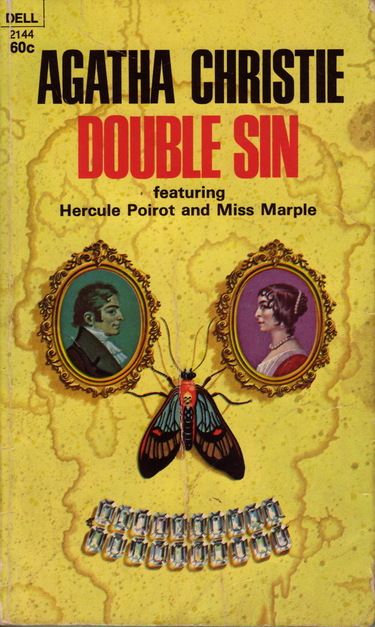
But first, a little spotlight on some of the stories we read in Double Sin & Golden Ball. These two collections are both a smattering of all of Agatha's sleuths and styles. We have Poirot and Marple and James Bond (no, not THAT James Bond) and little romantic couples and CREEEPYYYY couples and cat people (yes, CAT PEOPLE) and the list goes on and on! The title story from Double Sin and Other Stories is a fun one. Poor over-worked Poirot (he just CAN'T say no to trivial cases because his little grey cells need stimulation!) agrees to go on a bus holiday with Hastings to get some R&R. Along the way they meet a nice girl named Mary who works in the antiques business with her kind aunt. Mary is on her way to meet up with an American collector who wants to buy a set of "valuable miniatures." When the group stops for lunch, Mary is sure she sees a man trying to steal her suitcase with the miniatures! She runs outside to confront the guy and he's like whoa, settle down, we just have the same suitcase (aka, my airport baggage claim nightmare.) Mary's like whoops, my bad, kind sir! HOWEVER, when they arrive at the hotel later that day, Mary is devastated to find out that her miniatures WERE STOLEN AFTER ALL! Have no fear, Poirot is here! (sayeth Poirot) and the vacationing sleuth gets to work finding his poor friend's treasures.

Double Sin is a rather fun collection if you want to have a bit of Poirot and a bit of Marple in your life. Some other fun stories from the book are Sanctuary (Miss Marple's vicar's wife pal, Bunch, heads into church to do some stuff and stumbles across a man DYING on the church floor. His mysterious last words are "sanctuary!" and something about jewels. Bunch gets in touch with Miss Marple straight away to help discover what happened to the poor man), and The Theft of the Royal Ruby (aka The Adventure of the Christmas Pudding - one of our favorites!)

The Golden Ball and Other Stories is a bit disappointing, to be honest. It's a mix of the not-so-great romantic mystery vignette stories from The Listerdale Mystery (some of them are seriously like, moralistic tales, it's weird) and some straight up #DARK ghost stories from The Hound of Death. We have had a running text conversation about our thoughts and feelings on these short stories and the stretches concerning Golden Ball were almost all Emily giving Audrey the basic creepy plot followed by exclamations of "WHAA?!?!" (Spoilery example: "One with a ghost gypsy who tries to save someone from a terrible fate by marrying him then turns out terrible fate is that he accidentally kills ghost gypsy then he dies too and they both are ghosts!" "WHAT. AGATHA STOP IT.") - essentially, if you're looking for some ghosty reads for Halloween, definitely give this a crack, because it's got all the haunted houses and ghost children your Halloween heart might desire (starting about midway through the book, with The Hound of Death). If you're looking for your typical Agatha short story gems, give this one a pass, and get yourself to Poirot Investigates.

The YOA Treatment:
In her Autobiography, Agatha discusses her mother's dabbling in the occult (in addition to several other religions, including Catholicism and Buddhism #wellrounded). Agatha talks about Mother Clara having a sense about danger and even sensing people's thoughts, and this interest transferred a bit to the daughter, as many of Agatha's early stories and some of her subsequent work followed her interest in spiritualism and paranormal activity.

Many of the tales in The Golden Ball (which was not published in the UK), which were pulled from the alternate collection The Hound of Death, concern the terrible mysteries of the paranormal world. Compared to Agatha's novels, these stories feel totally unusual, intentionally scary, as opposed to a who-dunnit style mystery. If you're in the market for a quick spooky tale to read aloud to your pals over the light of a flickering Jack-o-lantern this weekend, we can recommend The Lamp, or The Hound of Death.

- A. & E.

P.s. Don't forget to sign up for Booktrack and try out a fun way to experience Agatha, for free! Go back to our post from a few days ago to find the link for signup.

Agatha's First Drafts

7.28.2016
(image from here)
The YOA Treatment:
Although we have a bit of a love/hate relationship with short stories (#trueconfessions), we have enjoyed getting to know more about Agatha Christie's writing process by seeing how her sprightly, easy-to-read style and enthralling plots fit into both short story and novel form.  Many times we have seen Agatha almost doing a trial run of plot ideas in a short format, which she then fleshes out into a full-length novel. Some notable examples are "Triangle at Rhodes"/Evil Under the Sun, "The Case of the Caretaker"/Endless Night, and, most pertinent to this month, "Yellow Iris"/Sparkling Cyanide (also known as Remembered Death).

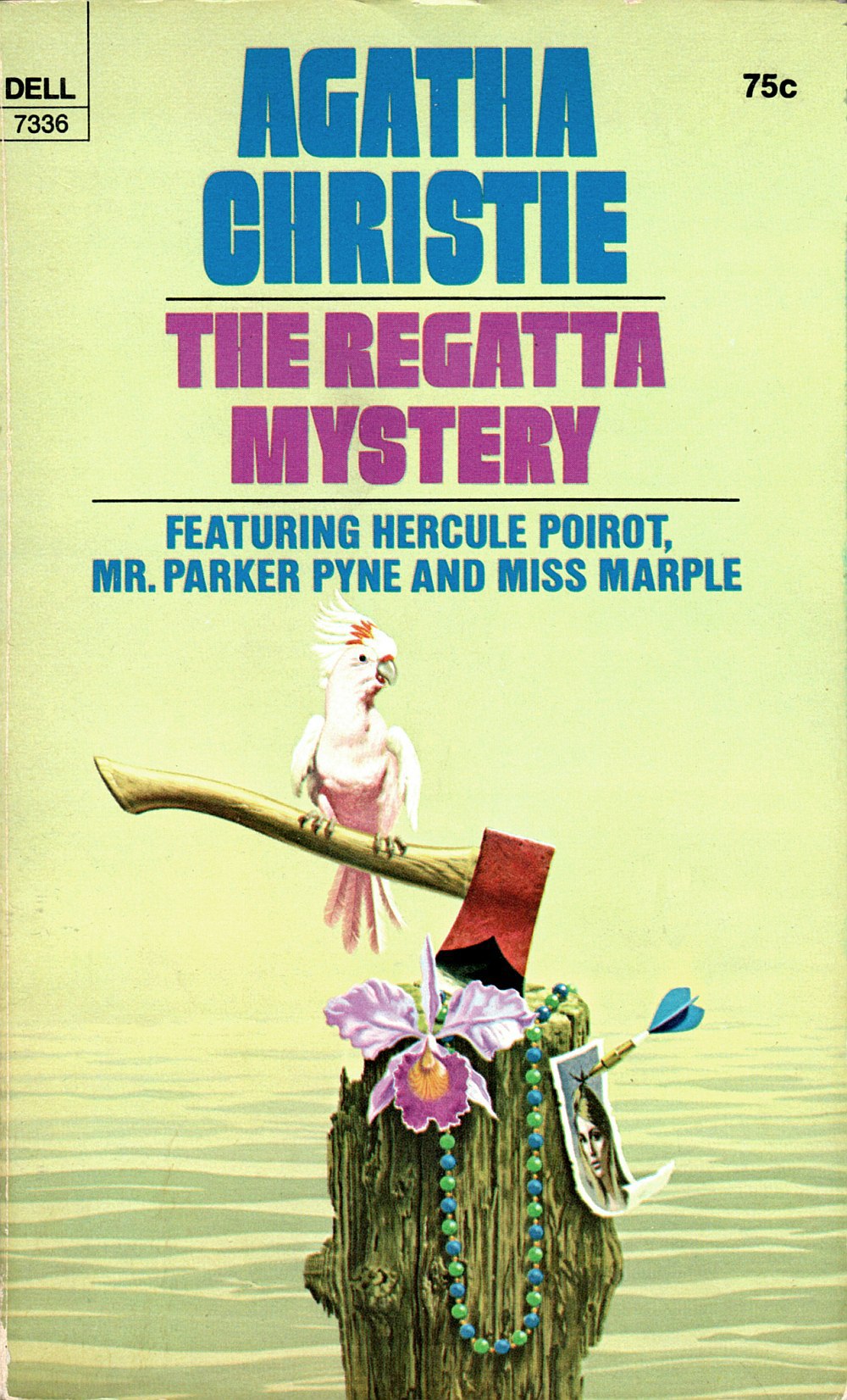
Emily recently read "Yellow Iris" in The Regatta Mystery collection and obvi the inspiration is clear, from the settings to the style of murder to the characters... with one notable exception: NO POIROT IN CYANIDE! Another familiar mystery solver, Colonel Race, who is a friend of Poirot's, gets to be on the case in Sparkling Cyanide, while good ol' Hercule solves the mystery in "Yellow Iris." We aren't sure exactly why Agatha ditched Poirot for the novel version of this whodunnit, but we do know that she found him infuriating and regularly wished she wasn't stuck with him, so maybe she wrote Sparkling Cyanide during one of their tiffs!

We have so enjoyed reading Sparkling Cyanide this month with the Maidens of Murder! Be sure to head over to their Instagram (@maidensofmurder) tomorrow to for a discussion of the book! We'll also be posting our recap here on the blog over the weekend.

Happy reading!

-A. & E.

Everybody In: The Regatta Mystery | 1939

6.30.2016
Image from here
"I wonder if you'll ever commit a crime, Poirot?" said Stillingfleet. "I bet you could get away with it all right. As a matter of fact, it would be too easy for you -- I mean the thing would be off as definitely too unsporting." 
"That," said Poirot, "is a typically English idea."
-The Dream, p. 161

The Sum of It
This set of short stories contains tales featuring three of Agatha's best known detectives: Poirot, Parker Pyne, and Miss Marple. Many of these are legit SHORT stories, some of them are really more like vignettes. A few of the stories will be well known by fans of the David Suchet Poirot series as they have been adapted in that medium. The Mystery of the Baghdad Chest, Yellow Iris, The Dream, and Problem at Sea can all be found in this little collection. 

My favorite story in this collection was one I hadn't seen before, called In a Glass Darkly. The story is written in first person, which I always enjoy from Agatha. The narrator is visiting a friend and dressing for dinner in a mirror when he sees in the mirror what appears to be a reflection of a woman being strangled by a man with a scar on his face. But when he turned around, all that was behind him was a wardrobe and a wall. He feels like the vision was perhaps a premonition, so he warns the girl he saw in the vision (his friend's sister) about it, causing her to break up with her fiance. After the narrator is grazed on the cheek by a bullet in WWI, he comes home and marries the girl. Later in life, he finds the scene repeated live and in person, and learns something about himself. He also comes to wonder about the vision he saw; did it alter the course of their lives? There's a hint of the supernatural in this story, and a nice level of creepiness, it's a delicious little mystery snack!

The YOA Treatment
So, yeah, more short stories. This was a pretty fun set, really, though there's also a fair sprinkling of some regrettable pre-war racism and sexism. There are several decent tales in the mix. In addition to the one I summarized above, I also really enjoyed The Yellow Iris, even though I was familiar with the plot from television. It's a good demonstration of Poirot using those little grey cells to solve a life-and-death style puzzle in real time as a dinner party unfolds following a panicked call from one of the ladies at the party who claimed to be in peril. (Fun fact: Agatha must have really enjoyed this one too, as The Yellow Iris was later expanded into a full-blown novel called Sparkling Cyanide, which we'll be reading soon along with our #bookstagram friends, The Maidens of Murder!)

The Parker Pyne story Problem at Pollensa Bay is a classic example of Mr. Parker Pyne's methods of basically employing an attractive woman to seduce a man in order to solve some sort of relationship problem #gigolo. The Miss Marple story, although her tone and style of speech is perpetually amusing, is not much of a tale, disappointingly. It was fun to meet several different mystery solvers, along with some independent storytellers, in the same set. 

No strong feelings about this book, honestly, though given the mini-stories, it's a fine set to toss in your work bag for quick reads while you're waiting for a meeting to start!

-E.


OY with the Short Stories Already: The Mysterious Mr. Quin | 1930

3.14.2016

“In moments of great stress, the mind focuses itself upon some quite unimportant matter which is remembered long afterwards with the utmost fidelity, driven in, as it were, by the mental stress of the moment. It may be some quite irrelevant detail, like the pattern of a wallpaper, but it will never be forgotten.” 
― The Mysterious Mr. Quin

The Sum of It:
As indicated in this post's title, this book is a set of short stories that are all set in different locations and involve different characters, with the exception of two: Mr. Satterthwait, an older man with impeccable culinary appetites and an interest in nosing about in other people's drama, and Mr. Harley Quin, a mysterious stranger who turns up at opportune moments to help Mr. Satterthwait figure out who done it and strategically seats himself in such a way that a stained glass window makes his outfit look colorful and so that shadows fall across his face, making him look like he's wearing a mask. LIKE A HARLEQUIN, GET IT? His function is that something about him helps other people remember important but seemingly insignificant details that are essential to mystery solving. He does this by staring at people from dark corners and asking questions like "why?"

The YOA Treatment:
Ok. With every apology and all due respect to Dame Agatha, this book was REALLY tough for me to get through. A set of short stories, which is not my favorite medium to begin with so I could be impaired by my bias, these tales are each so sketchy plot-wise as to be at times truly confusing in the way they careen along to a marginal resolution. The two characters who link everything together, the eponymous Harley Quin and his friend Mr. Satterthwait, appear throughout, but Mr. Quin hardly ever says anything, and at the end turns out to be some kind of potentially spiritual being (Is he Death? Is he, like, a ghost? I honestly do not know). The additional characters in each story are totally forgettable, if they even take hold in the imagination long enough to care what resolution there is to the mystery. I suspect this is why Harley Quin hasn't taken hold as a character in literary history in the same way as Hercule Poirot or Miss Marple. 

In her autobiography, Agatha mentions that at points in her career, writing was more of a job than a joy. The way these plots and even the theme and character of Harley Quin feel unfinished and unresolved, I can't help but wonder if this set of stories was written during one of those moods. We've read that allegedly Agatha really liked Harley Quin as a character, so I'm willing to give him the benefit of the doubt til I try another of his books, but so far I am noooot feelin' it. SORRY AGATHA!!

-E.

Halloween in February: The Hound of Death | 1933

2.06.2016
(image from here)

"The first night of Witness for the Prosecution was not misery. It was one of my plays that I liked best myself." -Agatha Christie: An Autobiography, p. 532


The Sum of It:
Today marks the end of three sets of short stories in a row for The Year of Agatha. I had never read The Hound of Death before, so it was fun to have 12 new Agatha stories to digest. HOWEVER, I must be honest about the fact that I didn't exactly love this set...

I'll provide a brief pros and cons list to give you some more insight into my feelings:

PROS:
-This collection is the first time we are introduced to what is considered one of Agatha's most clever stories, The Witness for the Prosecution. I had actually never read this story (which was famously adapted into a successful play and films...see below for more deets), so this was easily my favorite from the book.
-Wireless, The Mystery of the Blue Jar, and SOS are three of my other favorites from this collection. I found the criminals (and their comeuppances!) very clever. I shall not give any other sort of spoilers, but be sure to check these ones out. 
- Agatha writes these stories without a central Poirot or Miss Marple-esque character throughout, but does a good job of writing new, mostly interesting "sleuths," who are often psychiatrists, but sometimes just everyday dudes in the right place at the right time.

CONS:
-This book is primarily focused on stories dealing with supernatural events. As a result, most of them read like very average ghost-ish stories to me. I appreciate Agatha doing something different, but I would not say it is her strong point. (#wewantPoirot)
-Since some of the stories do have a logical ending ("Oh we thought it was a ghost haunting the place, but it might have actually been a person tricking us!", etc. [This is me trying to not spoil anything]), the ones that end more ambiguously feel like a bit of a let down, because I was often waiting for a clever twist at the end.

The YOA Treatment:
Sidenote for some interesting tidbits on The Hound of Death collection: 
1.) This book was the first Agatha book to be available in the UK, but not the US.
2.) It was at first not even available to purchase with cash monies in stores, but instead had to be bought with coupons from a magazine called The Passing Show
3.) As with many of her short story collections, many of these stories were first published in magazines prior to the book collection. 
4.) It is believed that one of the stories, The Call of Wings, is one of Agatha's earliest writings - maybe even from 1910.
#agathafacts

(image from the 1957 film adaptation of Witness for the Prosecution found here)
Let us turn our attention to the most successful story from this book: The Witness for the Prosecution. Living in a day and age where legal dramas are very popular (The Good Wife, Suits, Law & Order, Serial, Making a Murderer, I'm looking at you), Agatha shows a fairly mature understanding of the value of star witnesses in this short story-turned-play. The short story is a pretty condensed look at the case proceedings of Leonard Vole, a handsome, charismatic young man who has recently become romantic-ish besties with a much older lady who has died under mysterious circumstances...and left him quite a bit of cash in her will. With the case not looking good for old Leonard, his lawyer Mr. Mayherne needs an alibi witness real bad. But Mayherne gets more than he bargained for when he puts Leonard's "wife" Romaine on the stand...

Agatha gives some insight into the court-scene-writing process in her Autobiography. She admits that she was initially terrified of adapting the story into a play because of her limited knowledge of court proceedings. In the end, she did a lot of research, got a barrister to come in and check her facts, and was pleased with the result: "I was happy, radiantly happy, and made even more so by the applause of the audience." Witness for the Prosecution checks all the boxes in what people love in legal dramas: shady love affairs, emotional cross-examination, legal loopholes, and surprising jury manipulation. Even her pre-barrister-approved, magazine short story version from 1925 shows that Agatha was the queen of crime -- and the law -- all along.

-A.

Quick Draw: Poirot Investigates | 1925

2.02.2016

"I rather wished Poirot had been there. Some times I have the feeling that he rather underestimates my capabilities."
- Poirot Investigates, p. 40

The Sum of it All:
Poirot Investigates is the second in our current series of short story collections, but it is not short on auburn-haired ladies in distress, snappy telegrams from Poirot ("Of course black bearded man was not Havering only you or Japp would have such an idea"), and lightening fast mystery solving. The stories in this set are the first short stories featuring the dynamic duo of Poirot and Hastings, published in 1925 (in America, came out in 1924 in the UK #firstandfinest). Unlike The Thirteen Problems, these stories are not unified by a linked plot, but rather a simple set of quick cases.

The short-story format means super quick plot build up and resolution, which can provide for a nice, fast read while one is waiting through a bizarrely lengthy debate in a House Education Committee about whether or not college students should have to have records proving they've been inoculated against meningitis (I mean, I wasn't fully paying attention due to reading said book but I'm not really sure what there is to debate there...) ANYHOW BUT also the super short format can (#nooffenseagatha) mean kind of rote and less interesting plots. REGARDLESS, there are some majorly classic Agatha hits in this set. Two of my favorites include:

  • The Mystery of Hunter's Lodge: A classic set-up (murdered monied uncle, discovered dead by the maid, just after a mysterious stranger called on him in the GUN ROOM [srsly]) is made a bit more complicated by Poirot being bedridden due to the flu. Hastings volunteers for a chance to show off his mystery-solving prowess on his own and joins Inspector Japp at the remote hunting lodge where the crime took place. There are DISGUISES, Poirot in a dressing gown, and twin revolvers. There's also a grisly demise for the real criminals #justdesserts #yikes
  • The Adventure of the Egyptian Tomb: Full disclosure, I was already familiar with this plot on account of it being one of my fave David Suchet Poirot stories. I always like the ones that take place in the Middle East because they provide a cool change of scenery and Agatha's experiences traveling in that part of the country provide for great visuals. This one involves Poirot's strong belief in the power of superstition, a potentially cursed tomb, and a series of deaths connected to an archaeological dig. Poirot soon learns that the deaths, seemingly only linked by their connection to the tomb of King Men-her-Ra, have another important thing in common. PLUS, Poirot rides a camel and is disappointed in the Sphinx ("It has not the air happy," he declared, "How could it, half-buried in sand in that untidy fashion.")!

The YOA Treatment: 
While there's not a thematic link between the short stories in this set, there is a reoccurring bit that links the stories: mocking Hastings.

Agatha wrote that while Poirot sometimes aggravated her with his fussy ways and disregard for others, she always loved Hastings. However, it's a little hard to tell that based on this set of stories because Hastings really gets called out A LOT, and it always provokes a chuckle. There are many incidences where Hastings' bragging on his own brilliant detective skills gives a solid wink at the reader because we all know that he has either missed a major detail or is just 100% off base. There's also a solid sprinkling of Poirot-to-Hastings digs. A sampling:

"Poirot," I said. "Am I quite demented?"
"No, mon ami, but you are, as always, in a mental fog."

"It's all very well," I said, my anger rising, "but you've made a perfect fool of me! From beginning to end! No, it's all very well to try to explain it away afterwards. There really is a limit!"
"But you were so enjoying yourself, my friend. I had not the heart to shatter your illusions."

"Your judgments of character are always profound, my friend."
I glanced at him uneasily, but he seemed perfectly serious. A twinkle, however, came into his eye, and he added slyly: "That is to say, when there is no question of a beautiful woman!"
I looked at him coldly.

"He's not [Japanese]," I ejaculated in a whisper to Poirot. [Edited for a more appropriate level of cultural sensitivity #1925]
"Observation was always your strong point, Hastings! Nothing escapes you. No, the man is not [Japanese]. He is an Italian."

While these quick reads are lighter fare than the more complex plots found in Agatha's novels, they're a fun set of vignettes that allow Agatha to flex her mystery muscles. Enjoy!

-E.