Top Social

Image Slider

Showing posts with label #ghostpeople. Show all posts

Short Story Honesty & The Occult: Double Sin + The Golden Ball | 1961 & 1971

10.29.2016
(image from here)

(image from here)
"Suddenly the child stirred. His eyes opened. He looked past his mother towards the open door. He tried to speak and she bent down to catch the half-breathed words. 'All right, I'm comin,' he whispered, then sank back. The mother felt suddenly terrified; she crossed the room to her father. Somewhere near them the other child was laughing. Joyful, contented, triumphant, the silvery laughter echoed through the room. 'I'm frightened, I'm frightened,' she moaned.

He put his arm around her protectingly. A sudden gust of wind made them both start, but it passed swiftly and left the air quiet as before.The laughter had ceased and there crept to them a faint sound, so faint as hardly to be heard, but growing louder till they could distinguish it. Footsteps -- light footsteps swiftly departing.

Pitter-patter, pitter-patter, they ran -- those well-known halting little feet. Yet -- surely -- now other footsteps suddenly mingled with them, moving with a quicker and lighter tread."
  - The Golden Ball and Other Stories, p. 166

The Sum of It:
More short stories for the both of us this week! We are kind of reaching our limit of clever-ish things to say about dear Agatha's short stories, so we decided to combine our two book posts this week and offer a little Halloween weekend twist on our latest reads.

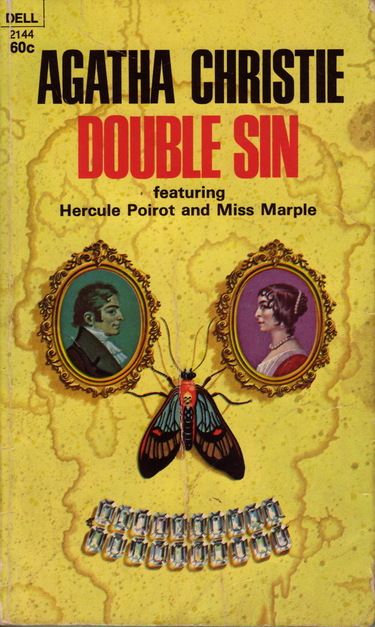
But first, a little spotlight on some of the stories we read in Double Sin & Golden Ball. These two collections are both a smattering of all of Agatha's sleuths and styles. We have Poirot and Marple and James Bond (no, not THAT James Bond) and little romantic couples and CREEEPYYYY couples and cat people (yes, CAT PEOPLE) and the list goes on and on! The title story from Double Sin and Other Stories is a fun one. Poor over-worked Poirot (he just CAN'T say no to trivial cases because his little grey cells need stimulation!) agrees to go on a bus holiday with Hastings to get some R&R. Along the way they meet a nice girl named Mary who works in the antiques business with her kind aunt. Mary is on her way to meet up with an American collector who wants to buy a set of "valuable miniatures." When the group stops for lunch, Mary is sure she sees a man trying to steal her suitcase with the miniatures! She runs outside to confront the guy and he's like whoa, settle down, we just have the same suitcase (aka, my airport baggage claim nightmare.) Mary's like whoops, my bad, kind sir! HOWEVER, when they arrive at the hotel later that day, Mary is devastated to find out that her miniatures WERE STOLEN AFTER ALL! Have no fear, Poirot is here! (sayeth Poirot) and the vacationing sleuth gets to work finding his poor friend's treasures.

Double Sin is a rather fun collection if you want to have a bit of Poirot and a bit of Marple in your life. Some other fun stories from the book are Sanctuary (Miss Marple's vicar's wife pal, Bunch, heads into church to do some stuff and stumbles across a man DYING on the church floor. His mysterious last words are "sanctuary!" and something about jewels. Bunch gets in touch with Miss Marple straight away to help discover what happened to the poor man), and The Theft of the Royal Ruby (aka The Adventure of the Christmas Pudding - one of our favorites!)

The Golden Ball and Other Stories is a bit disappointing, to be honest. It's a mix of the not-so-great romantic mystery vignette stories from The Listerdale Mystery (some of them are seriously like, moralistic tales, it's weird) and some straight up #DARK ghost stories from The Hound of Death. We have had a running text conversation about our thoughts and feelings on these short stories and the stretches concerning Golden Ball were almost all Emily giving Audrey the basic creepy plot followed by exclamations of "WHAA?!?!" (Spoilery example: "One with a ghost gypsy who tries to save someone from a terrible fate by marrying him then turns out terrible fate is that he accidentally kills ghost gypsy then he dies too and they both are ghosts!" "WHAT. AGATHA STOP IT.") - essentially, if you're looking for some ghosty reads for Halloween, definitely give this a crack, because it's got all the haunted houses and ghost children your Halloween heart might desire (starting about midway through the book, with The Hound of Death). If you're looking for your typical Agatha short story gems, give this one a pass, and get yourself to Poirot Investigates.

The YOA Treatment:
In her Autobiography, Agatha discusses her mother's dabbling in the occult (in addition to several other religions, including Catholicism and Buddhism #wellrounded). Agatha talks about Mother Clara having a sense about danger and even sensing people's thoughts, and this interest transferred a bit to the daughter, as many of Agatha's early stories and some of her subsequent work followed her interest in spiritualism and paranormal activity.

Many of the tales in The Golden Ball (which was not published in the UK), which were pulled from the alternate collection The Hound of Death, concern the terrible mysteries of the paranormal world. Compared to Agatha's novels, these stories feel totally unusual, intentionally scary, as opposed to a who-dunnit style mystery. If you're in the market for a quick spooky tale to read aloud to your pals over the light of a flickering Jack-o-lantern this weekend, we can recommend The Lamp, or The Hound of Death.

- A. & E.

P.s. Don't forget to sign up for Booktrack and try out a fun way to experience Agatha, for free! Go back to our post from a few days ago to find the link for signup.

Bonus Read: Christopher Bollen's Orient | 2015

6.09.2016
(Grab a copy of Orient at your local bookstore, or Amazon!)
"What else can I tell you that you won't believe? That I saw the killer's face the night I left? I did. I held a flare into the darkness and saw a face so familiar that anyone might pass it on the sidewalk and not blink an eye. They might even say hello." -Orient, p. 6

Clearly we are in the zone this year, reading a book a week in order to meet the goals of our project. Being bookish, of course, we often wish we had more time in the day to take in additional tomes, and the Memorial Day holiday weekend afforded us a bit of said coveted time for bonus reading! We had a long list of potential candidates, but when we learned of author Christopher Bollen's Agatha Christie fandom, we knew his 2015 mystery/thriller Orient was the book for us!

Twitter revealed Bollen as a fellow fan, and led us to this super fun Daily Beast article accounting his pilgrimage to Greenway House, Agatha's home in Torquay (the article is really a great read and offers us lots of fun tidbits about the Queen of Crime). We got even more excited about reading his tale of crime after identifying with this description of his own childhood:

"My only recreation during sixth and seventh grade was reading Christie. I craved her murders. I envisioned myself strolling through the village of St. Mary Mead or attending an archaeology dig in Mesopotamia alongside Poirot and a number of suspicious, well-tailored aristocrats."

We second that emotion! Bollen explains that he got his start as a grade-school writer, crafting Christie-inspired tales of crime with lots of murders and female murderers, but drifted away from detective stories as he grew up, favoring more "literary" literature. Eventually, as we all do, he circled back to his childhood interests and decided to try his hand at mystery writing, taking inspiration not only from Agatha's clever, puzzling mysteries, but also her deft depiction of place and characters. 

Though the name of the town where he set his book (inspired by a real life town on the North Fork of Long Island) coincidentally echoes one of Agatha's most well-known books, Bollen writes "I liked that my Orient held a quiet acknowledgement of the master."

Thusly, we present our Year of Agatha review of Orient, an NPR Best Book of the Year!

The Sum of It:
We enter the story through a mysterious prologue, a message to readers from the main character at the end of the story, the first of many ably executed Christie call-backs in the book. The character, Mills Chevern (an adopted name), hooks you with his own background, but also with statements such as: 

"It is hard for me to picture those first days without seeing the madness that was to follow. I realize now that the deaths in Orient would have happened whether I made my way east or not. They were like matchsticks in a book waiting neatly to be ripped and burned."

UH, YEAH! TELL US MORE.

Mills, a teenager who grew up in foster care in California and made his way to New York City, gets taken in by Paul, a friendly architect with "the head of a lion," who by way of helping Mills get clean takes Mills out to his summer house in the small coastal town where Paul grew up, Orient. Mills finds himself dropped right in the middle of some standard suburban-style strife, old-timers who resent newcomers disrupting idyllic village life, battles between members of the village historical board on how best to preserve their place, some desperate housewife action, husbands looking to prove their virility, and rebellious teens. Mills finds that Orient has also become home to some cosmopolitan artists hoping to find their creativity stoked by the pastoral setting. 

Mills finds himself a bit of a polarizing figure in town, a scraggly young stranger who arrives just before a series of local murders rocks the village, paired with the periodic washing up on the shore of creepy mutant animals, presumably the bi-products of a government laboratory on a nearby island. Even so, he has a few friends in town, his benefactor, Paul, Beth, a native of Orient who has returned from a stint in New York with her artist husband, and the handsome, angsty teen next door, Tommy (who is maybe not so much a friend as a fascination #crushing #hearteyes). From the time the first dead body turns up in the bay, all eyes are on the poor guy who just wants to help Paul clean out his house and form something like a normal life. 

The tension in the tale builds like music, starting slow, then gathering like dark storm clouds rolling in from the ocean. You can almost hear the Jaws theme getting faster and scarier as the pages turn, which explains why it was 1:42 a.m. when Emily finished the book and sent a photo of her totally surprised/impressed face to Audrey.

The YOA Treatment:
This was a delicious, compelling mystery with some major Agatha elements. We got fooled by some totally classic red herrings, and Bollen's keenly crafted depiction of the tensions in village life definitely remind us of a heightened version of the tea and scandal found in St. Mary Mead. In particular, one of the twists amid the reveal of the killer is SUCH an Agatha move, which we obviously can't tell you about here because you should for sure read this book, but it's just an added little element to help explain the motive of the killer that adds a hint of spice and a little more depth to the story. 

The setting of the book comes alive, perhaps particularly so due to recent consumption of similarly set tales, including Showtime's The Affair, set in Montauk, the Harrison Ford/Greg Kinnear version of Sabrina #ontheNorthShoreofLongIsland (David did a GAP AD), and of course F. Scott's perfect tale of West Egg, The Great Gatsby. It simultaneously made us want to visit a Long Island seaside village and NEVER visit such a village because #MURDER. 

As an aside, one of the more interesting descriptive elements in the book which eventually made us chuckle was Bollen's choice of words in describing everyone's skin tones. At one point we started asking ourselves, is everyone in this town supposed to be an alien, or has dear Bollen developed a sort of color-blindness specific to skin? There are at least eight different instances of totally alive people being described with skin in tones of blue, green, and grey; "her skin as gray-green as algae," "light hair and skin-color, that of a mildewed paperback novel," "his complexion was a shade of yellow-green," "the pewter pallor of her skin," and even someone, an alive someone, described as having cheeks the color of blueberries #ghostpeople #reversesixthsense? Certainly lent a distinct tone to all the people in town! 

While we feel like Agatha has had an inspirational effect on most mystery writers today, whether in her ability to create a Rubik's-style puzzle in each element of the story or her talent for really persuasive red herrings, we really enjoyed reading a totally new thriller bold in its embrace of Agatha's influence. We recommend fitting this into your library as well.

-E. & A. 

SaveSave