Top Social

Image Slider

Showing posts with label Poirot. Show all posts

Poirot's Mythology Lesson: The Labors of Hercules 2.0

4.27.2018
(image from here)
"In the period before his final retirement he would accept twelve cases, no more, no less. And those twelve cases should be selected with special reference to the twelve labors of ancient Hercules. Yes, that would not only be amusing, it would be artistic, it would be spiritual." 
-The Labors of Hercules, p. 14

The Sum of It: 
Poirot is going through one of those phases where he's being kind of dramatic about retiring. In that he's like should I retire? Should I not retire? Should I work on my vegetable marrow cultivation? (The whole vegetable marrow obsession of Poirot's is one of my favorite things in all of Christie's writing.) He's having a little night in with a rando pal named Dr. Burton and they're discussing retirement among other things and Dr. Burton randomly pivots to ask the history behind Poirot's first name: Hercule. Dr. Burton is wondering if it's like a family name? Were his parents really into reading The Classics? Poirot is like uh IDK, also IDK about The Classics, NEVER READ THEM. The next day Poirot is feeling lame for not having read The Classics, particularly those tales about his namesake, Hercules, and, after learning a bit about said Greek hero, decides he will give himself a little challenge: before he retires he will accept only twelve more cases, and each case will match up with one of the twelve labors of Hercules. 

What follows in this book is twelve short stories outlining these twelve "final" cases of Poirot (as we know, Poirot rarely follows through with his retirement ultimatums and always gets pulled into doing "one more!" so we can never take the word "final" very seriously). Besides the mythology connection theme, there isn't necessarily an overarching mystery thread going between them all, but this is kind of a welcome change to Poirot's usual stories, and we get to see a lot of different cases involving kidnapped dogs, missing school girls, disgraced prime ministers, blackmailed hotel guests, and even Poirot's old girlfriend, Countess Vera Rossakoff! 

The YOA Treatment:
As you probably heard time and time again during our initial Year of Agatha, Emily and I were not huge fans of Agatha's short story collections. Nothing against short stories in general, we just prefer a longer, more in-depth mystery in novel form. However, reading The Labors of Hercules might have converted me to a short story liker, if not a full blown short story lover. I was not very familiar with these particular cases (since Emily read them for our first Year of Agatha, and I can't remember if I had ever read this book as a kid!) so it was fun to experience some puzzles that were unfamiliar. The concept seems a bit gimmicky, but Agatha does a good job of presenting plausible cases that tie into Hercules's labors and with a bit of a lighter tone than some of her other short stories. It was also interesting to see her, as she has done with other short stories, test out some ideas that make it into her later novels. The most obvious example from this collection is the similarities between The Girdle of Hippolyta and Cat Among the Pigeons. I was a little sad to not see Hastings by Poirot's side in this set, but Japp and Poirot's ever-faithful valet, George, make several appearances. 

Overall, I heartily recommend The Labors of Hercules as a fun, easy Poirot that can be read in multiple sittings or, honestly, just one dedicated afternoon. And if you're usually averse to short stories, I dare you to give this one a chance and see if it doesn't make you a convert as well.

-A.
SaveSave

Weekend at Angkatell's: The Hollow 2.0

3.31.2018
(image from here)
"Then he looked down on the shot man, and he started. For the dying man's eyes were open. They were intensely blue eyes and they held an expression that Poirot could not read but which he described to himself as a kind of intense awareness. And suddenly, or so it felt to Poirot, there seemed to be in all this group of people only one person who was really alive - the man who was at the point of death." 
-The Hollow, p. 107

The Sum of It:
We begin our story with party planning. Lady Lucy Angkatell is wandering her house in the early hours of the morning, muttering to herself about her forthcoming house party, and wondering how she's going to make her guest list mesh. WE FEEL YA, GIRL #beenthere. She has an odd mix of friends and family coming to visit her home, The Hollow, and she isn't sure their personalities are going to be a good fit. On her guest list are the Christows: the husband a hottie, arrogant doctor named John who is simultaneously close to a breakthrough in his research into Ridgeway's Disease, having an affair with the dedicated sculptor, Henrietta Savernake, and being kind a bit of a jerk to his naive and devoted wife, Gerda; aloof cousins, David and Edward Angkatell, coming with some skipping Lucy in the line of succession inheritance business that seems a bit unfair; and ANOTHER cousin, Midge Hardcastle, who is sensible and described often as being "sturdy." The eccentric Lucy is right to be wary of the tensions between this group, as Midge is kind of in heart love with Edward, who is in love with Henrietta, who is having an affair with John, who married to Gerda. #YIKES. 

When everyone arrives for the weekend, it appears that everyone might make it out unscathed, until a neighbor shows up in the middle of their nighttime bridge game asking to borrow some matches. This neighbor is none other than glamorous film star, Veronica Cray...who happens to also be John Christow's ex #awkward. She asks John to walk her home after her SUUUUUPER plausible excuse to drop by, and he does so without much arm twisting. The next morning John is feeling a bit guilty, but before he can feel too bad about it, he is shot dead, his dying words being "Henrietta..." But Veronica isn't the only Angkatell neighbor, and, as it happens, Hercule Poirot has been invited to lunch on the exact afternoon John Christow is shot. As Poirot happens upon the tableaux that is everyone standing around gaping at the dying John, it's apparently that not everything is as it seems, and that it's going to take the brains of the world's greatest detective to solve this case!

The YOA Treatment:
The Hollow (also known as Murder After Hours) is one of those books that checks every box on the list of hallmarks of a Christie classic. Weekend party at a country home of some random Lord or Lady? Check. Love triangles galore? Check. Poirot? Check. It's interesting that Agatha, in true Agatha fashion, due to her dislike of her own Belgian detective, regretted putting him in this novel, noting in her Autobiography that the book would have been better without him. I thought he was a bit subdued, but worked for this particular puzzle. He's on vacay in one of his country cottages and, hilariously, a bit annoyed when he first stumbles upon the John Christow murder, thinking the Angkatells have put together some sort of fake murder mystery game for him to solve. HE DID NOT COME TO THE COUNTRY FOR THIS KIND OF NONSENSE! 

While not necessarily my favorite Christie, I did enjoy this book. I always enjoy hearing Agatha's memories of her own home or estates of people she knew come through her descriptions of country homes in her books. In this case, she modeled The Hollow after the home of British actor, Francis L. Sullivan, who famously won a Tony award in 1955 for his role in the stage production of The Witness for the Prosecution. 

-A.

And Now His Watch Is Over: Curtain | 1975 [SPOILERS]

1.05.2017
(image from here)
"I should have known.
should have foreseen...
'Cher ami!' Poirot had said to me as I left the room.
They were the last words I was ever to hear him say." 
-Captain Arthur Hastings, Curtain, p. 237

The Sum of It:
My dear friends, I have come to my final Agatha Christie book for this year. As if that in and of itself wasn't slightly emotional enough, I had forgotten that something rather jarring happens in this particular novel.

FRIENDLY REMINDER THIS POST DOES INCLUDE SPOILERS!

Captain Hastings has returned to Styles. Yes, Styles! Remember where the Poirot/Hastings bromance first started wayyyy back in the day when Agatha was just a cool dispensary gal who wanted to try her hand at writing a murder by poison book? Hastings and Poirot are still old friends, and yet also literally getting on in years. Styles has been turned into a sort of boarding house/country hotel where Poirot has taken up residence. Hastings arrives to visit and is quite startled by how Poirot's health has deteriorated. In place of Poirot's faithful manservant, Georges, he now has a quasi nurse named Curtiss who has to carry the poor feeble Belgian detective around - #poorestPoirot! And also #poorestHastings because his wife has passed away and his daughter, Judith, who is also residing at Styles (more on that shortly) is kind of a jerk to him (YOUR DAD IS SWEET HASTINGS, BE GRATEFUL PLZ!)

Poirot is delighted to have Hastings around once again so they can do what they do best: solve crime! Poirot lays before Hastings a series of deaths that all seem a bit odd. In each case there was a clear murderer with a motive...and yet, also in each case a certain individual, "X" to Poirot, was either acquainted with someone involved, or was in the area at the time of the crime. And this "X" was now at Styles! Poirot is CERTAIN someone is meant to be murdered and is determined to stop this "X" once and for all!

Styles is once again full of characters only Agatha Christie can do justice. There is a retired military man painfully embarrassed by his nagging wife, an unattractive scientist and his mysteriously ill wife, Hastings' daughter, Judith, who won't stop flirting with a man her father thinks is TROUBLE, and, of course, Hastings himself, somewhat subdued in his later years, and yet never too old to have his head turned by a woman with auburn hair.

The YOA Treatment:
So, elephant in the room and #spoiler, Poirot dies in this book. I remember reading this novel back when I was a teenager and thinking "well good grief, this one seems a bit slow" and then finding myself at the end of chapter 17 and bursting into tears. I don't even think I finished the remaining chapters. I barely could this time around!

When reporting on the death of his dearest friend, Hastings says:
"I don't want to write about it at all. I want, you see, to think about it as little as possible. Hercule Poirot was dead - and with him died a good part of Arthur Hastings."

(image from here)
Nearly as heartbreaking as those lines is David Suchet's description of his feelings on playing the death scene of Hercule Poirot in the television adaptation:

"I am about to breathe my last as Agatha Christie's idiosyncratic Belgian detective, Hercule Poirot, who has been a part of my life as an actor for almost a quarter of a century...it is, quite simply, one of the hardest things I have ever had to do.
This is the death of a dear friend. For years it has been Poirot and me, and to lose him is a pain almost beyond imagining." -Poirot and Me

(I'M NOT CRYING, YOU'RE CRYING!)

Poirot is and always will be my first Agatha Christie love. He was my gateway into her vast wealth of delicious mysteries. Curtain serves as a fitting farewell for Hercule Poirot. Though this book was published right before Agatha's death, she wrote it in the 1940s, spiriting the manuscript away to be kept top secret until the time was right to off her irksome little Belgian. Curtain has all the delightful hallmarks of Christie in her prime. Though you do spend several chapters wishing Hastings would stop just chatting people up and make something happen (!!), you can't help but gasp at her nearly-Roger-Ackroyd-esque conclusion.

Farewell, cher ami Poirot: I am so happy to have ended this Year of Agatha with your final chapter.

-A.

PS: *what is dead may never die* #themonogrammurders #closedcasket

Something's Rotten in the State of Meadowbank: Cat Among the Pigeons | 1959

12.12.2016
(image from here)

"But you must remember this," said Miss Bulstrode, "one or other of the girls may wish to make herself important by exaggerating some incident or even by inventing one. Girls do very odd things..." -Cat Among the Pigeons, p. 94

The Sum of It:
As we get closer and closer to the end of our Agatha journey this year, I am becoming more and more sad about saying goodbye to Poirot! Although Emily and I discovered this year that we prefer a Miss Marple book (#sorryHercule), it was still sad to realize this was my second to last Poirot read! Okay so on to the summarizing:

Our story begins in Ramat (a fictional Middle Eastern country) where the Prince of the land (one Prince Ali Yusef, Hereditary Sheik of Ramat) is consulting his British private pilot and pal, Bob Rawlinson. There's a revolution going on, and Prince Ali has decided he needs to flee the country or be killed. Bob agrees to fly him out, but before they go, Prince Ali entrusts Bob with a huge task: thinking of a way to smuggle nearly a million pounds's worth of jewels out of the country! Bob is like GEEZ, LOUISE HOW DO I DO THAT? The palace is full of spies, and the two men's plane ride will be dangerous enough. Luckily, Bob's sister and niece have been visiting him, and they should be able to leave the country un-searched. Bob goes to their hotel to make the jewel arrangements and potentially bid farewell (forever!?) to his family, but they are not there. He spends some time in their room doing something mysterious to hide the jewels, and then takes off with Prince Ali on their flight to freedom.

Some months later, Bob's niece, Jennifer, is one of many girls arriving at fancy-dancy school, Meadowbank, for the start of term. The school is run by "headmistress extraordinaire" Miss Bulstrode, who prides herself on running an establishment that takes on the brightest students, with a couple of princesses sprinkled in for the wow factor. One of these princesses is Princess Shaista of Ramat. Princess Shaista is fond of touting the fact that a) she is royal, b) she was engaged to her cousin, the now deceased Prince Ali (Bob and Ali's plane crashed in the mountains as they attempted to flee #RIP #sadface), and c) as an important royal, she is likely to be kidnapped at any moment. Miss Bulstrode and Co. assume she is just a dramatic teenage girl and ignore her fears.

Meadowbank is experiencing an influx of new staff, notably a new games mistress, Miss Springer, a new French mistress, Mlle. Blanche, and a young gardener named Adam, who is repeatedly described as obnoxious to the Meadowbank staff, as they assume all the young girls will be in love with him (#accurate). We learn early on that Gardener Adam is actually not a gardener (well, sort of, apparently his mom was good with plants?), but in fact a secret agent sent to keep an eye on Princess Shaista. The school year seems to be going along swimmingly, until games mistress Miss Springer is found #MURDERED in the new sports pavilion! Although a rather brusque and disliked woman, there doesn't seem to be much motive for her death. Local Inspector Kelsey is doing his best on the case, and then has to work double time when there is a SECOND murder, and a kidnapping to boot! The case needs a professional, and so, nearly 3/4 through the book, one of Meadowbank's plucky students gets herself to London to bring in none other than Hercule Poirot to make sense of it all. As he makes his way through his usual interviews, it becomes apparent that something (or more importantly, someONE!) is not right this year at Meadowbank...there is a cat among the pigeons!

The YOA Treatment:
When I first started reading this book, it felt a bit like Agatha was in two places at once. The opening scenes set in Ramat (and the following intrigue) felt very much like They Came to Baghdad or Destination Unknown. And then the rest of the story set at Meadowbank felt like her usual English countryside murder mystery. However, she did a fairly good job of bringing the two together and leaves you with a story that is one part caper, one part whodunit. I was a bit disappointed that Poirot didn't come into the picture earlier (and when he did, he figured things out awwwwfully quickly), but the cast of colorful Meadowbank characters kept my attention until it was finally time for Hercule's appearance.

I also admire Agatha's take on a bit of a coming of age story by setting this mystery at a girl's school. Quite a bit of the story is seen through the eyes of several of Meadowbank's students and it's entertaining to see how their adolescent trials and tribulations fit into the plot. Secret cigarettes are discovered, tennis rackets are unraveling, tiffs are had with Mother, and the halls are thick with gossip about the teachers. I'm attempting to work my way through Emma Cline's truly excellent book, The Girls, and while Cat Among the Pigeons is vastly different, I get some of those same pangs of recognition of my younger self like "Oh wow, that IS what it was like to be 15 and have a crush on the hot guy that mows the lawn at your school."

Overall, a read that's fun and intriguing and with a bit of Poirot to boot!

-A.

Bonus Read & Guest Post: The Monogam Murders | 2014

12.04.2016
(image from here)
"Ah! Now you think like a proper detective. Hercule Poirot is educating you on how to use the little gray cells." 
-Hercule Poirot, The Monogram Murders, p. 233

We are so pleased to have company this week as we recap a bonus read, The Monogram Murders. Sophia from the utter delightful book blog, Main Street & Maple, joined us as we dug into this 2014 NEW case starring our favorite Belgian sleuth, Hercule Poirot! For those of you not familiar with Monogram Murders (and the subsequent Closed Casket), it is penned by mystery author Sophie Hannah, who received permission from the Agatha Christie Estate to revive dear Hercule. The result is fairly wonderful, but let's give you a little background first....

The Sum of It:
It's 1929 and Poirot has decided to take staycation to a new level and rent a room at a boarding house literally across the street from his usual abode, #whitehavenmansions. Whilst at Mrs. Unsworth's lodging house, Poirot befriends Scotland Yarddie, Edward Catchpool, and the two enjoy spending time talking crime and working out crossword puzzles by the fire. Poirot has also developed a penchant for Pleasant's Coffee House, a small cafe that apparently has the best coffee in the world, and decent food to boot. On his weekly table for one dinner dates, Poirot encounters a harried and terrified woman (later found out to be named Jennie) in the cafe. Poirot approaches Jennie and asks her if anything is wrong. She ominously tells Poirot there's nothing to be done to help her cause she's basically a DEAD WOMAN WALKING. "Who's after you!?!" Poirot asks. "Lemme help you out!" But Jennie refuses, instead begging him to, when she is eventually found #murdered, to not look for her killer because she deserves to die! #OMINOUS. Poirot is rightly concerned about the situation, particularly when, later that night, Catchpool tells him of not one, but THREE murders that have taken place at a fancy London hotel! All three victims are laid out as if awaiting burial...and each has a monogrammed cufflink in their mouth #creepytown. Is Mademoiselle Jennie among the dead?! You'll just have to pick up and copy to find out AND to see if Poirot and Catchpool hurry to catch the killer before he (or she!) strikes again!

The YOA Treatment:
Since we are nearly finished (EEK!) with our Year of Agatha project, and have only a handful of Poirot stories left, we felt this was a good time to see how we felt about Sophie Hannah's Poirot. We enlisted Sophia's help in reviewing Monogram Murders to also get some perspective from someone new to Agatha Christie's works. Here's her verdict:

This might be a cardinal sin as a guest blogger on Year of Agatha, but I have never read a Hercule Poirot story! Shh, don’t tell them! Having no experience with Hercule Poirot previously, I felt I was getting to know the famous detective along with Detective Catchpool, his partner on the case. Unlike the girls of Year of Agatha, who undoubtedly know Poirot well, to me, he started off as just another detective in a mystery novel. Regardless, without knowing whether Hannah stayed true to his character, I was instantly charmed with Poirot’s quirks and peculiarities. I messaged Audrey & Emily as soon as I was done asking, "Does he always talk in the third person?!"  

In true Christie fashion, the plot weaved throughout The Monogram Murders is captivating and intricate. When I read mystery novels, I am always trying to guess who did it and how it was done (aren’t we all??), but I COULD NOT figure it out in this novel. And while the plot is incredibly complex, I never found myself lost or lagging behind. Poirot has a brilliant manner of keeping the reader up to speed without spoon feeding the answers. 

Adding to the fun of uncovering the mystery in this novel, is the vibrant cast of characters. From Poirot himself to the animated hotel-owner to the esteemed artist, there was really never a dull moment at the Bloxham Hotel (which is almost a character in itself). 

Now that I’ve read Sophie Hannah’s take on Hercule Poirot, I think it’s about time I pick up a Poirot novel done by the queen herself!

Overall, we Year of Agatha girls thoroughly enjoyed The Monogram Murders. Full disclosure, the first chapter was a little off-putting for us - we still aren't totally sold on the idea that Poirot would trust his evening hot drink to a cafe, or that he would be drinking that much coffee since super rich hot chocolate is his usual jam. However, we can buy that if he did go through a coffee shop phase, it would be in his earlier days before he gets too old and fussy! But after the first "scene" at Pleasant's, we were totally hooked. The initial round of hotel murders is presented a bit more macabre than the usual Agatha (seemed a bit more Sherlock than Poirot), but the premise is as much a recipe for a late night page turner as any Christie! While the overall pacing of the book was quite excellent, we were a bit bogged down by the ending. Poirot is famous for his EPIC and often lengthy denouements, but this one felt particularly long for some reason. Sophia's assessment is accurate that, while it was complex, it was thoroughly explained. However, it felt as though Poirot's assembled group of suspects/witnesses/etc. would have had to sit for hours to hear his full explanation!

Now, on to what we loved. Poirot did truly feel like Poirot in Monogram Murders. Hannah has done a wonderful job of capturing the Hastings/Poirot relationship in Poirot's interactions with Catchpool, with the latter playing the pivotal Hastings role of saying a small, innocuous phrase that sets off Poirot's little gray cells into a spiral of understanding. Poirot was full of his usual bizarre requests, sending people on random errands that end up producing vital pieces of evidence, and interviewing witnesses like a pro. We heartily recommend this as a read for any Agatha Christie fan, and think the Queen of Crime herself would be pleased with this fresh Poirot success!

A huge thanks to Sophia for reading along with us! If you're in the market for a non-Agatha mystery to read, be sure to check out her reviews of recent thrillers for some great recommendations!

-A & E.

SaveSave

Beginnings & Ends: Poirot's Early Cases, Miss Marple's Final Cases, & Problem at Pollensa Bay | 1974, 1979, & 1991

11.20.2016
(image from here)
(image from here)
(image from here)

"Remember it, and if you think at any time that I am growing conceited - it is not likely, but it might arise."
I concealed a smile.
"Eh bien, my friend, you shall say to me, 'Chocolate box.' Is it agreed?"
"It's a bargain!" -Poirot & Hastings, "The Chocolate Box," Poirot's Early Cases, p. 139

The Sum of It:
We are getting deep into the land of We Have Read All These Short Stories Before In Other Collections...but never fear! The good thing about revisiting short story collections is coming across one you really enjoy. This time, that story for me was "The Chocolate Box." 

The story begins with Poirot and Hastings having a cozy night in, sipping warm drinks (Poirot has what sounds like a truly tasty cup of hot chocolate, and yet Hastings observes he would basically rather poke his own eye out than drink the stuff #sillyhastings) and reminiscing on Poirot's old cases. Poirot says uh, you know there was this one time when I actually got the case WRONG. And Hastings is like GASP, tell me everything. 

Back when Poirot was in the Belgian detective force, there was a big old row going on in France between the Catholic church and the state. One true anti-Catholic baddie guy named Paul Deroulard was a French politician with a Belgian wife who died from falling down a flight of stairs (#yikes #handrailsplz.) After her death, Paul inherited all her money and her house in Brussels. While living there, old Paul ALSO dies rather suddenly. Poirot recalls that he was about to go on vacay, and, being a "bon catholique," was not too devastated by this guy's death. However, he received a visit from a beautiful young woman named Virginie, a cousin of the late Mrs. Deroulard, who requested Poirot's assistance in solving the death of Paul. For all Poirot makes fun of Hastings being star-struck by the beautiful ladies, Poirot himself really can't say no when they ask him for help.

Poirot's investigations lead him to the Deroulard home, where he poses as a journalist to get some answers from the household, which includes several servants, Paul's elderly mother, an English friend named Wilson, and a French neighbor named Saint Alard. Paul Deroulard died suddenly as he had retired to smoke and drink with his guests after dinner. Dinner seemed to have been partaken by all and untampered, same with the after-dinner refreshments. However, the case takes a turn when Poirot discovers that Paul Deroulard alone was a major chocoholic, and always had some after dinner. A quick pose as a plumber, and a rifle through some medicine cabinets make the whole case clear to Poirot. However, as he returns to the Deroulard home to announce the murderer, he finds that he was completely wrong! Poirot has oddly fond memories of the case, as he imagines it keeps him humble. But we all know that Hercule Poirot will never be as humble as he imagines, and that is precisely why we love him.

Miss Marple's Final Cases is made up of several short stories, nearly all of which we have already discussed here on the blog. However, I do heartily recommend giving it a read, especially if you want to read more about Miss Marple in her St. Mary Mead everyday life!

And speaking of St. Mary Mead, it was intriguing to read what smacks of a first run at The Murder at the Vicarage in "The Love Detectives" from Problem at Pollensa Bay & Other Stories. Mr. Satterthwaite & Mr. Quin team up with Colonel Melrose to discover who has coshed cranky old Sir James Dwighton over the head in his library. Of course the initial likely suspect is his beautiful young wife and the Dwighton's houseguest turned Mrs. D.'s boyfriend turned ex-houseguest, Paul. However, additional injured parties come out of the woodwork as the investigation continues, and it seems like there is no end of motives for the murder of Sir James. Do Satterthwaite and Quin work it out in the end? You'll just have to pick up a copy to find out!

The YOA Treatment:
We have several exciting things coming up over the next few weeks as #PHASEONE of The Year of Agatha comes to a close! We are very much looking forward to a guest blog post by the delightful Sophia from Main Street & Maple book blog, as well as a little Cyber Monday deal in our Etsy shop #AgathashirtsforChristmas #Poirotpresents! Be sure to stay tuned in the next few weeks for more details.

Have a wonderful weekend!

-A.
SaveSave
SaveSave

Memory Lane: Elephants Can Remember | 1972

11.13.2016
(image from here)

"So I thought that what we've really got to do is to get at the people who are like elephants. Because elephants, so they say, don't forget." -Mrs. Ariadne Oliver, Elephants Can Remember, p. 31

The Sum of It:
Elephants Can Remember reunites two of our favorite sleuth besties: Poirot and Mrs. Ariadne Oliver. Mrs. Oliver is paying her famous author dues and attending a literary luncheon with the masses. She has some initial fun chatting with other writers and eating salad and whatnot, but then it gets to the point in the event where everyone gets coffee and is expected to mingle and she is pounced upon by a rather detestable fan. A Mrs. Burton-Cox gushes about her adoration of Mrs. Oliver's books, and then moves on to something unexpected. Mrs. Burton-Cox nonchalantly asks, Oh hey, you have a goddaughter named Celia, right? Mrs. Oliver is taken aback by the question and then has kind of a legit hard time remembering if she actually DOES have a goddaughter named Celia. In the end she decides, yes she does, although she hasn't seen Celia in a long time. Mrs. Burton-Cox goes on to say Hey Celia is supposed to marry my son, but there's a bit of #MYSTERY surrounding the death of her parents, specifically WHICH ONE KILLED THE OTHER. It would appear that Mrs. Oliver has somehow completely forgotten (or maybe suppressed the memory of) the rather gruesome murder/suicide of her old friend (and Celia's mother), Molly Ravenscroft and her husband, General Alistair Ravenscroft. The pair was found near their home many years prior, shot dead, with only their fingerprints on the gun at the scene. It was assumed that either some terrible accident had occurred (#unlikely), or that one had killed the other and then themselves...but which had done the deed?

Mrs. Oliver is kind of frustrated Mrs. Burton-Cox is bringing up these painful memories and can't really understand why it matters to the marriage of Celia and Mrs. B-C's son, Desmond (neither can I, to be honest.) Mrs. Burton-Cox is insisting that she needs to know what happened to give her blessing to Celia and Desmond's union. Mrs. Oliver finally escapes the horrid lady, determined to not think on the matter any further because it's none of her business. But Mrs. Burton-Cox has laid some nagging seeds of curiosity, and before she knows it, Mrs. Oliver is heading over to see Poirot to get his advice on the matter. Elephants, they decide, are the way to go about solving the matter. Elephants, meaning people who were close to the Ravenscrofts back in the weeks leading up to their deaths. These "elephants" will transport them back in time and tell them everything they need to know to solve Ravenscroft tragedy.

The YOA Treatment: 
When Agatha Christie wrote Elephants Can Remember, she was in her early 80s and nearing the end of her career. This is actually the last novel she wrote featuring Poirot and Mrs. Oliver (Curtain was actually written much earlier, though published in 1975.) She received some criticism for this novel (not unlike many from these later years), and I will say some of the reviews are justified. While the premise is intriguing, the solving of a murder committed much earlier is not unlike many of her other novels, many of which are referenced in the book (Five Little Pigs, Mrs. McGinty's Dead, Sad Cypress, or Hallowe'en Party) and are better reads. The language is not as snappy, and at times a bit muddled. Elephants Can Remember was included in a 2009 study comparing Agatha's early and later works, and it is thought that, due to the at times confusing and repeated language in this book, she may have been suffering from Alzheimer's disease.

I get a little pang of sadness when I think of aging Agatha, remembering along with Poirot in this book of their former glory days. However, despite its flaws, Elephants Can Remember is still a mystery, and a rather good one at that. I was surprised at the ending, and I think you will be too. You can tell Agatha was still doing what she loved, and was determined to keep writing for as long as she could #resilience #queen.

- A.

The Girl Who Cried Murder: Hallowe'en Party | 1969

10.21.2016
(image from here)

"I saw a murder once," said Joyce.
"Don't be silly, Joyce," said Miss Whitaker, the schoolteacher.
"I did," said Joyce.
"Did you really?" asked Cathie, gazing at Joyce with wide eyes. "Really and truly saw a murder?"
"Of course she didn't," said Mrs. Drake. "Don't say silly things, Joyce."
"I did see a murder," said Joyce. "I did. I did. I did."
-Hallowe'en Party, p. 14-15

The Sum of It:
I present to you the first of two #spookystories this weekend! Our first tale starts on a dark and stormy (well, maybe not specifically stormy...) night in the village of Woodleigh Common. Mrs. Ariadne Oliver is visiting a pal she met on a cruise (#cruisepals #shuffleboard), Judith Butler, and is quasi-helping out at a Halloween party for the local kids. Mrs. Oliver is sitting around, kinda just enjoying being a resident celebrity, and observing the party prep. In what appears to be an attempt to impress Mrs. Oliver, young party attendee Joyce Reynolds blurts out that she has seen a murder once. Everyone rolls their eyes and says don't be ridiculous, Joyce, that's obvi not true. Joyce keeps insisting she has seen a murder based on the fact that she didn't realize it was a murder at the time, but now that she's older, she gets that it was. More eye rolls commence, and then everyone continues going about their Halloween business. It seems like a pretty enjoyable party with treats and games and a local lady who dresses up as a witch. However, the evening turns truly sinister when young Joyce is found #DROWNED in the apple bobbing tub!

Joyce's death appears to be quite definitely #MURDER and Mrs. Oliver is badly shaken up (disturbed to the level of potentially giving up apples! #GASP!) from the whole affair. She rushes to London to visit the only person who can help her: Hercule Poirot. He agrees to look into the case and travels with Mrs. Oliver to Woodleigh Common to get down to investigating. Poirot's first order of business is to see if there was a murder in Woodleigh Common that Joyce could have potentially witnessed. He discovers a great many deaths...but were any of them truly murders?

The YOA Treatment:
I enjoyed this book very much. *(Caveat: I would say a good percentage of my enjoyment came from reading this right before Halloween. Agatha really does her holiday-themed mysteries rather well.)* I adore the Mrs. Oliver/Poirot dynamic, and their relationship works well for this particular story. Mrs. Oliver feels semi-responsible for Joyce's death, as her presence probably sparked Joyce's comments about witnessing a murder, which likely led to her death. It makes sense that Mrs. Oliver would turn to the very best for help to ease her conscience and take the burden of crime solving off her shoulders. The story gets occasionally bogged down in a great deal of time dwelt on sex crimes and the fashion choices of mid-60s teenage boys. There is also a fairly bizarre part that highlights the silliness/sometimes stupidity of tween-aged girls, and yet, I can forgive Agatha all of this because of her use of a single, well-placed clue that got my wheels turning along with Poirot's to ultimately discover Joyce's killer.

-A.

PS: for an absolute treat, I also recommend this young man's Agatha Christie reviews on YouTube. BE WARNED: he does have spoilers. But it's totally worth it.

Pre-Fame Poirot: The Underdog and Other Stories | 1951

10.16.2016
(image from here)
"Lord," said Japp, stretching himself backward, "I believe I could manage another egg, and perhaps a rasher or two of bacon. What do you say, Captain?"
"I'm with you," I returned heartily. "What about you, Poirot?"
Poirot shook his head.
"One must not so replenish the stomach that the brain refuses to function," he remarked.
-The Underdog & Other Stories, p. 108

The Sum of It:
I'm back on the short stories train this week! This week's collection is The Underdog and Other Stories. Many of these little gems have been in other short story collections we have read this year, but two were new to me - and both quite fun indeed!

The Market Basing Mystery is an obvious first attempt of Agatha's later short story, Murder in the Mews. Poirot, Japp, and Hastings are basically on a nice crime solvers retreat weekend in the country having brunch when they are called to the scene of what is first deemed a suicide, but the doctor on the scene is sure it can't be! The dead gentlemen (a reclusive fellow named Protheroe #murderatthevicarage!) interacted mainly with his dedicated housekeeper, Miss Clegg, who doesn't have much to say about her master's death. However, two randos had recently showed up to stay with Protheroe, and Miss Clegg found THAT very mysterious. It just takes a little time of handkerchief and cigarette investigating for Poirot to sniff out the culprit!

In The Lemesurier Inheritance, Poirot and Hastings run into an old acquaintance of Hastings at dinner. This young fellow, Captain Vincent Lemesurier, is quickly called away because his father is gravely ill. After he leaves, Poirot learns the sad (and rather epicly confusing, if I'm being honest) history of the Lemesurier family. If I have this right, great-great, etc. grandpa Lemesurier was like crazy I think and thought his wife was fooling around behind his back and then also there's a thing where the first born sons of the Lemesuriers always die and never get to inherit the vast fortune and the fortune always goes to third or sixth sons or distant cousins or whatnot. Anyway, Poirot and Hastings are a little taken aback when they find out that Captain Vincent has jumped out of the train and died on his way to go see his dying father! Thus continues the "curse" of the Lemesurier first borns, as Vincent stood to inherit his father's estate. Time goes by, and more Lemesuriers die until the fortune finally goes to a Hugo Lemesurier. However, the curse is apparently still going strong because Hugo's American wife pays Poirot a visit and says that her young first-born son, Ronald (who has curly auburn hair #important), has been nearly killed several times! The only person who could benefit from Ronald's death is Ronald's even more baby brother (we are talking like a five-year-old here) and that just doesn't seem plausible, says Poirot. Poirot heads over to the Lemesurier home to get to the bottom of this "curse" and finds out there is something shady going on FOR SURE.

The YOA Treatment:
It's interesting to get a taste in these short stories of Poirot & Co. in their fairly early days of crime solving. Of course Poirot had a career with the police back in Belgium before he moved to London, but these stories in Underdog (and more to come when we get to Poirot's Early Cases) show Poirot when he is solving British crimes, but has not reached the realm of international fame that he has in books like The ABC Murders, Death on the Nile, etc. He doesn't go around saying "well of course you must have heard of me, etc.", because people really don't know that yet. There are a few stories (I'm thinking particularly of the title story and The King of Clubs where a bona fide prince gets involved) where Poirot is investigating a more high-level case. However, many are more commonplace mysteries: ladies wondering if their husbands are poisoning them, missing cooks, checking out some potentially shady business at a party, etc. It's nice to see that Poirot has to pay his dues just like the rest of us! I can't wait to see more of his early life in Poirot's Early Cases.

- A.

The Crescent of Intrigue: The Clocks | 1963

10.02.2016
(image from here)
"Inspector Hardcastle walked in manfully. Unfortunately for him he was one of those men who have cat allergy. As usually happens on these occasions, all the cats immediately made for him. One jumped on his knees, another rubbed affectionately against his trousers. Detective Inspector Hardcastle, who was a brave man, set his lips and endured." -The Clocks, p. 62-63

The Sum of It:
Happy October, one and all! Fall is trying to creep in here in still much-too-warm Tennessee, and we are taking advantage of every minute of it! Our seasonally-appropriate first read from this past week (aka part one of our unplanned time-keeping themed reads, Emily will soon be posting on Hickory, Dickory, Dock) is Dame Agatha's 1963 The Clocks.

Regular girl Sheila Webb works as a typist at the Cavendish Secretarial and Typewriting Bureau (apparently primarily concerned with novels of the risqué variety), and one September day, is asked for PARTICULARLY by a Miss Pebmarsh at Wilbraham Crescent to stop by and type something up. Sheila is like uh, never heard of this lady, but I type for a lot of people so guess she's some rando that thinks I do a good job? A message has been left for Sheila to go ahead and let herself and make herself at home, so that's exactly what she does. However, the scene she finds is equal parts bizarre and terrifying. Miss Pebmarsh's front room is filled with clocks - one chiming the hour and the others stopped at 4:13 (#CREEPY) - AND, of course, a dead body. Sheila is horrified and goes shrieking from the house, falling literally into the arms of (we assume) handsome Colin Lamb, a "marine biologist" who is checking out Wilbraham Crescent out for totally NBD reasons (totally not, more on that later...)

The police are summoned and come to find that a) Miss Pebmarsh is blind, b) she did not ask for Sheila to come and type for her cause she's never heard of her before, c) she has no idea who this dead man is inside her house, and d) she only has one clock and wants to know where the other ones have come from! Colin Lamb buddies up with Detective Inspector Hardcastle to look into the case. Why does this passing random dude get to help, you ask? Well because he is a secret agent, of course! He has been checking up on Wilbraham Crescent (basically a bunch of town houses all in a half circle that are in two rows so the backs come up to each other? I think?) to follow up on a clue found in the pocket of a dead spy.

The dead man in Miss Pebmarsh's house is a total mystery. He looks super ordinary, he has a fake business card on him, and nobody is calling to say they're missing a person, so the police are a bit stumped. Inspector Hardcastle and Colin's canvassing of the neighborhood turns up a frazzled mom, an extremely entertaining, deeply committed cat lady, and some intense gardeners, but nothing to really go on. Suddenly Colin has an idea. He happens to know a guy. A guy who has been retired for some years...someone who might need a little cheering up. And there's nothing like a good mystery to cheer up Hercule Poirot!

The YOA Treatment:
As we are heading into the final few months of this Year of Agatha project (where has the time gone!?!?), it is fascinating to see the lifecycle of Agatha Christie's interests in writing. We have been reading her books for the most part fairly chronologically and you can see how her interests in classic detective mysteries and spy thrillers came and went. She of course starts out with Mysterious Affair at Styles, but then spends a great deal of time in her early years with the more caper-y novels like Secret of Chimneys, Seven Dials, etc., and then settles back into many years of the more traditional Roger Ackroyd, Death on the Nile, Murder at the Vicarage, etc. In her later years (where we are currently intrenched book-wise) she harkens back to her love of the thriller with They Came to Baghdad, Destination Unknown, Passenger to Frankfurt, etc., but with The Clocks, she has tried to do both. And I'm not sure if it works...

Poirot receives basically all of his information on the crime through Colin, an exercise of the little grey cells he has done before, and yet, since he doesn't really make an appearance until nearly halfway through the book, and so much of the crime-solving happens through Colin's eyes, Poirot seems a bit like an afterthought. It's as if Agatha really wanted to write another spy novel, yet this one set in England, and threw Poirot in to bring back the readers who maybe weren't as thrilled with Destination Unknown or They Came to Baghdad? I did enjoy this read. I think the premise is quite clever, and although the murder's solution isn't one of her most stellar, it is more plausible (in my opinion) than the wrap-up for Colin's secret agent-ness. Though not the Poirot and Hastings repartee fest of the 1930s-40s, The Clocks is still a great deal of fun and certainly worth the time of anyone needing a little Belgian detecting in their life.

-A.

Hotel for Dogs: Mrs. McGinty's Dead | 1951

9.19.2016
How great is this first edition cover? Found it here

"But talk, however light, however idle, gives away, inevitably, the sort of person you are. The wise criminal would never open his mouth, but criminals are seldom wise and usually vain and they talk a good deal -- and so most criminals are caught." -Mrs. McGinty's Dead, p. 54

The Sum of It:
This story begins as Poirot leaves a French restaurant he has discovered and is standing on the sidewalk, quite satisfied with his meal, when Agatha offers one of my favorite (and also one of the most relatable) sentences she's ever written:

"Alas," murmured Poirot to his moustaches, "that one can only eat three times a day..." 

Heard that, Poirot. Anyhow, Poirot is not just bemoaning that he can't just constantly consume French food, he's also feeling a bit bored with life, and not having anything important to do during the times between meals, not even his pal Hastings to hang around with (poorest lonely Poirot!) Fortunately, his old friend Superintendent Spence swings by his flat that evening with a request for help. 

Spence and his crew have just solved the small town murder of an elderly housekeeper. Only the convicted murderer, the lady's lodger, just doesn't seem like the right culprit to Spence. It's bothering him, and he wonders if Poirot might go nose around bitty town Broadhinny and see if he might be able to figure out whether the lodger really is the culprit or, if not, who it might be. Poirot is desperate for anything to do so he's like I'M IN and arranges at once to visit the little village. 

Accommodations in the village are sparse, and Poirot ends up lodging in the one "guest house" in town which is basically just these people's home, and they are turrible housekeepers and have giant dogs everywhere and there's a draft and the doors never shut all the way and there's spinach on the couch...i.e. Poirot's delicate sensibilities are really put to the test here and he feels like he's making major sacrifices for his craft. Indignities are furthered when, as he is approaching one of the area homes to interview people, he gets brained with an apple core! However, this quickly becomes happy news when he realizes his assailant, a driver tossing refuse out the window, is none other than his old pal, detective novelist and apple aficionado, Ariadne Oliver! YAY now things are fun! 

"Murmuring in an explanatory voice, 'Stiff after the long drive,' Mrs. Oliver suddenly arrived out on the road, rather in the manner of a volcanic eruption. Large quantities of apples came too and rolled merrily down the hill. 'Bag's burst,' explained Mrs. Oliver. She brushed a few stray pieces of half consumed apple from the jutting shelf of her bust and then shook herself rather like a large Newfoundland dog. A last apple, concealed in the recesses of her person, joined its brothers and sisters." 

Like I said, fun. Anyhow, Poirot and Ariadne (with the help of a local gal named Maude) set about figuring out the mystery which they quickly discover is somehow linked to a newspaper article featuring four by-gone lady murderers; One of these former notable criminals is in disguise and living in town and Mrs. McGinty knew too much...but which one?? Oooh it is tres' mysterious. 

The YOA Treatment:
Listen, when Poirot and Ariadne Oliver are together, I am always happy. They are such nice foils to each other, and have a charming banter (which we all know I value like the king's rubies). Unlike darling Hastings, she pushes back on Poirot, and refuses to simply act as his hapless Watson, but she still helps him sort through the facts and get to the root of things. I don't like it as much when Poirot is all by himself because he seems lonely, so it always makes me happier when he has a friend. He and Ariadne have a nice little dynamic #teamworkmakesthedreamwork. 

"Mrs. Oliver, glass in hand, approached Hercule Poirot towards the end of the Carpenters' party. Up till that moment they had each of them been the center of an admiring circle. Now that a good deal of gin had been consumed, and the party was going well, there was a tendency for old friends to get together and retail local scandal and the two outsiders were able to talk to each other. 'Come out onto the terrace,' said Mrs. Oliver in a conspirator's whisper." 

Hooray for Poirot having a conspirator :). This is a solid mystery with a nice little puzzle in the middle -- which of the people in town matches with one of the past criminals in the paper? Several of them seem like they could fit, and it's a real thinker. Those of you who prefer the more intuitive cases that leave you competing with Poirot to see who can solve it first will truly enjoy this tale, I recommend! Two mustaches up. 

-E. 

The Nun Motif: After the Funeral | 1953

9.03.2016
(image from here)
"It shows you, Madame, the dangers of conversations. It is a profound belief of mine that if you can induce a person to talk to you for long enough, on any subject whatever! sooner or later they will give themselves away." -Hercule Poirot, After the Funeral, p. 283

The Sum of It:
We are back to good old fashioned big family murder this week with After the Funeral (also called Funerals are Fatal). The story begins with the rather sudden, yet not entirely unexpected, death of older gentleman, Richard Abernethie. His remaining family members (sisters-in-law, nieces, nephews, and one younger sister) attend his funeral without much pomp and circumstance. However, the drama turns up a notch when eccentric Cora Abernethie Lansquenet blurts out her observations of her brother's death: "But he was murdered, wasn't he?"

The family is rather taken aback, assuming Richard's death in his sleep was perfectly natural, and rush to chalk up her remarks to Cora Be Cray. However, Cora's words linger with each Abernethie as they leave the family gathering...especially when Cora turns up #MURDERED the next day! (and #murdered with a hatchet no less...it's pretty gruesome for Agatha...#yikes.) The Abernethie's lawyer, Mr. Entwhistle, is very disturbed by the turn of events, and after some light investigation of his own, he enlists the heavy-duty assistance of retired detective Hercule Poirot to get to the bottom of who is killing the Abernethies.

There is kind of a lot of comings and goings in this book. Poirot doesn't get involved until two murders in, and the book divides most of its time between Enderby, the Abernethie family home, and Cora's small cottage, which is short-term inhabited after her death by her companion, a Miss Gilchrist who spends a lot of time defending the poor artistic abilities of her late mistress and telling sad tales of her own out-of-business tea shop. Richard Abernethie's surviving family members are often visiting one another and repeatedly having vague discussions about their alibis for each murder and how lucky it is that Richard left them money. #suspicious? There's also quite a bit about nuns showing up to the point of giving one of the characters the creeps (don't worry - it ends up helping Poirot solve the crime in the end.) However, overall, I enjoyed this book immensely. It's the kind of Christie you know and love, and you can tell it's the kind of story Agatha liked to write. I've always liked the solution of this story because of its simplistic cleverness (those of you who have read it will know what I mean!)

The YOA Treatment:
After the Funeral features Poirot investigating in his usual style, yet with a few, unexpected additions. Sure, he does his usual spiel of talking to all the characters involved to size them up and see if some basic conversation will lend him any clues. Per usual, this works like a charm, and a few slips of the tongue during a Poirot chat are enough to give the murderer away. However, this story also briefly features a lesser-known Poirot comrade: one Mr. Goby. Mr. Goby shows up in chapter 12 and is described as an elderly man (as is Poirot in this story), "small and spare and shrunken," with an aversion to eye contact and in possession of a double-jointed thumb #odddetail. Like Poirot, Mr. Goby is retired, but is willing to take a few days to do some P.I. work for Poirot by giving him the skeletons in the closet of all the potentially guilty Abernethies (along with some grumpy speeches about the Government.) Mr. Goby can be found giving Poirot a hand in several other books, including The Mystery of the Blue Train, Third Girl, and Elephants Can Remember. It's always fun to see Agatha spice up Poirot's world with new associates, particularly in these later stories devoid of the usual Hastings/Miss Lemon/Japp crew.

-A.

A Smattering of Sleuths: Three Blind Mice and Other Stories | 1950

7.25.2016
(image from here)
"Snow was piled five feet high, drifting up against the doors and windows. Outside it was still snowing. The world was white, silent, and—in some subtle way—menacing." - Three Blind Mice and Other Stories, p. 24

The Sum of It:
Our read this week is another collection of short stories featuring nearly all of Agatha's sleuths! The book begins with one of Agatha's most notable stories, Three Blind Mice (more on that later!), and then follows Miss Marple up to her old crime-solving tricks in St. Mary Mead in Strange Jest, Tape Measure Murder, The Case of the Perfect Maid, and The Case of the Caretaker. Poirot makes an appearance with The Third Floor Flat, The Adventure of Johnny Waverly, and Four and Twenty Blackbirds. Finally, Mr. Quin and Mr. Satterthwaite work together in The Love Detectives. The collection as a whole is a fun, satisfying read. Like Emily's review of The Regatta Mystery, this is a great collection to read when you want something quick to read while commuting or to read over a period of time when you can't devote a lot of time to an Agatha book. Overall, these stories are quite clever and give a good taste of the personality of each of Agatha's best-known sleuths.

One story in particular deserves a little more attention: Three Blind Mice. Newlyweds Molly and Giles are trying their hand at bed and breakfast-ing by turning their home into a guest house. They happen to open for business right as a massive snowstorm blows through. As their eclectic group of guests begin to arrive, Molly and Giles receive a sobering phone call from the police: a woman has been murdered in London, and her murderer has left an ominous clue of the lyrics to the nursery rhyme Three Blind Mice and the location of a possible second murder: Molly and Giles' guest house! A policeman arrives to investigate via skis (because of excessive snow), but that doesn't stop someone in the house from #MURDERING anyway!

The YOA Treatment:
Three Blind Mice was originally written by Agatha Christie as a radio drama for Queen Mary's 80th birthday (apparently, it was the Queen's particular birthday request! We don't blame her at all!) Agatha then adapted the radio play into the short story in this collection, and then later into a play -- The Mousetrap. Those of you familiar with Agatha have no doubt heard of the record-breaking production The Mousetrap. This play holds the record for the longest running play of all time, and has been seen in London's West End continuously for over 60 years! The play was one of her works that Agatha was most proud of. Part of its success likely stems from Agatha's desire to keep the ending's twist a secret. The short story of Three Blind Mice in this collection was published in the US only and Agatha insisted it not be published in the UK so Mousetrap attendees would be surprised by its solution. Very clever, Agatha! Very clever, indeed.

-A.

Sunbathers Beware: Evil Under the Sun | 1940

7.11.2016
(image from here)
"It was, Hercule Poirot thought, like watching the needle of a compass. Patrick Redfern was deflected, his feet changed their direction. The needle, do what it will, must obey the law of magnetism and turn to the north. Patrick Redfern's feet brought him to Arlena Stuart."
-Evil Under the Sun, p. 15-16

The Sum of It:
Papa Poirot is on vacation again! But, like usual, he isn't even totally off the detective clock because wherever Poirot is, murder cannot be far behind. Poirot is enjoying a summer holiday on the English coast at a little island resort called The Jolly Roger Hotel (which Agatha goes to great pains to describe as fabulous but it sounds very #Daytona to us...). As always, he is surrounded by a smorgasbord of fellow vacationers, some of whom are quite boisterous and have wild theories about how sunbathing will LITERALLY put hair on your chest (Mrs. Gardner, we're lookin at you) or are constantly bragging about how rich they are (shut it, Mr. Blatt) or are famous and refined fashion designers with exotic perfume (yes ma'am, Rosamund Darnley). The most sensational guest at The Jolly Roger is Arlena Stuart: a gorgeous actress with a reputation for being a home wrecker and a pretty dull husband. Drama starts heating up big time when Arlena and young, handsome, and very married Patrick Redfern get their not-so-subtle flirt on. No stranger to hot mess #lovetriangles, Poirot steers clear of the drama (aside from eavesdropping on their alone time), hoping nothing deadly becomes of all this sexual tension. But sure enough, Patrick Redfern soon stumbles upon his summer fling #MURDERED on a secluded island beach, apparently strangled as she lay sunbathing!

Of course nearly the entire resort population had a death wish on Arlena: there was no love lost between Arlena and her husband Kenneth Marshall and stepdaughter, Linda, Patrick Redfern's timid wife Christine wasn't too thrilled about the hold Arlena had on her husband, and Rosamund Darnley would be very interested in becoming Mrs. Marshall #2…except Kenneth Marshall had no intention of ever divorcing his wife. Evil Under the Sun is a terrific example of straightforwardly enjoyable Agatha Christie: plenty of fun characters, juicy drama, and a solution that isn't necessarily her most clever, yet we dare say keeps you guessing until the last minute! We also highly recommend this as a beach read. Not only will you feel right at home with the waves crashing and sun shining as Agatha describes the pleasures of #beachlife, but this book goes by nice and fast if you have a few hours of uninterrupted time.

The YOA Treatment:
As with many of her books, infidelity plays a big part of Evil Under the Sun not only as a characteristic of arguably the two least likable characters, but also as a possible murder motive. Agatha Christie was sadly well acquainted with the heartache that comes from an adulterous marriage. Agatha's first husband, Archie, left her for another woman early in her writing career and it sent her into an understandable spiral of sadness. As described in her autobiography, Archie was generally super selfish and pretty straightforward about being in love with someone else and even kind of blamed Agatha for making him unhappy because she had to go take care of her sick mother (GOOD GRIEF, ARCHIE).

While Agatha went on to remarry and move past her first husband #TeamMax (who maybe also was a little unfaithful but we don't know that for sure and if it happened it didn't break her heart like Archie did so we're still #TeamMax), you can sense the feeling she puts into writing characters who have a cheating spouse. Christine Redfern's heartache feels very real in Evil Under the Sun as she watches her husband swooning over Arlena, and basically all the other characters have various reasons for disliking Arlena's homewrecking-self, and judging Patrick (although pretty much everyone blames Arlena for being a siren and gives Patrick the #Ulysses-style excuse of being helpless under her gaze #noexcusesforbeingadickguys #lookinatyouArchie). There's even a priest in this book who just goes with "that woman is straight up evil" for her siren-like ways.

Even though Agatha kind of sadly gives cheaters the benefit of the doubt in her autobiography (one of the only times we wanted to be like #LEANIN, girl, don't blame yourself for this!), she uses the behavior as a theme in many of her books, and in this one we hope she got a little satisfaction from giving a cheater their just desserts (disclaimer: no one is saying murder is appropriate retaliation, just sayin').

-A. & E.

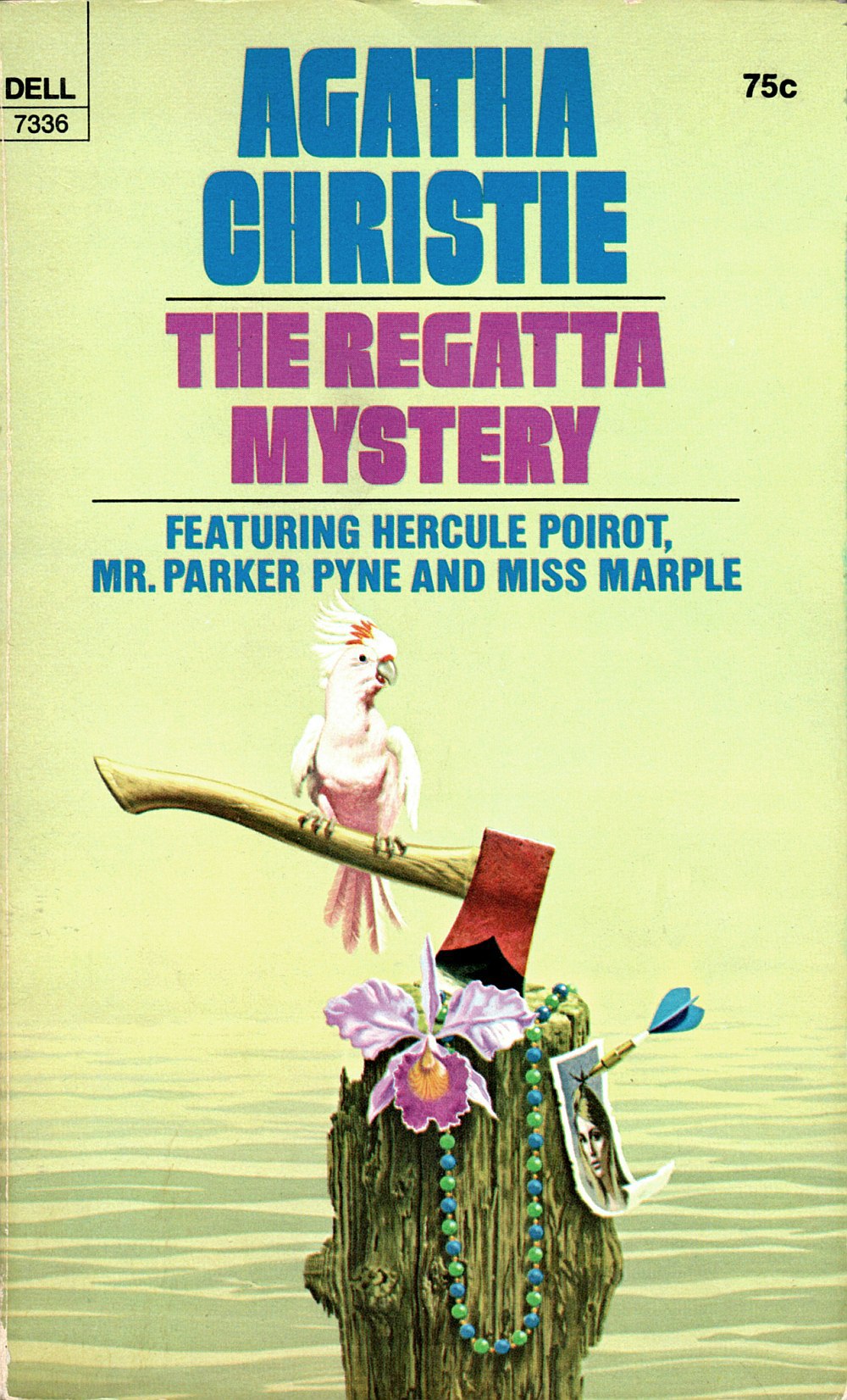
Everybody In: The Regatta Mystery | 1939

6.30.2016
Image from here
"I wonder if you'll ever commit a crime, Poirot?" said Stillingfleet. "I bet you could get away with it all right. As a matter of fact, it would be too easy for you -- I mean the thing would be off as definitely too unsporting." 
"That," said Poirot, "is a typically English idea."
-The Dream, p. 161

The Sum of It
This set of short stories contains tales featuring three of Agatha's best known detectives: Poirot, Parker Pyne, and Miss Marple. Many of these are legit SHORT stories, some of them are really more like vignettes. A few of the stories will be well known by fans of the David Suchet Poirot series as they have been adapted in that medium. The Mystery of the Baghdad Chest, Yellow Iris, The Dream, and Problem at Sea can all be found in this little collection. 

My favorite story in this collection was one I hadn't seen before, called In a Glass Darkly. The story is written in first person, which I always enjoy from Agatha. The narrator is visiting a friend and dressing for dinner in a mirror when he sees in the mirror what appears to be a reflection of a woman being strangled by a man with a scar on his face. But when he turned around, all that was behind him was a wardrobe and a wall. He feels like the vision was perhaps a premonition, so he warns the girl he saw in the vision (his friend's sister) about it, causing her to break up with her fiance. After the narrator is grazed on the cheek by a bullet in WWI, he comes home and marries the girl. Later in life, he finds the scene repeated live and in person, and learns something about himself. He also comes to wonder about the vision he saw; did it alter the course of their lives? There's a hint of the supernatural in this story, and a nice level of creepiness, it's a delicious little mystery snack!

The YOA Treatment
So, yeah, more short stories. This was a pretty fun set, really, though there's also a fair sprinkling of some regrettable pre-war racism and sexism. There are several decent tales in the mix. In addition to the one I summarized above, I also really enjoyed The Yellow Iris, even though I was familiar with the plot from television. It's a good demonstration of Poirot using those little grey cells to solve a life-and-death style puzzle in real time as a dinner party unfolds following a panicked call from one of the ladies at the party who claimed to be in peril. (Fun fact: Agatha must have really enjoyed this one too, as The Yellow Iris was later expanded into a full-blown novel called Sparkling Cyanide, which we'll be reading soon along with our #bookstagram friends, The Maidens of Murder!)

The Parker Pyne story Problem at Pollensa Bay is a classic example of Mr. Parker Pyne's methods of basically employing an attractive woman to seduce a man in order to solve some sort of relationship problem #gigolo. The Miss Marple story, although her tone and style of speech is perpetually amusing, is not much of a tale, disappointingly. It was fun to meet several different mystery solvers, along with some independent storytellers, in the same set. 

No strong feelings about this book, honestly, though given the mini-stories, it's a fine set to toss in your work bag for quick reads while you're waiting for a meeting to start!

-E.


A Series of Unfortunate Events: Taken at the Flood | 1948

6.25.2016
(image from here)
"The unexpected has happened, eh?"
"On the contrary," Poirot corrected him. "It is the expected that has happened — which in itself is sufficiently remarkable." -Taken at the Flood, p. 170

The Sum of It:
This week's first read, Taken at the Flood (also called There is a Tide) begins with Hercule Poirot spending an air raid in The Coronation Club listening to a story. A Major Porter, described as the club bore, is droning on about some rich-family drama and Poirot, trying to distract himself from the understandably frightening air raid, can't help but listen in. Major Porter is telling the story of the Family Cloade, and how the wealthiest Cloade, Gordon, had been suddenly killed when his London home was bombed. Just before his death, Gordon had married a young, beautiful widow named Rosaleen and, without having made a new will after his marriage, the entirety of Gordon's vast fortune had gone to her upon his death…much to the chagrin of the rest of his family. But Major Porter's story doesn't end there. He goes on to speculate on the actual dead-ness of Rosaleen's first husband, one Robert Underhay, with whom Major Porter was acquainted. Perhaps Underhay didn't actual die in Africa as originally reported, Major Porter hypothesizes.

It is not until two years later that Poirot has need of the details of this story. The war has ended and the Family Cloade are collectively rather strapped for cash. Back when Gordon was alive, the family wanted for nothing. The genuinely generous Gordon encouraged his brothers and sisters and nieces and nephews to live life as they wished, send him their bills, and made no secret that he planned to leave all of them very well-off after his death. But now the Widow Rosaleen controls his millions, and Rosaleen's brother, David Hunter, controls Rosaleen. The Cloades, understandably, would really benefit from Major Porter's air raid tale to hold some truth. And lo and behold, one day a mysterious stranger comes into town, attempts to blackmail David Hunter about the whereabouts of Rosaleen's first husband, and then is found murdered in his hotel room. Poirot is called to the scene and his memory of The Coronation Club story is finally useful. But something doesn't sit well with Poirot. Everything seems to have fallen into place a little too easily. To Poirot, the solution makes more sense if just about everything is not what it seems…

The YOA Treatment:
While this story is not my absolute favorite Poirot novel, there are some elements that I do appreciate about Taken at the Flood. Most interestingly, we get a look into British life post-World War II. The fact that relationships are strained, family members have been killed, taxes are high, and money isn't as plentiful as it once was all play a part in not only acknowledging the real world of many of Agatha's readers at the time of this novel's publication, but also the mystery itself. Even Poirot himself has been changed a bit by the war. He is, of course, still his ever-confident self, but is willing to show some moments of vulnerability. For example, he talks about how he was frightened during aid raids. He says "I am sitting very sick in my stomach (for I did not like air raids, and I am not very brave though I endeavor to put up the good appearance)."

We know from her autobiography that Agatha herself lived through some pretty scary times during the bombings on London, even losing part of her home at one point. Though in typical Christie style she kept calm and carried on, she chose to write two books at once (The Body in the Library and N or M?) to keep herself distracted from the constant bombs and sirens. Her real home, Greenway, was even requisitioned in the war effort due to its coastal location. This story shows that Agatha, though she wasn't a sentimental type of person, appreciated what her countrymen had been through. I admire Agatha for staying true to her readers by keeping her characters in a world to which they could relate.

-A.