Top Social

Image Slider

Showing posts with label Miss Marple. Show all posts

Small Town Secrets: A Murder is Announced 2.0

4.30.2018
Image from here
"Ye gods and little fishes," said Sir Henry, "can it be? George, it's my own particular, one and only, four-starred pussy. The super-pussy of all old pussies. And she has managed somehow to be at Medenham Wells, instead of peacefully at home in St. Mary Mead, just at the right time to be mixed up in a murder. Once more a murder is announced -- for the benefit and enjoyment of Miss Marple."
- A Murder is Announced, p. 71

The Sum of It
First of all how adorably quaint is that quote, which in these modern times COULD be read with one's mind in the gutter to much hilarity. So, exciting news in the little village of Chipping Cleghorn -- literally -- as the citizens open their morning papers over breakfast. "A murder is announced and will take place on Friday, October 29th, at Little Paddocks, at 6:30 p.m. Friends please accept this, the only intimation," reads a small announcement amid notices of available dachshund puppies and antiques for sale. The curiousity of several is stoked, and they turn up promptly at Ms. Letitia Blacklock's home, Little Paddocks, to see what the mystery is all about. Everyone is quite shocked when a sudden power outage plunges the drawing room into darkness, and then a voice yelling at everyone to put their hands up is followed by one gunshot and then another! When the room is re-lit, the hostess is covered in blood from a wound on her ear due to a near miss, and the masked intruder lies dead in the hallway #DRAMA. 

Who put the notice in the paper? Who planned this whole event? Was someone really trying to kill Miss Blacklock, and if so why? The police must sort through the curious inhabitants of Chipping Cleghorn to find the answers to these questions and more, particularly after another murder follows the death of the intruder. Fortunately for them, Miss Marple just so happens to be in town visiting the local vicar's wife, daughter of one of her old pals. It quickly turns out the shooting is only one of many mysteries as Miss Marple and the local detectives uncover multiple secret identities, money plots, hidden doorways, and old ladies on the coast of Scotland to get to the bottom of the murder announced. 

The YOA Treatment
J'adore Miss Marple, and her ability to be on the spot just as mysteries pop up around her certainly delights in this classic tale. She's at the top of her game in this book, still sprightly enough to go tramping down village lanes and hide in cupboards, and certainly not missing a beat in her analyses of human nature. This is a well-crafted mystery, one that keeps the reader guessing, but also one that does offer some good hints along the way that might allow the clever reader to figure out who-dunnit, a rarity in Agatha's books! 

One of the interesting aspects of this book among the Agatha-folk is the inclusion of the characters Miss Murgatroyd and Miss Hinchliffe, two spinster ladies who live together and take care of each other. It honestly seems quite clear that the two might even be a couple, which seems awfully open minded of 1950's Agatha, herself quite Victorian in her typical sensibilities! Another one of my favorite aspects of the book is the prominent role a goiter plays, as this malady can't help but being amusing in its randomness and drama. I really enjoyed this story, and though I was familiar with its twists from the television adaptation (which is great #MatthewGoode #HeartEyesForever), I was still eager to reach Miss Marple's reveal of the true murderer in the end. I'll certainly recommend this one to Agatha-curious pals.

- E. 

The Local Gossip: The Moving Finger 2.0

3.26.2018
Image from here
"You see," he said, "crude, childish spite though it is, sooner or later one of these letters will hit the mark. And then, God knows what may happen! I'm afraid, too, of the effect upon the slow, suspicious, uneducated mind. If they see a thing written, they believe its true. All sorts of complications may arise."
-The Moving Finger, p. 15

The Sum of It:
Brother and sister duo Jerry and Joanna have absconded from the city to the quaint village of Lymstock, where Jerry is meant to follow his doctor's orders of rest and relaxation as he heals from injuries suffered when an airplane he was flying crashed. They're renting a fusty little house from an equally fusty old lady, and Joanna, sophisticated city girl though she is, and her brother are trying to take an interest in local goings on #villagelife. 

Shortly after they arrive, however, they receive a so-called "poison pen letter," pieced together from letters cut out of a book, accusing them of being a risque couple as opposed to a perfectly innocent brother and sister, and calling Joanna some rather nasty names. They laugh it off, but find that they are only the most recent of many villagers who have received such letters making vicious but typically unfounded and untrue allegations against the recipients. When one of the recipients is found dead, her letter nearby and an apparent suicide note at her side, the police decide to track down the sender once and for all, as the letters have now begun to result in real injury. However, the case escalates when the dead woman's maid is found quite clearly murdered, having been bludgeoned in the head. Jerry and the police work to track down the letter writer and presumed killer, but run into frustration time and again. Meanwhile Jerry develops a bit of a crush on the dead woman's awkward daughter, and EVENTUALLY, like 3/4 of the way through the book, Miss Marple turns up, asks a few questions, and essentially solves the case. Quite like Miss Marple, really!

The YOA Treatment:
When Audrey read this one during the first go-around, she was adamant that I needed to read it someday, and now that I've finally gotten around to it, I can certainly see why. This book, written during Agatha's prime, is funny and clever, a page turner with a pleasant narrator in Jerry. The village of Lymstock is perfectly painted, and one can just imagine the fluffy old ladies gossiping about the most recent poison pen letter outside the adorable local grocer. Even though Miss Marple honestly barely figures in the story at all, I found this to be one of my favorite Christie reads. 

One of the most enjoyable characters in my opinion was Megan, the awkward young lady Jerry finds himself quite taken with. She's terribly self aware, and makes funny observations about the provincial opinions of the people in town and her own family's inability to figure out what to do with her #notagirlnotyetawoman. I very much enjoyed the scenes when Jerry and Megan take a day trip into the city so he can buy her some clothes befitting a lovely young woman rather than an awkward girl, and they escape themselves and the village for a sophisticated dinner and dance. Even though I have seen the (very good) adaptation several times, I wasn't quite sure who the killer was, and found myself quite satisfied by the build up and reveal. I often enjoy the light, fun mysteries more than the heavier ones, but this one seemed to have a nice balance that would suit any Christie reader, and I'm certain I'll find myself recommending it to many friends!

- E. 

Tea and Scandal: The Murder at the Vicarage 2.0

1.31.2018
"I daresay everyone thinks it is somebody different. That is why it is so important to have proofs. I, for instance, am quiet convinced I know who did it. But I must admit I haven't one shadow of proof." 
Image from here
- The Murder at the Vicarage, p. 213.

The Sum of It:
The Murder at the Vicarage was Agatha's first introduction of the inquisitive, gossip-fueled, always-a-step-ahead amateur sleuth Miss Marple, and since Audrey read this one last year and raved about how fun it was, I had to make it my first re-read of 2018. 

This story is narrated by the charming if a bit grumpy Vicar of St. Mary Mead, a small and veeery quintessential British village, which seems to have approximately 15 inhabitants, though there must be more because at once point the village church is described as crowded. But such a British village, no matter how tiny, is not immune to scandal, and right off the bat there's a discrepancy with the church money, an extramarital affair with a handsome artist in the Vicar's shed, and pretty soon after that, an actual murder in the Vicar's own study! The victim, Col. Protheroe, was ill-liked nearly universally, known for bossing everyone around, shouting constantly, and harsh convictions in his courtroom. Miss Marple, for one, can think of at least 7 people would would have liked to see him dead. 

As the evidence settles, largely aided by Miss Marple and her troupe of elderly lady busybodies who spend nearly all their time documenting the intricacies of town life (when not arranging their Japanese rock gardens or hosting visiting novelist nephews), the police suffer from an abundance of confessions and conflicting evidence. The more confused everyone becomes, the more serene and unflappable Miss Marple remains, biding her time until enough of the facts line up with her initial conclusion to clear everything up for the police and the poor Vicar, who's forced to become a bit of an amateur sleuth himself!

The YOA Treatment:
One of the things we came to realize about Miss Marple stories over the course of The Year of Agatha was that her tales have a uniquely clever tone and engaging pace. Perhaps because Agatha saw a bit of herself in Miss Marple, or a bit of some favorite neighbors, there's always a bit of a twinkle in Miss Marple's eye. No matter how silly or fanciful others think she is, she's actually two steps ahead of them at every turn, but never crows about it. She just bides her time, deducing all the way, until her conclusions are undeniable. Often, people in her circle start out the book annoyed by her nosiness and pronouncements about human nature, but she always wins them over by the end. Her spunk and quiet confidence are refreshing and charming, and The Murder at the Vicarage is a classic example. 

Miss Marple stories are also often quite funny, and The Murder at the Vicarage certainly fits that bill. Between the fussy Vicar, his flighty and mischievous young wife, their foolish and outspoken nephew Dennis, and their wholly incompetent maid, Mary, that one household alone had me chuckling out loud as I read. Miss Marple, gifted in the art of light irony spoken with a twinkle in her eye, is also awfully funny, especially as she interacts with her vainglorious author nephew Raymond or pompous policemen.  Agatha also injects her own sense of humor in the narration, such as this little poke at modern literature, given as a description of Raymond: 

"I cannot say that I have at any time a great admiration for Mr. Raymond West. He is, I know, supposed to be a brilliant novelist, and has made quite a name as a poet. His poems have no capital letters in them, which is, I believe, the essence of modernity. His books are about unpleasant people leading lives of surpassing dullness." 

The Murder at the Vicarage is the perfect introduction to Miss Marple, and to Agatha on the light side, and was also a perfect way to start of my year of reviewing some of Audrey's favorites from The Year of Agatha! 

- E. 

Miss Marple's Last Case: Sleeping Murder | 1976

1.01.2017
Image from here
"No," said Miss Marple. "You believed him. It really is very dangerous to believe people. I never have for years." - Sleeping Murder

The Sum of It
Gwenda Reed, a young lady who grew up in New Zealand, has been sent to England by her new husband, Giles, to find them a house along the coast. She spies a white Victorian house from the road outside the town of Dillmouth, and gets a feeling that its the house for her. She goes about renovating the house based on her intuition, envisioning a new door connecting the dining room and drawing room, choosing a wallpaper of cornflowers and red poppies for a room that she feels used to be a nursery, asking the gardener to cut a new walkway in the garden. Only, it turns out there used to be a door where she asked for a new one to be cut, and a cupboard in the room that had been painted shut revealed old wallpaper exactly like what she had asked for, and when the gardeners went to cut the new path, evidence of an old path in the same spot was found. 

Gwenda starts thinking she's psychic or something, which weirds her out, and so she decides to get away for a bit to visit her husband's friend #FamousNephew Raymond West, along with his wife and aunt, one Miss Jane Marple, in London. While they're watching the play The Duchess of Malfi, a character utters the line: "cover her face, mine eyes dazzle; she died young" and Gwenda shrieks, jumps out of her seat, runs out of the theater and takes a cab back to Raymond's house where she sits shivering in bed until Miss Marple comes in with a water bottle and a calm request that Gwenda tell her what exactly is going on. Gwenda finally tells her that when she heard the line, she immediately envisioned a man with "monkey's paws" strangling a beautiful blonde woman in the foyer of her house, then saying those exact words. Somehow, Gwenda is sure this woman's name was Helen. She tells Miss Marple about the other weird stuff going on related to her house, and that she's afraid she's going nuts.

Miss Marple explains that what makes more sense is that Gwenda has actually been in the house before, and maybe even witnessed a murder, even though Gwenda is sure she's never been to England. However, a bit of investigating reveals that her late father actually took her to England, to the very house, to live with her young stepmother, Helen, for a couple years when Gwenda was a baby. The stepmother eventually disappeared, and her father died soon after, having sent little Gwenda to live with relatives in New Zealand. Once she hears this, Gwenda is like oh crap was my stepmother #MURDERED in my house, and did I see it as a tiny child?! She and her husband Giles decide to start investigating, even though Miss Marple tells them they really ought to let "sleeping murder" lie, as getting mixed up in an old crime like this is #DANGEROUS. They're like yeah yeah this is our house, we have to protect it #HomeAlone and decide to embark on digging up old relatives,  lovers, and employees of Helen's and trying to get to the bottom of why she really disappeared all those years ago. Out of concern (and probably curiosity, knowing her) Miss Marple arranges to visit some family friends in Dillmouth so she can keep an eye on things and help them out. Turns out in the end that it's a bloody good thing, too! 

The YOA Treatment
As we were reading this one, we were both thinking "man, Agatha might have struggled a bit with Tommy and Tuppence in old age but she is still on FIRE with Miss Marple!" Then Audrey remembered that Sleeping Murder is actually one of two books, along with the last Poirot, Curtain, that Agatha always said she wrote during WWII and left in a safe in the names of her daughter and husband, for posterity's sake (and in the way of an inheritance, should the war prove fatal for Agatha, EEK thank goodness it didn't, not only because we would have missed out on so many great books!!) So, this final Miss Marple was actually written long before several others that were released before this one was published following Agatha's eventual death in the 1970s. 

Regardless, this book is top form Agatha, a very creepy and mysterious mystery that absolutely keeps you guessing until the very end (as long as you haven't seen one of the two TV adaptations, or, if you've seen the ITV Marple version, you'll still be guessing as to when the troop of summer stock actors will turn up [spoiler: they are not in the book]). It really is a very clever concept with some truly deceptive red herrings, and the initial premise of a potentially haunted or sentient house reminded us of some other classics, like Henry James' The Turn of the Screw or one of our favorite recent novels, Rebecca Makkai's The Hundred-Year House. 

While the real onus of the sleuthing is left to Gwenda and Giles, Miss Marple guides them along in their amateur detecting and steps in to help when she's needed. Since this book was technically written before Agatha let Miss Marple start getting really frail, in light of the last few Marples we've been reading, it was also nice to bid farewell to our favorite lady sleuth when she's still depicted in her prime, weeding in the garden, running up stairs, and garnering the respect of police inspectors all over England. 

One of the most surprising things about The Year of Agatha for both of us has been that we truly enjoyed Miss Marple's mysteries even more than our beloved Poirot's! The joy and mischievous twinkle of Miss M's sleuthing style, the cozy nature of her environs and the clever, dark-horse nature of her character are a delight to read. While we've finished all the Marple books at this point, we feel confident that we'll be revisiting her stories many times over the years to come. 

- E. & A. 

P.s. We'll post about Curtain, and about our plans for 2017, after Audrey returns from her honeymoon later this week! 

Don't Count Her Out: Nemesis | 1971

12.30.2016
Image from here (this is a cool mystery blog to check out!)

"You, my dear, if I may call you that, have a natural flair for justice, and that has led to your having a natural flair for crime. I want you to investigate a certain crime. I have ordered a certain sum to be placed so that if you accept this request and as a result of your investigation this crime is properly elucidated, the money will become yours absolutely. I have set aside a year for you to engage on this mission. You are not young, but you are, if I may say so, tough." - Nemesis, p. 22

The Sum of It
Miss Marple, quite the rheumatic old lady, has taken to daily perusing the obituaries to see if she knows any of the deceased. One day, she notes that her old compatriot from A Caribbean Mystery, Mr. Rafiel, has passed away. She's awfully sad about that and thinks to herself that she wishes she could have seen him again before he died. Soon she hears from his attorneys saying they've got something for her from the deceased, and could she come to London? Upon visiting said attorneys she learns that Mr. Rafiel has left her a large sum of money on the condition that she solve a mystery for him. Only he leaves not a single clue as to what the mystery is. Miss Marple is not quite sure if she's going to be able to undertake this task. She tracks down his old secretary and can't learn anything from her, except that Mr. Rafiel did have a few kids, one of whom was a deadbeat son.

Pretty soon she gets notice that passage for her has been booked on a tour of the great homes and gardens of a certain part of England, by Mr. Rafiel, and every accommodation has been made for her. This must be part of the mystery! Off she sets on this bus tour, scrutinizing each of her fellow passengers to see who might be involved in the mystery. She recognizes one lady who had chatted with Miss Marple in St. Mary Mead not too long before, only she had different color hair... mysterious. She befriends a handsome, intelligent lady who used to run a girls school and eventually confesses to Miss Marple that she's not just on the tour to check out fancy homes and gardens, but that it is a "pilgrimage" of sorts to find out about a former pupil of hers who died, she says, because of love. Aha, thinks Miss Marple, now I'm onto something...only then this lady is killed by a boulder while walking on a path during the tour and Miss Marple can't get anything else out of her! 

Mr. Rafiel has also arranged for Miss Marple to stay with three sisters in their crumbling estate while she's in the village where her new friend has been killed, and Miss Marple distinctly senses that SOMETHING is up with these ladies, though she's not sure what exactly. She also discovers that at least one other person on her tour has been planted there by Mr. Rafiel to help keep an eye on her and help her parse out clues. She's getting closer and closer, and as she tours the little village, ever watchful, chatting up the post office lady and dropping into people's homes for tea, she gets closer and closer to the truth til everything comes to a head with a late night encounter with a dangerous person in Miss Marple's bedroom! 

The YOA Treatment
I don't know what it is about Miss Marple. Maybe because Agatha herself was a still clever but pretty old lady at this point, but this book is totally on point. I love how the mystery gradually unfolds from knowing only that there IS a mystery of some kind to one by one learning new pieces of the mystery, and THEN moving on to actually solving it. Miss Marple does a bit of Poirot-style "well I think I know something but I can't tell you til I figure out this other thing and make sure I'm right," which keeps you on the edge of your seat. 

Even though this one is set outside of St. Mary Mead, it is set in another small country village, and Miss Marple seems quite at home here. It also provides yet another example of not judging a book by its cover. Just because Miss M is a little old lady who gets tired out from a trip to the post office doesn't mean her mind isn't valuable and sharp as ever. Even Mr. Rafiel, who judged everyone around him pretty harshly, had the utmost respect for Miss Marple's mind, and counted on her to solve a mystery very dear to his heart as his last wish! 

While there is a bit of circling and circling around the main point of something, or slightly repetitive rehearsal of facts, this is still a solid and enjoyable read. I'm actually adding this one to my favorites list, which is well populated by Miss Marple books at this point! I think one thing I have consistently enjoyed about the Miss Marple stories, as well as other Agatha books with female leads, is that Agatha doesn't really write them like she thinks its unusual that a woman would be so clever and capable in the face of mystery and danger. While she certainly demonstrates that others around her might be mystified by this possibility, Agatha's language and style in writing these characters is not showy or like "haha-see-how-I-prove-a-big-point," and the characters themselves don't even make a big deal out of what they're doing, she just quite casually lets ladies save the day over and over again.

In my opinion, this little old lady detective still fit right in Agatha's wheelhouse, even near the very end of her writing career. 

- E. 


Miss Marple Hits the Beach: A Caribbean Mystery | 1964

11.22.2016
Image from here
"Do you think a murderer ought to be a happy man?"
Miss Marple coughed. "Well, they usually have been, in my experience." 
"I don't suppose your experience has gone very far," said Mr. Rafiel. 
In this assumption, as Miss Marple could have told him, he was wrong. But she forbore to contest his statement. Gentlemen, she knew, did not like to be put right in their facts." 
- A Caribbean Mystery, p. 113

The Sum of It: 
Nephew Raymond really is so very generous to his Aunt Jane. In this book, one of Agatha's last few featuring Miss Marple, our little old lady of mystery is quite out of her element at a tropical Caribbean resort, where Nephew Raymond has dispatched her for her health. Back home, everybody from the ladies down the street to Scotland Yard know of her prowess as a detective, but here, she's just a "fluffy old lady" who knits and prattles on about the weather. 

That is, until another elderly visitor to the resort drops dead, presumably of heart failure, until Miss Marple and the resort's doctor figure out that he didn't actually have any heart problems, and the young lady who cleans his room points out that the heart pills on his bathroom sink that substantiated the "heart failure" diagnosis were never there before, and actually belonged to another guest. The day of his death, the old fella had been talking loudly to Miss Marple about a murderer he had a snapshot of, but just when he pulled it out of his wallet he saw someone behind Miss Marple and shoved it back in and changed the subject #MYSTERY. The old man's death, and subsequent murder investigation, put everyone on edge, especially the hotel's proprietress, Molly Kendal. 

When Molly, who's been having nightmares, finds another person connected to the case with a knife in her back, things go from bad to worse. At this point, despite people constantly dismissing her, only Miss Marple can figure out what's going on, and she enlists the island's other most senior resident, Mr. Rafiel, to add some credibility to her deductions. They do the math, and come down to the surprising fact of the real killer not a moment too soon!

The YOA Treatment: 
Part of the delight of a Miss Marple book is observing her in her element, the small town, country life, where her constant memory of the oddities of neighbors makes her crime solving ability unparalleled. So, this book, set in a random tropical setting, feels a bit out of the wheelhouse, like one of those newer Nancy Drew books written by Carolyn Keene's ghostwriter where Nancy and her pals zoom around a lake on jetskis. That said, this one was stronger than I was afraid it was going to be, in terms of the mystery! I thought I remembered the killer from seeing the television version of A Caribbean Mystery (which is actually pretty good!), but the book still held my interest and kept me turning the pages til my hunches were confirmed! 

There were a lot more aspects of this book that felt like callbacks to Miss Marple's Victorian upbringing than I remember in others, from her lamenting a woman on the island who doesn't present herself as well as she "ought to", and how she really ought to marry again, to some unfortunate lingo and characterization of the people of color who live on the island #CRINGEWORTHY. Both Agatha and Miss Marple were getting on up there in age by the time A Caribbean Mystery was published, so perhaps that explains some of it. 

While this isn't my favorite Miss Marple, I was pleased to see Agatha could still spin quite a yarn as we move into the later years of her career. 

Bon voyage!

- E. 

Beginnings & Ends: Poirot's Early Cases, Miss Marple's Final Cases, & Problem at Pollensa Bay | 1974, 1979, & 1991

11.20.2016
(image from here)
(image from here)
(image from here)

"Remember it, and if you think at any time that I am growing conceited - it is not likely, but it might arise."
I concealed a smile.
"Eh bien, my friend, you shall say to me, 'Chocolate box.' Is it agreed?"
"It's a bargain!" -Poirot & Hastings, "The Chocolate Box," Poirot's Early Cases, p. 139

The Sum of It:
We are getting deep into the land of We Have Read All These Short Stories Before In Other Collections...but never fear! The good thing about revisiting short story collections is coming across one you really enjoy. This time, that story for me was "The Chocolate Box." 

The story begins with Poirot and Hastings having a cozy night in, sipping warm drinks (Poirot has what sounds like a truly tasty cup of hot chocolate, and yet Hastings observes he would basically rather poke his own eye out than drink the stuff #sillyhastings) and reminiscing on Poirot's old cases. Poirot says uh, you know there was this one time when I actually got the case WRONG. And Hastings is like GASP, tell me everything. 

Back when Poirot was in the Belgian detective force, there was a big old row going on in France between the Catholic church and the state. One true anti-Catholic baddie guy named Paul Deroulard was a French politician with a Belgian wife who died from falling down a flight of stairs (#yikes #handrailsplz.) After her death, Paul inherited all her money and her house in Brussels. While living there, old Paul ALSO dies rather suddenly. Poirot recalls that he was about to go on vacay, and, being a "bon catholique," was not too devastated by this guy's death. However, he received a visit from a beautiful young woman named Virginie, a cousin of the late Mrs. Deroulard, who requested Poirot's assistance in solving the death of Paul. For all Poirot makes fun of Hastings being star-struck by the beautiful ladies, Poirot himself really can't say no when they ask him for help.

Poirot's investigations lead him to the Deroulard home, where he poses as a journalist to get some answers from the household, which includes several servants, Paul's elderly mother, an English friend named Wilson, and a French neighbor named Saint Alard. Paul Deroulard died suddenly as he had retired to smoke and drink with his guests after dinner. Dinner seemed to have been partaken by all and untampered, same with the after-dinner refreshments. However, the case takes a turn when Poirot discovers that Paul Deroulard alone was a major chocoholic, and always had some after dinner. A quick pose as a plumber, and a rifle through some medicine cabinets make the whole case clear to Poirot. However, as he returns to the Deroulard home to announce the murderer, he finds that he was completely wrong! Poirot has oddly fond memories of the case, as he imagines it keeps him humble. But we all know that Hercule Poirot will never be as humble as he imagines, and that is precisely why we love him.

Miss Marple's Final Cases is made up of several short stories, nearly all of which we have already discussed here on the blog. However, I do heartily recommend giving it a read, especially if you want to read more about Miss Marple in her St. Mary Mead everyday life!

And speaking of St. Mary Mead, it was intriguing to read what smacks of a first run at The Murder at the Vicarage in "The Love Detectives" from Problem at Pollensa Bay & Other Stories. Mr. Satterthwaite & Mr. Quin team up with Colonel Melrose to discover who has coshed cranky old Sir James Dwighton over the head in his library. Of course the initial likely suspect is his beautiful young wife and the Dwighton's houseguest turned Mrs. D.'s boyfriend turned ex-houseguest, Paul. However, additional injured parties come out of the woodwork as the investigation continues, and it seems like there is no end of motives for the murder of Sir James. Do Satterthwaite and Quin work it out in the end? You'll just have to pick up a copy to find out!

The YOA Treatment:
We have several exciting things coming up over the next few weeks as #PHASEONE of The Year of Agatha comes to a close! We are very much looking forward to a guest blog post by the delightful Sophia from Main Street & Maple book blog, as well as a little Cyber Monday deal in our Etsy shop #AgathashirtsforChristmas #Poirotpresents! Be sure to stay tuned in the next few weeks for more details.

Have a wonderful weekend!

-A.
SaveSave
SaveSave

Star Struck: The Mirror Crack'd | 1962

11.12.2016
(image from here)
"I don't think," he said gently, "that anything that you or I could say about murders is likely unduly to excite or shock Miss Marple. I can assure you, my dear Miss Knight, that Miss Marple can contemplate murder and sudden death and indeed crime of all kinds with the utmost equanimity." - The Mirror Crack'd, p. 203

The Sum of It:
Times, they are a'changin' (ain't that the truth, AGH) in St. Mary Mead, and Miss Marple is trying to come to terms with it. There's a new "development" with lots of brand new houses built all close together, a new supermarket (where they expect you to shop for your own groceries #ew), and even Miss Marple's friend Mrs. Dolly Bantry has sold her old estate, Gossington Hall, and is living in the lodge at the gates. Gossington has been purchased by an American film star, Marina Gregg, on the waning end of her fame, and her husband, which has the town all a-twitter with celebrity gossip. After a recent bout of illness, and getting quite on in years, Miss Marple is constantly frustrated with the limitations she finds on herself, from her inability to tend her own garden to dropped stitches in her knitting, and worst of all, to her new live-in help, Miss Knight, insisted upon by nephew Raymond and Miss Marple's doctor. Miss Knight is always up in Miss Marple's grill and treats her like a senile child (does that make sense? well, she does). What Miss Marple needs is a good murder to consider, and soon a party at Gossington Hall provides her with just that!

Dolly gets invited to the party, since it's her own former house, and she's just about to meet the movie star, Marina Gregg, when Ms. Gregg's face freezes with what appears to be "dread" during a conversation with the woman in line in front of Dolly, Heather Badcock. The book's title comes from Dolly's description of Ms. Gregg's face at this time, like Tennyson's Lady of Shalott when the curse has come upon her. Just a few minutes later at the party, Heather Badcock drops dead, #MURDERED with poison in her daquiri! Turns out she had switched drinks with Ms. Gregg so everyone is like uh oh, looks like someone's got it out for you, Marina! While Miss Marple tries to work out what exactly happened, a few more people die (or disappear!) before she's able to work out just what it was that came upon Marina Gregg that day at the party. 

The YOA Treatment:
Honestly this is a rough week here in the states, and it feels a bit difficult to be cheerful and creative. Even so, it was nice to have a visit from one of our favorites, Miss Marple, who like a certain candidate we know, simply refuses to acknowledge anyone underestimating her, and just continues to do her thing like a boss #WEREWITHHER. 

At this point, Miss Marple is quite an old lady, which she was a bit when Agatha first started writing about her, but now she's been poking around solving mysteries for quite some time, and people are starting to reference her as "about 100 years old" and telling her she needs to take midday naps and try easier knitting patterns. While she's quite aware of her physical capabilities, she's also quite aware that mentally she's still sharp as a tack, so she has to do a bit of sneaking to let her detective flag fly, especially behind the back of her live-in help, Miss Knight, who is just #theworst. 

By the end of the book, though, Miss Marple has gathered about her some new allies, from police to her bright young housekeeper, Cherry, and has proved yet again that she's got what it takes to do her own thing, even if she needs a bit of help around the house now and then. I really enjoyed seeing her continue to hold her own, while being perfectly frank with herself about what she was and was not capable of. Sometimes that type of thing is depicted sadly, and with frustration, but the way Agatha wrote it came across as refreshing and encouraging, especially in a week when the ladies of the world could use a bit of encouragement. 

- E. 

The Five Star Experience: At Bertram's Hotel | 1965

10.09.2016
(image from here)
"Inside, if this was the first time you had visited Bertram's, you felt, almost with alarm, that you had reentered a vanished world. Time had gone back. You were in Edwardian England once more." 
-At Bertram's Hotel, p. 2

The Sum of It:
I'm back with Miss Marple this weekend - and it's been such a treat! Miss Marple's niece, Joan (married to the regularly-referenced nephew Raymond West), wants to give Auntie Jane a bit of a vacay. Joan asks Jane where she would like to go, and Miss Marple answers straight away: SEND ME TO BERTRAM'S! Apparently Miss Marple visited this classy establishment as a teenager and half wants to relive the good old days and half is just plain curious if it's still as great as she remembers.

So off she goes to Bertram's, where the staff keeps the old fashioned lights burning bright by offering traditional English delicacies such as seed cake and REAL muffins (there is a great deal of truly delightful talk about the distinctions between American and English muffins), maids with caps, and a host of old timers to give the place character. Miss Marple happily runs into old pal Lady Selina Hazy and the two are happy to sit and eat the top notch seed cake and have a good gossip. And there's plenty to gossip about, especially when the uber-famous Lady Bess Sedgwick saunters in one day. Lady Bess has an astounding history of every kind of adventure, from being in the French resistance to saving children from burning houses to having a race car driving boy toy.

Lady Selina and Miss Marple's gossip is further fueled by the appearance at Bertram's of Lady Bess's estranged daughter, Elvira, and the bombshell that Bess and Elvira maybe both have it going on with aforementioned racing driver, Ladislaus Malinowski #drama. Elvira runs around morbidly talking about what happens to her money when she dies, Bess discovers her first husband is working at the hotel, and the Bertram residents are further shocked when said ex-husband is shot as he attempted to shield Elvira from a would-be killer! Add to the mix a string of robberies and a befuddled Canon Pennyfather who may or may not be involved in them and Bertram's has quite the mystery to solve!

The YOA Treatment:
At Bertram's Hotel is by no means Dame Agatha's most fantastic novel (something we have been running into a lot recently...), however, its immense charm comes from Agatha's attention to detail and setting the scene of a location you can genuinely believe Miss Marple would want to revisit. Agatha spends a great deal of time describing the hotel's staff, fantastic tea spread, accommodation of American and English visitors, and attentive staff. Even the chair options at Bertram's get a shoutout:

"There was a general appearance of rich red velvet and plushy cosiness. The armchairs were not of this time and age. They were well above the level of the floor, so that rheumatic old ladies had not to struggle in an undignified manner in order to get to their feet."

After reading this book, more than anything I was dying to stay at a real life Bertram's. Apparently, Agatha is thought to have based Bertram's on Brown's Hotel in London (somewhere she regularly visited). This makes sense because you can feel Agatha writing from her own experience in Bertram's.

(image from here)
At Bertram's Hotel is a terrific read for when you want to be transported to the cozy, plush atmosphere of a stellar hotel (a la The Grand Budapest Hotel), and possible get a glimpse into Agatha Christie's own memories.

-A.

Agatha's Short-Story Feast: The Adventure of the Christmas Pudding | 1960

9.21.2016
(image from here)

"This book of Christmas fare may be described as 'The Chef's Selection.' I am the Chef!" -Agatha Christie's Foreward for The Adventure of the Christmas Pudding, p. 7

The Sum of It:
It's short stories for me this week! I actually enjoyed this collection quite a bit, mostly because of the love you can tell Agatha put into the curation of the collection (more on that later.) This collection features mostly Poirot, with a dash of Miss Marple at the end. While each of the six stories in this book are delightful in their own Agatha way, my favorite by far was the title story: The Adventure of the Christmas Pudding.

It's Christmastime and Hercule Poirot plans to spend the holiday in his modern flat "with its radiators and the latest patent devices for excluding any kind of draught." Do we expect anything less? However, he is persuaded to abandon his hermit Christmas plans to investigate a stolen ruby thought to perhaps be at Kings Lacey - a large home in the countryside. Appeased by the balmy 68 degree interior of Kings Lacey (thank goodness for central heating), Poirot does what he does best: chats up the guests. The Laceys aren't thrilled because their granddaughter, Sarah, is dating an odious young man named Desmond Lee-Wortley (throughout the story he seems like kind of a pill, but honestly not THAT horrific.) Mrs. Lacey has invited Desmond for Christmas because she thinks it will rid Sarah of her urge for a bad boy if it looks like the grandparents could care less about having him around. #smort! Other Kings Lacey guests include Desmond's ill sister, several other Lacey grandchildren, cousin Diana, and old friend of the family, David. 

Poirot is legit ready to see what it's like to have an IRL English Christmas (as well as using that as his cover for spending the holiday with the Laceys), and manages to really get the whole experience: there's a great deal of talk about the Christmas feast, which includes oyster soup, two turkeys (one roasted, one boiled), and, of course, plum pudding! The pudding turns rather ominous when Poirot receives an anonymous/rather grammatically-lacking note warning him against eating the pudding and THEN, when the ensemble is eating, said pudding and finding tiny treasures inside such as sixpence, buttons, etc., one lucky devil finds (GASP) a ruby-esque stone! Everyone laughs it off ("duh it isn't real!", etc.), and Poirot deftly pockets the stone for further sleuthing purposes. This story goes on to include a Boxing Day murder that may or may not be fake, Poirot basically giggling into his pillow as someone breaks into his room in the middle of the night, and a mystery Poirot may not be able to solve!

The YOA Treatment:
This book begins in the most delightful way possible: with a foreword by Agatha describing this book in terms of a three-course dinner:

"There are two main courses: The Adventure of the Christmas Pudding and The Mystery of the Spanish Chest; a selection of Entrees: Greenshaw's Folly, The Dream, and The Under Dog, and a Sorbet: Four-and-Twenty Blackbirds."

Agatha goes on to describe how The Adventure of the Christmas Pudding is her particular favorite because it reminds her fondly of her childhood Christmases spent with her brother-in-law's family. You can see so many similarities between Agatha's memories of these holidays and the Christmas Poirot experiences with the Laceys - even down to the oyster soup! She talks about their epic feasts with course upon course, and then concludes: "during the afternoon we ate chocolates solidly. We neither felt, not were, sick! How lovely to be eleven years old and greedy!"

Since the latest and greatest Agatha books usually came out at Christmastime (A Christie for Christmas!), I can imagine this one was particularly popular. Hearing about the cozy fires, the midnight church service, the stockings, the snow, and the general merriment certainly made me long for an English countryside Christmas (for real, can it be Christmas already!?!!) Agatha ends her foreword: "And how deep my gratitude to the kind and hospitable hostess who must have worked so hard to make Christmas Day a wonderful memory to me still in my old age."

My deepest gratitude to you as well, Dame Agatha!

-A.

Nursery Rhyme Nightmares: A Pocket Full of Rye | 1953

8.12.2016
(image from here)
"If wonder--I suppose it would be great presumption on my part--if only I could assist you in my very humble and, I'm afraid, very feminine way. This is a wicked murderer, Inspector Neele, and the wicked should not go unpunished." -Miss Marple, A Pocket Full of Rye, p. 107

The Sum of It:
My read this week turned out to be a very unexpected favorite! A Pocket Full of Rye is our third Miss Marple read in a row, and just continued to solidify my love for Agatha's elderly sleuth. A Pocket Full of Rye begins with an awful lot of death. The Fortescue family are shocked when patriarch businessman Rex Fortescue dies after a violent illness shortly after having his morning tea at the office. It turns out to be a case of #POISONING, and unlikely that he was poisoned in the office! Inspector Neele is on the case, and travels to casa de Fortescue (aka Yewtree Lodge) to see if perhaps old Rex was poisoned at breakfast? Rex's much younger second wife, Adele, emerges as a likely suspect, as she inherits quite a large amount of cash from dead Rex, and has a not so secret boyfriend on the side. HOWEVER, Inspector Neele has to cross her off his list when she turns up #POISONED as well post afternoon tea! Fortescue sons business-minded Percival and recently-returned prodigal Lancelot (yes, those are their for real names) and their wives are rattled further when the family maid, Gladys, ALSO turns up dead! And with a clothes pin on her nose...#mystery!

This last death ushers Miss Marple on to the scene. She literally just shows up on the Yewtree Lodge doorstep to discuss the Gladys death, having been the one to train young Gladys as a maid back in the day. She feels a sense of responsibility to bring her young protégée's killer to justice, and Inspector Neele is grateful for her help. He recognizes her ability to act as unassuming confident to the household. With their powers combined, they do eventually get to the bottom of who is doing all the killing at Yewtree Lodge.

The YOA Treatment:
Two interesting points emerge from A Pocket Full of Rye. The first is that Agatha has once again used a nursery rhyme theme as a plot device, and actually does so quite well this time. This set of murders seems to be follow a Mother Goose rhyme. Rex Fortescue had found some dead blackbirds in his dinner, and on his desk (seemingly a practical joke), and then upon his death, was found with rye in his pocket. His wife, Adele, was killed after "eating bread and honey," and maid Gladys was found dead "in the garden hanging out the clothes." As with other Agatha novels with a nursery rhyme theme ("Hickory, Dickory, Dock", "One, Two, Buckle my Shoe," etc.), Miss Marple and Inspector Neele must determine if the killer is just nutso, or if there is a hidden meaning behind the killings.

A second theme I found particularly interesting from this book is Miss Marple's vengeful attitude toward solving this crime. She is troubled and deeply angered by the way Gladys was demeaned after death with the clothes pin put on her nose. She describes the killer several times in her discussions with Inspector Neele as someone who must be very, very wicked. Inspector Neele comments to himself that he wouldn't have expected someone of Miss Marple demeanor to be so vindictive, and yet, understands her desire to seek justice for someone from, as she says kindly, "her part of the country." I shall not spoil the ending, but rest assured that Miss Marple gets her "surge of triumph" in the end.

-A.

Miss Marple's American Friends: They Do It With Mirrors | 1952

8.06.2016
(image from here)
"You've got a nose for that sort of thing. You always had. You've always been a sweet innocent-looking creature, Jane, and all the time underneath nothing has ever surprised you, you always believe the worst." -Ruth Van Rydock, They Do It With Mirrors, p. 14

The Sum of It:
We are back with Miss Marple for a second time this week. This time, our favorite Jane is meeting up with an old school friend from sort of back-in-the-day study abroad situation in Europe. This American friend, Ruth Van Rydock, and Jane spend most of their catch-up discussing Ruth's increasing concern for her sister, Carrie Louise's wellbeing. Ruth can't put her finger on what's up with Carrie-Louise, just that something is amiss and will Jane please be a dear and help her get to the bottom of it? You know Miss Marple can't resist some investigating, so she goes along with Ruth's suggested ruse of Miss Marple being super poor and needing some R&R at her wealthy friend's home.

So Miss Marple heads to Stonygates, which serves not only as the home of Carrie-Louise, her third husband, Lewis Serrocold, and their vast assortment of family members (more on that momentarily), but also a kind of rehabilitation hospital/work house for youths with a criminal past. Carrie-Louise has a history of husbands with a penchant for bettering society. Her first husband, an older Swedish gentleman named Gulbrandsen, was big into charity. Her middle husband was fun-loving Johnnie Restarick who ran off with a Yugoslavian (gasp!), leaving Carrie-Louise and her vast fortune from dearly departed Gulbrandsen free to marry current hubby Lewis and take up good deeds once again (so. many. husbands.) If you think the husband situation is complicated, don't even get me started on the children and grandchildren: adopted, natural, in-law, and step-children all alike find a home with Carrie-Louise and Lewis. Child of note is Carrie-Louise's stepson, Christian Gulbrandsen. Christian, who serves on the board of trustees of the Gulbrandsen Trust (from which Stonygates receives its funding) drops by the house unexpectedly with a vague need to talk to Lewis about something important, and asking people how Carrie-Louise's health is these days #suspiciousness.

The evening's post-dinner activities get dicey when one of the troubled youths shows up demanding to talk to Lewis Serrocold, cornering him in the study, locking the door, shouting threats, and ultimately firing shots wildly. The assembled family members are stunned that the youth, Edgar, would turn so violent, but are shocked further when housekeeper Miss Bellever announces that Christian Gulbrandsen has been shot dead in his bedroom upstairs! The family and investigating officer Inspector Curry are mystified as to who would have had an opportunity to shoot Christian, since everyone was captivated by the Edgar/Lewis drama, and the rest of the troubled youths were accounted for in their rooms for the night. Was someone able to slip away? Miss Marple believes some sort of conjuring trick might just be the answer.

The YOA Treatment:
They Do It With Mirrors is a good example of Miss Marple's ability to make, and keep, friends. In many of her books we see Miss Marple able to work her way into the trust and hearts of those involved with whatever crime she's low-key investigating. Police officers typically dismiss her at first (and are often annoyed by her pointed questions), but she always earns their respect by the end. Suspects and family members of victims are also hesitant to open up to the old lady who happens to be on the scene, and yet by Miss Marple's denouement, wouldn't trust anyone else with their secrets. If you're lucky enough to be Miss Marple's friend, you will stay such for life. Many times throughout Mirrors, Miss Marple reminiscences on the fact that although she hasn't seen Carrie-Louise for some time, they always stay in touch with letters and "cards at Christmas." When Carrie-Louise needed her most (even though she didn't know it right away!), Jane Marple was there. We see this kind of loyalty in Poirot as well (I mean, he does keep Hastings around way longer than you would assume he would...), but, in my opinion, it's Miss Marple that wins the gold medal for friendship.

-A.

The Old Man and the Twee: The Body in the Library | 1941

8.03.2016
Image from the blog Pulp Covers
"Downstairs in the lounge, by the third pillar from the left, there sits an old lady with a sweet, placid, spinsterish face and a mind that has plumbed the depths of human iniquity and taken it as all in the day's work. Her name's Miss Marple. She comes from the village of St. Mary Mead, which is a mile and a half from Gossington; she's a friend of the Bantrys and, where crime is concerned, she's the goods, Conway." 
- The Body in the Library, p. 101

The Sum of It:
Yayyyy you guys it's Miss Marple! This is only like the second legit full Miss Marple novel I've gotten to read this year and I have been so excited about it. I remained excited through the reading of it, because this one is great (is that starting to sound like a blog cliche? For real though, so many of them are really great, which is why Agatha has been crowned Queen of Mystery millions of times over in loads of countries. So we're all on board, yeah?) It all begins in an "Oh What a Beautiful Morning"-esque scene at Miss Marple's friend Dolly Bantry's estate #Oklahoma #UKnotOK #RodgersandHammersteinandAgatha. Don't believe me? Give this a whirl: 

"Mrs. Bantry was dreaming. Her sweet peas had just taken a First at the flower show. The vicar, dressed in cassock and surplice, was giving out the prizes in church. His wife wandered past, dressed in a bathing suit, but, as is the blessed habit of dreams, this fact did not arouse the disapproval of the parish in the way it would assuredly have done in real life. 

Mrs. Bantry was enjoying her dream a good deal. She usually did enjoy those early-morning dreams that were terminated by the arrival of tea. Somewhere in her inner consciousness was an awareness of the usual noises of the household. The rattle of the curtain rings on the stairs as the housemaid drew them, the noises of the second housemaid's dustpan and brush in the passage outside. In the distance the heavy noise of the front-door bolt being drawn back.

Another day was beginning. In the meantime, she must extract as much pleasure as possible from the flower show, for already its dreamlike quality was becoming apparent."

In some of her more lyrical writing, Agatha is basically depicting waking up in a grand house as the opening scene to a Broadway musical. We half expect Mrs. Bantry to subsequently be dressed by birds, BUT INSTEAD she is awoken by a quivering housemaid who busts in the door to inform the Bantrys that there is a body in the library!

Turns out there is a random stranger's corpse in the library, a young woman with platinum blonde hair, too much makeup (even in death), a cheap dress, and varnished fingers and toes. Who is this girl?? Why is she dead in the Bantrys' library? How did she get there? So many mysteries right away, and Mrs. Bantry naturally calls in Miss Marple tout suite. Eventually we learn that she's a temporary dance hostess from a resort hotel in the area who had recently gained the favor of a wealthy and aged hotel guest, Conway Jefferson, who is wheelchair-bound, though quite acute otherwise. Bantry had recently decided that he was going to adopt this rando (whose name, in life, was Ruby) and bequeath upon  her a fortune, leaving his daughter-in-law, her son, and his son-in-law, totally up a creek (his actual children died in a plane crash and he had been keeping these two semi-relatives close since then). Right away, then, there's a couple suspects: the two semi-relatives who were on the brink of being bumped out of a fortune. One problem: both have alibis. Agh so whodunnit?? The rest of the cast involves a bridge hostess, tennis coach/handsome dancing pro, a dude who can't find his car, a man who works in films, a girl guide (aka girl scout), and even a quick stop-in with our friends at the St. Mary Mead vicarage from #blogfavorite Murder at the Vicarage!

There are like four detectives on the case, one of whom is familiar with Miss Marple and wisely advises everyone else to let her in on the huddle, because he knows her to be one sharp lady. As usual, we get quite a few St. Mary Mead anecdotes-as-evidence, including a frog jumping out of a clock, as well as some Miss Marple realness on how the world is dark and full of terrors #thenightisdarkandfullofterrors. In part because the ending is not quite the same as the tv Marple version, I did NOT know who the culprit was til she FINALLY revealed it at the very end. 

The YOA Treatment:
So there's a bit of treatment in that summary, but this book provided yet more evidence that Miss Marple is really a winner. I think both of us going into this year felt sure we were Poirot devotees, and have come to realize that Miss Marple is at least giving him a run for his money. She is so clever, yet unassuming, and gets to the heart of the problem each time. In her autobiography, Agatha notes that her real interest in murder mysteries is not the criminal, but the victim. Miss Marple seems to reflect that interest in her detecting as well, always sympathetic. 

Agatha also seems to really enjoy giving her characters some flaws, and where  Poirot is quite conceited and so particular as to be ridiculous at times, Miss Marple's nosiness, seemingly absent-minded human interaction style, and frank statements sometimes rub other characters the wrong way. However, what she may lack in manners, in my opinion, she more than makes up for with her truly dark sensibility about the general depravity and evilness of the human condition #heartofdarkness. All through this book, she's cautioning people to basically not give anyone too much benefit of the doubt, and in the end, that's the reason she solves the mystery and leaves the police in her dust. 

This book was a fun read and satisfies the Marple craving nicely, for those who are so inclined (or even for those who don't know they are!)

- E.

A Smattering of Sleuths: Three Blind Mice and Other Stories | 1950

7.25.2016
(image from here)
"Snow was piled five feet high, drifting up against the doors and windows. Outside it was still snowing. The world was white, silent, and—in some subtle way—menacing." - Three Blind Mice and Other Stories, p. 24

The Sum of It:
Our read this week is another collection of short stories featuring nearly all of Agatha's sleuths! The book begins with one of Agatha's most notable stories, Three Blind Mice (more on that later!), and then follows Miss Marple up to her old crime-solving tricks in St. Mary Mead in Strange Jest, Tape Measure Murder, The Case of the Perfect Maid, and The Case of the Caretaker. Poirot makes an appearance with The Third Floor Flat, The Adventure of Johnny Waverly, and Four and Twenty Blackbirds. Finally, Mr. Quin and Mr. Satterthwaite work together in The Love Detectives. The collection as a whole is a fun, satisfying read. Like Emily's review of The Regatta Mystery, this is a great collection to read when you want something quick to read while commuting or to read over a period of time when you can't devote a lot of time to an Agatha book. Overall, these stories are quite clever and give a good taste of the personality of each of Agatha's best-known sleuths.

One story in particular deserves a little more attention: Three Blind Mice. Newlyweds Molly and Giles are trying their hand at bed and breakfast-ing by turning their home into a guest house. They happen to open for business right as a massive snowstorm blows through. As their eclectic group of guests begin to arrive, Molly and Giles receive a sobering phone call from the police: a woman has been murdered in London, and her murderer has left an ominous clue of the lyrics to the nursery rhyme Three Blind Mice and the location of a possible second murder: Molly and Giles' guest house! A policeman arrives to investigate via skis (because of excessive snow), but that doesn't stop someone in the house from #MURDERING anyway!

The YOA Treatment:
Three Blind Mice was originally written by Agatha Christie as a radio drama for Queen Mary's 80th birthday (apparently, it was the Queen's particular birthday request! We don't blame her at all!) Agatha then adapted the radio play into the short story in this collection, and then later into a play -- The Mousetrap. Those of you familiar with Agatha have no doubt heard of the record-breaking production The Mousetrap. This play holds the record for the longest running play of all time, and has been seen in London's West End continuously for over 60 years! The play was one of her works that Agatha was most proud of. Part of its success likely stems from Agatha's desire to keep the ending's twist a secret. The short story of Three Blind Mice in this collection was published in the US only and Agatha insisted it not be published in the UK so Mousetrap attendees would be surprised by its solution. Very clever, Agatha! Very clever, indeed.

-A.

Friday Night Murder: A Murder is Announced | 1950

7.04.2016
(image from here)
He said reverently: "She's just the finest detective God ever made. Natural genius cultivated in a suitable soil." 
-Sir Henry Clithering, A Murder is Announced, p. 58

The Sum of It:
Our latest read just happens to be one of my very favorites: A Murder is Announced. Not only does it feature Miss Jane Marple (who I dare say may be my favorite Agatha detective to read! #stillalsolovepoirot #dontworry), but the premise and solution are some of my very favorites.

This postwar story takes place in the small village of Chipping Cleghorn (these town names just get better and better!) on the morning of Friday, October 29th. Everyone is casually opening up their morning papers and reading every bit of it (as one should read the paper), including the section where people are selling their furniture and whatnot, and lo and behold there is a murder announcement:

"A murder is announced and will take place on Friday, October 29th, at Little Paddocks at 6:30 p.m. Friends please accept this, the only intimation"

Uh, weird, right? Friends of the mistress of Little Paddocks, one Miss Letitia Blacklock, are a little puzzled by the announcement, but are also 100% planning to show up at 6:30 to see what happens. Stranger still, Miss Blacklock and her household of "scatty" (*frequently used Agatha descriptor*) companion Dora, two cousins Julia and Patrick, lodger Philippa, and dramatic maid Mitzi, are equally puzzled after reading the newspaper, with no-one owning up to placing the announcement. Evening arrives and the neighbors start arriving, pretending like nothing is up and all nonchalantly commenting on how Miss Blacklock has turned on the central heating and has some lovely flowers on display (#chrysanthemums). But the evening turns deadly when the lights suddenly go out, a man demands everyone in the darkened to "stick em up!", shots are fired, and when the dust clears, the group's stranger attacker is found dead in the hallway, presumably having killed himself when the robbery went wrong.

Inspector Craddock appears on the scene to interview each of the bizarre evening's attendees and ends up with conflicting reports, many revealed secrets, and more questions than answers. Who was the rando who ended up dead? Was he trying to kill Miss Blacklock? If he didn't kill himself…then who did? But never fear, Miss Marple enters the mix via her old pal Sir Henry Clithering and makes quick work of this Chipping Cleghorn conundrum.

The YOA Treatment:
It's a bit difficult to talk about what exactly I LOVE about this particular Agatha Christie novel because it would require #spoilers (don't worry - I shan't really give away anything!) What I'm getting at is that the story's solution is built upon a succession of such terrifically placed clues, some of which are typographical (#hint) and therefore so delightfully clever! When I finished reading this book for the first time, I had to go back nearly page by page so search out the breadcrumbs Agatha had left me along the way that I had just completely breezed by.

This was another one of Agatha's personal favorite books, and in the same way of And Then There Were None and Orient Express you can tell the added effort she made with both the story and her characters. You still have the fairly formulaic roles (the gruff army Colonel, the sulking young people, a bumbling companion, etc.) and yet their personalities shine through more than many Agatha books.

All in all, I would highly recommend A Murder is Announced and keeping an eye on your local newspaper - you never know what kind of announcements you'll find!

-A.

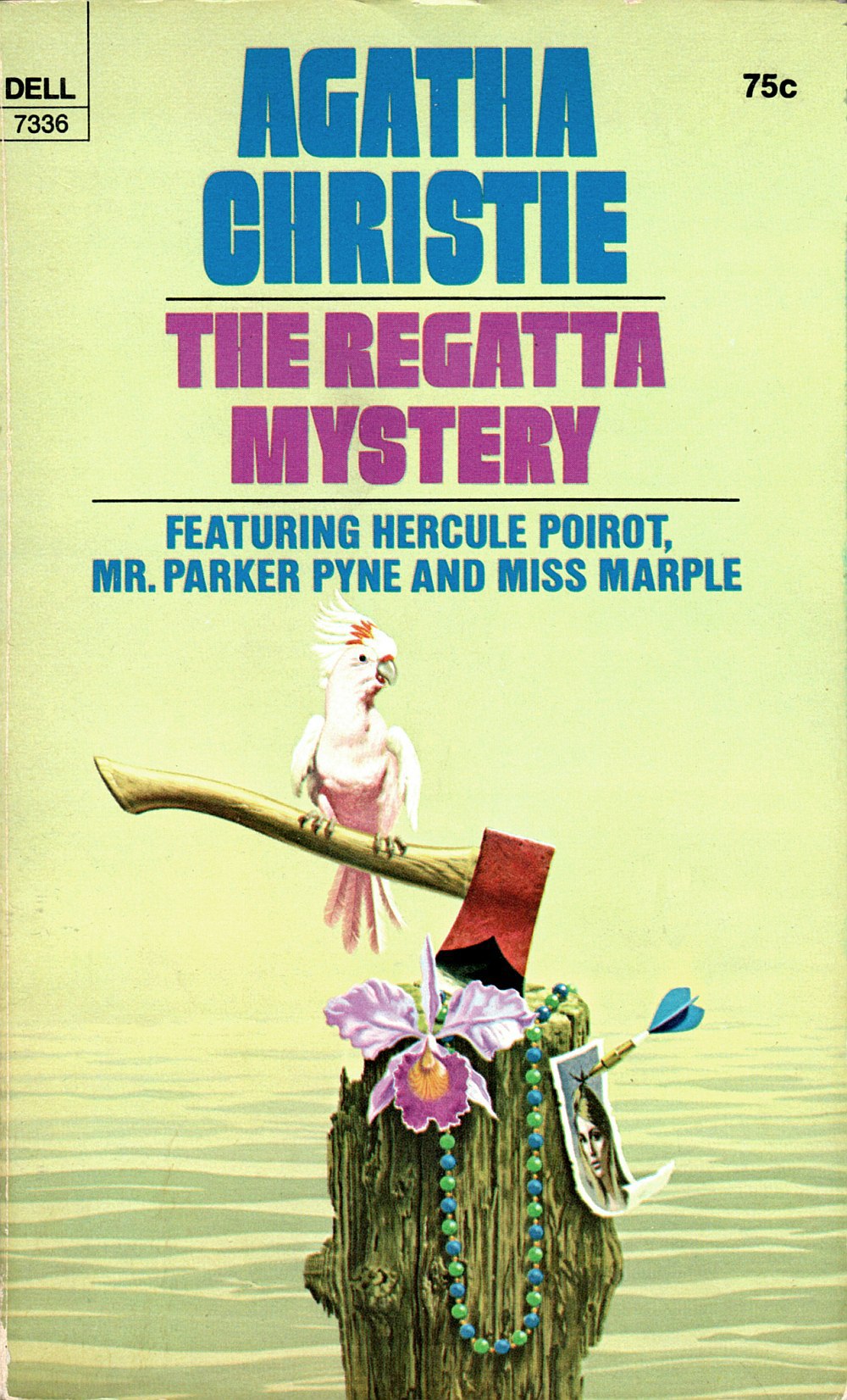
Everybody In: The Regatta Mystery | 1939

6.30.2016
Image from here
"I wonder if you'll ever commit a crime, Poirot?" said Stillingfleet. "I bet you could get away with it all right. As a matter of fact, it would be too easy for you -- I mean the thing would be off as definitely too unsporting." 
"That," said Poirot, "is a typically English idea."
-The Dream, p. 161

The Sum of It
This set of short stories contains tales featuring three of Agatha's best known detectives: Poirot, Parker Pyne, and Miss Marple. Many of these are legit SHORT stories, some of them are really more like vignettes. A few of the stories will be well known by fans of the David Suchet Poirot series as they have been adapted in that medium. The Mystery of the Baghdad Chest, Yellow Iris, The Dream, and Problem at Sea can all be found in this little collection. 

My favorite story in this collection was one I hadn't seen before, called In a Glass Darkly. The story is written in first person, which I always enjoy from Agatha. The narrator is visiting a friend and dressing for dinner in a mirror when he sees in the mirror what appears to be a reflection of a woman being strangled by a man with a scar on his face. But when he turned around, all that was behind him was a wardrobe and a wall. He feels like the vision was perhaps a premonition, so he warns the girl he saw in the vision (his friend's sister) about it, causing her to break up with her fiance. After the narrator is grazed on the cheek by a bullet in WWI, he comes home and marries the girl. Later in life, he finds the scene repeated live and in person, and learns something about himself. He also comes to wonder about the vision he saw; did it alter the course of their lives? There's a hint of the supernatural in this story, and a nice level of creepiness, it's a delicious little mystery snack!

The YOA Treatment
So, yeah, more short stories. This was a pretty fun set, really, though there's also a fair sprinkling of some regrettable pre-war racism and sexism. There are several decent tales in the mix. In addition to the one I summarized above, I also really enjoyed The Yellow Iris, even though I was familiar with the plot from television. It's a good demonstration of Poirot using those little grey cells to solve a life-and-death style puzzle in real time as a dinner party unfolds following a panicked call from one of the ladies at the party who claimed to be in peril. (Fun fact: Agatha must have really enjoyed this one too, as The Yellow Iris was later expanded into a full-blown novel called Sparkling Cyanide, which we'll be reading soon along with our #bookstagram friends, The Maidens of Murder!)

The Parker Pyne story Problem at Pollensa Bay is a classic example of Mr. Parker Pyne's methods of basically employing an attractive woman to seduce a man in order to solve some sort of relationship problem #gigolo. The Miss Marple story, although her tone and style of speech is perpetually amusing, is not much of a tale, disappointingly. It was fun to meet several different mystery solvers, along with some independent storytellers, in the same set. 

No strong feelings about this book, honestly, though given the mini-stories, it's a fine set to toss in your work bag for quick reads while you're waiting for a meeting to start!

-E.


The Tale of Jerry and Joanna: The Moving Finger | 1943

5.07.2016
(image from here)
"The great thing in these cases is to keep an absolutely open mind. Most crimes, you see, are so absurdly simple. This one was. Quite sane and straightforward—and quite understandable—in an unpleasant way, of course." - Miss Jane Marple, The Moving Finger, p. 180

The Sum of It:
The Moving Finger has always been one of my favorite Agatha stories (incidentally, it was one of her favorites too!): the plot is very clever, it has a lot of romance (always a plus), and has some very Tommy and Tuppence-esque witty characters in brother and sister protagonist duo Jerry and Joanna Burton.

Recently-injured-and-now-convelescing Jerry Burton (also this book's narrator) and his sister Joanna begin the book by moving to the small country village of Lymstock for some quality R&R. ALAS they find the village quite twitterpated because someone has been sending nasty anonymous letters to nearly every resident. Jerry and Joanna aren't really bothered by the whole thing, but are quite fascinated to know who is behind them. As they settle into their new house (called Little Furze #namegoals) they make nice with the neighbors, namely:

The Symmingtons: lawyer dad, neurotic mom, spacey yet lovable older daughter, two little boys, and a hot nanny.
Mr. Pye: eccentric bachelor who knows all the town gossip
The Dane Calthrops: Vicar and fairly terrifying wife
Miss Emily Barton: Jerry and Joanna's landlady (Bartons AND Burtons - that won't be confusing at all…will it?)
The Griffiths: Dr. Owen and nosy sister Aimee.
There is also an appropriate sprinkling of housekeepers and housemaids, etc.

The anonymous letters seem to just be an in-bad-taste prank until Mrs. Symmington is found #DEAD, apparently having committed suicide after reading one of the letters. It all seems a straightforward deal, but at the same time, something about it seems fishy and Jerry has more questions than the detectives are willing to ask. Things REALLY heat up when the Symmingtons's maid, Agnes Waddle, is found #MURDERED in a cupboard under the stairs (#notHarry'scupboard). Now that there's an actual murder to solve, a Superintendent Nash shows up to sort it all out. Or at least tries to...

BUT WAIT, you might ask (I certainly did), isn't this a Miss Marple book? Where is Miss Marple? Fear not, she does show up quite near the end as a seemingly random guest of the Dane Calthrops, knits unobtrusively during teas and get-togethers, chats with Jerry, and comes up with a sneaky little plan to oust the killer! I remember the first time I read this feeling SO confident that I had solved the whole thing, but of course the simple answer was quite different, yet right under my nose the whole time!

The YOA Treatment:
As with many of her novels, Agatha has chosen a man as the narrator for this novel. In much the same way as Luke Fitzgerald from Murder is Easy, Jerry Burton plays more of the being-nosy-from-the-sidelines sort of character instead of the pretty formal sidekick-esque Dr. Sheppard from Roger Ackroyd or observer who gets told a lot of secrets Leonard Clement from Murder at the Vicarage. I admire Agatha for not sticking too closely to a formulaic narration style. As much as I love the Hastings/Poirot repartee, you do know what to expect with a Hastings-narrated novel. Being open to telling her stories through the eyes of different men (and women! I'm lookin' at you, Nurse Amy Leatheren from Murder in Mesopotamia!) is part of what makes Dame Agatha such a writing star for me.

As I was considering the subject of narration, I found a couple of interesting articles about book narrators:

Check out this article about books with unreliable narrators and this article about books written by women with great male narrators

Spoiler alert: Agatha makes both lists :)

-A.