Top Social

Image Slider

Hotel for Dogs: Mrs. McGinty's Dead | 1951

9.19.2016
How great is this first edition cover? Found it here

"But talk, however light, however idle, gives away, inevitably, the sort of person you are. The wise criminal would never open his mouth, but criminals are seldom wise and usually vain and they talk a good deal -- and so most criminals are caught." -Mrs. McGinty's Dead, p. 54

The Sum of It:
This story begins as Poirot leaves a French restaurant he has discovered and is standing on the sidewalk, quite satisfied with his meal, when Agatha offers one of my favorite (and also one of the most relatable) sentences she's ever written:

"Alas," murmured Poirot to his moustaches, "that one can only eat three times a day..." 

Heard that, Poirot. Anyhow, Poirot is not just bemoaning that he can't just constantly consume French food, he's also feeling a bit bored with life, and not having anything important to do during the times between meals, not even his pal Hastings to hang around with (poorest lonely Poirot!) Fortunately, his old friend Superintendent Spence swings by his flat that evening with a request for help. 

Spence and his crew have just solved the small town murder of an elderly housekeeper. Only the convicted murderer, the lady's lodger, just doesn't seem like the right culprit to Spence. It's bothering him, and he wonders if Poirot might go nose around bitty town Broadhinny and see if he might be able to figure out whether the lodger really is the culprit or, if not, who it might be. Poirot is desperate for anything to do so he's like I'M IN and arranges at once to visit the little village. 

Accommodations in the village are sparse, and Poirot ends up lodging in the one "guest house" in town which is basically just these people's home, and they are turrible housekeepers and have giant dogs everywhere and there's a draft and the doors never shut all the way and there's spinach on the couch...i.e. Poirot's delicate sensibilities are really put to the test here and he feels like he's making major sacrifices for his craft. Indignities are furthered when, as he is approaching one of the area homes to interview people, he gets brained with an apple core! However, this quickly becomes happy news when he realizes his assailant, a driver tossing refuse out the window, is none other than his old pal, detective novelist and apple aficionado, Ariadne Oliver! YAY now things are fun! 

"Murmuring in an explanatory voice, 'Stiff after the long drive,' Mrs. Oliver suddenly arrived out on the road, rather in the manner of a volcanic eruption. Large quantities of apples came too and rolled merrily down the hill. 'Bag's burst,' explained Mrs. Oliver. She brushed a few stray pieces of half consumed apple from the jutting shelf of her bust and then shook herself rather like a large Newfoundland dog. A last apple, concealed in the recesses of her person, joined its brothers and sisters." 

Like I said, fun. Anyhow, Poirot and Ariadne (with the help of a local gal named Maude) set about figuring out the mystery which they quickly discover is somehow linked to a newspaper article featuring four by-gone lady murderers; One of these former notable criminals is in disguise and living in town and Mrs. McGinty knew too much...but which one?? Oooh it is tres' mysterious. 

The YOA Treatment:
Listen, when Poirot and Ariadne Oliver are together, I am always happy. They are such nice foils to each other, and have a charming banter (which we all know I value like the king's rubies). Unlike darling Hastings, she pushes back on Poirot, and refuses to simply act as his hapless Watson, but she still helps him sort through the facts and get to the root of things. I don't like it as much when Poirot is all by himself because he seems lonely, so it always makes me happier when he has a friend. He and Ariadne have a nice little dynamic #teamworkmakesthedreamwork. 

"Mrs. Oliver, glass in hand, approached Hercule Poirot towards the end of the Carpenters' party. Up till that moment they had each of them been the center of an admiring circle. Now that a good deal of gin had been consumed, and the party was going well, there was a tendency for old friends to get together and retail local scandal and the two outsiders were able to talk to each other. 'Come out onto the terrace,' said Mrs. Oliver in a conspirator's whisper." 

Hooray for Poirot having a conspirator :). This is a solid mystery with a nice little puzzle in the middle -- which of the people in town matches with one of the past criminals in the paper? Several of them seem like they could fit, and it's a real thinker. Those of you who prefer the more intuitive cases that leave you competing with Poirot to see who can solve it first will truly enjoy this tale, I recommend! Two mustaches up. 

-E. 

One Wedding & Two Funerals: Crooked House | 1948

9.12.2016
(image from here)
“I've never met a murderer who wasn't vain... It's their vanity that leads to their undoing, nine times out of ten. They may be frightened of being caught, but they can't help strutting and boasting and usually they're sure they've been far too clever to be caught.” 
― Crooked House, p. 87

The Sum of It:
IT'S SO GOOD! K, got that out of the way. This one is narrated by Charles, a tall cutie-patootie who falls in love with this girl Sophia while they're out in Egypt at the end of WWII. Sophia is beautiful and has crisp brown hair and is quite English looking thus he is taken with her, and by the time she's about to head home he decides to pre-propose. She tells him to look her up when he gets back in a few years and she'll be thrilled to see him. She also tells him all about her unique familia, the Leonides clan. Her grandfather, Aristide, is an old Greek who came to England and made his fortune in restaurants and catering businesses. He built his first wife a great big crazy looking house and since her death, basically his whole family lives there in separate apartments within the rambling structure. Sophia jokingly calls it a "crooked house" from the nursery rhyme, and says that they're a crooked family, though not dishonest, just intertwined.

Charles is so pumped when he returns to England to be able to propose to the lovely Sophia who agrees to meet him for dinner the day he gets back, even though her beloved grandfather has just passed away. Charles can't wait to get the wedding bells a'chiming, but Sophia is like hold up fella, turns out grandfather was #MURDERED with poison in his insulin injection and she totally cannot get married til things get sorted. Charles, whose father JUST HAPPENS to be the Assistant Commissioner of Scotland Yard, quickly gets involved with the solving of the mystery due to his unique position as friend of the family/relative of crime solver #England. Quickly, he figures out what Sophia meant about the crooked house because everything over there is a bit cray.

Sophia's dad, Philip, is Aristide's son, and writes books on books. He is quiet, calm, and handsome. His wife, Magda, is a DRAMATIC stage actress who's always wanting to use family money to put on doomed productions and just acts out scenes instead of having real conversations with people. Philip's brother, Roger, is charming, clumsy, and in spite of being in charge of the family catering company, not exactly a business man. His wife, Clemency, is a scientist, and is very remote and cool, and has decorated their entire apartment in a minimalist style that seems to freak everyone out #hipster. Aristide's new young wife, Brenda, a former waitress, lives in the house, but the whole fam thinks she's a gold digger who's been busy getting her flirt on with Laurence, the tutor to Aristide's grandchildren, Eustace and Josephine, who are basically described like the kids from the Adams Family except less nice #creepy. Josephine is obsessed with detectives and goes around spying on people all the time and making notes and eating apples. Rounding out the house's occupancy is Aunt Edith, who came once wife #1 died to care for the children, and never left. Charles gets a feeling once he's talked to everyone in the house that literally any of them (except his beloved Sophia, of course) could have knocked off the old man. But which one?? And WHY??

The more Charles gets to know the family, the more he is concerned for their safety. When one of the house's staff is also murdered after someone is taken into custody for the first murder, everything is up in the air again, and the air of mystery gets more sinister. By the time the mystery gets resolved, we learn some sad stuff, and this book gets #DARK. Needless to say, if things work out for Charles and Sophia, they will both know a lot about one another's families before they even get hitched #agoodsign?

The YOA Treatment:
So as we've previously stated, this is one of Agatha's most favorite books of all that she wrote, and she saved the idea for when she'd have time to devote to something this complex and clever. And it for real is ah-mah-zing. The drama and tension in the house is palpable through the page, and the setting is so interesting with the different family apartments, which convey something unique about each group. Also the culprit is #SHOCKING for first time readers, which is why we don't want to include any spoilers in the post! What did you think??

Although the majority of Agatha's stories have made it to the screen at one point or another, somehow this one has not. Which is part of the reason we were SO PUMPED to learn that a film adaptation is planned and will be helmed by none other than genius of British television, Julian Fellowes!! AHHHH!! You guys, it gon' be so good. Anyhow, obviously this got us all fired up about who might be cast in this landmark adaptation, so we decided that the best people to cast the actors would be us. And so, our cast list follows:

(Matt Smith as Charles Hayward & Emilia Clarke as Sophia Leonides)

(Ralph Fiennes as Philip Leonides)

(Kate Winslet as Magda Leonides)

(Maggie Smith as Aunt Edith De Haviland)

(Clive Owen as Roger Leonides)

(Michelle Dockery as Clemency Leonides)

(Nicholas Hoult as Eustace Leonides)

(Bella Ramsey as Josephine Leonides)

(Carey Mulligan as Brenda Leonides)

(Matthew Goode as Laurence Brown)

(Daniel Day Lewis as Sir Arthur Hayward)

(Hugh Bonneville as Chief Inspector Taverner)

(Imelda Staunton as Nannie)

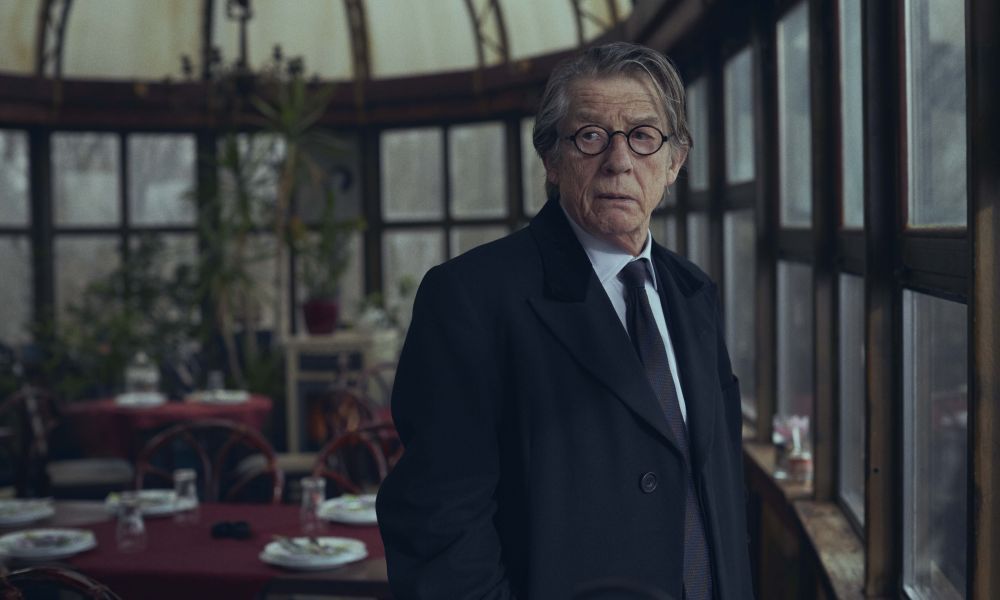
(John Hurt as Aristide Leonides)
*all images from IMDB*

What do you think?? Did you love the book? Were you shocked by the ending? Did you think that this one was particularly complex? Surprisingly dark? Why so? And most importantly, what do you think of our cast list?

Can't wait to hear what you all thought of Crooked House in the comments section!

- A. & E.

Unsolved Mysteries: Ordeal by Innocence | 1958

9.11.2016
(image from here)
"All right. It's your say so - and you're sticking to it. Jacko didn't kill her. Very well then - who did kill her? You haven't thought about that one, have you? Think about it now. Think about it - and then you'll begin to see what you're doing to us all..." -Micky Argyle, Ordeal by Innocence, p. 42

The Sum of It:
I'm going through a phase in this Year of Agatha project where I'm reading a lot of her books that have my most favorite premises, and today's read is no exception. Ordeal by Innocence follows the tribulations of the Argyle family, specifically, their painstaking efforts to figure out who killed their mother. Some years ago, mother Rachel Argyle was found dead, having been struck down from behind #yikes! At the time of her death, it was pretty clear she was killed by someone else in the house, meaning her husband, one of her children, the husband's secretary, or the household's long-time housekeeper. The most likely suspect was hot mess son, Jacko. Jacko had a history of disagreements with his mother, had a history of money troubles, and had recently been caught stealing by his mother and she wasn't gonna let that happen anymore. But Jacko says, I couldn't have killed her because at the time of her death I had been hitchhiking and was picked up by some random car driver so I'm innocent! However, no such car driver could be found during his trial, and so Jacko is convicted of the crime and thrown in jail, where soon after he dies of pneumonia.

The Argyle family has done their best to move on with their lives and so are pretty shocked when they receive a surprise visitor at their door, a geophysicist named Arthur Calgary, proclaiming: "GUYS, I WAS THE GUY IN THE CAR!" Apparently, Arthur picked Jacko up on his rounds of saying goodbye to pals before heading way out of town on the Hayes Bentley Expedition, and after dropping Jacko off Arthur is hit by a car and has a bit of amnesia and then heads to Australia to meet up with his expedition. He just recently has his memory restored when he sees old newspapers with the Jacko stories and realizes he was the alibi Jacko needed all along! Arthur expects the Argyle family to feel a sense of relief that Jacko wasn't Rachel's killer. However, as each one in turn explains to him, well then which of the rest of us DID kill her!?

The YOA Treatment:
You can tell when you read Agatha Christie's works, particularly this one, that she was intrigued by unsolved crime. In more than one book she mentions the Lizzie Borden case, and in this book she talks about another unsolved crime, the murder of Charles Bravo. I highly recommend looking up the story of Charles Bravo because it is pretttttty crazy! And it speaks to the drama of Ordeal by Innocence because after Jacko is shown to have an alibi for the time of the murder, the rest of the family is left in terrified mystery about which of them could have killed her...and which of them could be next? All in all, Ordeal by Innocence is a great read and I highly recommend it!

-A.

Rick Steves' Agatha Christie: They Came to Baghdad | 1951

9.07.2016
Image from the delightful Pulpcovers.com
"When Crosbie had gone Dakin sat bent over his desk. He murmured under his breath, 'They came to Baghdad...' On the blotting pad he drew a circle and wrote under it Baghdad -- Then, dotted around it, he sketched a camel, an aeroplane, a steamer, a small puffing train -- all converging on the circle. Then on the corner of the pad he drew a spider's web. In the middle of the spider's web he wrote a name..." - They Came to Baghdad, p. 12

The Sum of It:
Spies! Murder! Morse code! International intrigue! Kidnapping! Accomplished liars! Adventurers! Archaeologists! Air travel! Hair dye! Dust storms! Dickens references! This book has it all. Really like a lot. Like, almost everything that could potentially be in a mystery book is in this one, and it's not super long, page-count-wise. As a result it is a #teensybit #confusing, but overall a fun read. 

Essentially, the main character, Victoria Jones, is a clever fabricator of tales and great at imitating people, but is a terrible shorthand typist and quickly gets fired from her job for mocking her boss' wife (ha!). As she is eating two sandwiches and considering her next move on a park bench, she sees a super hot guy named Edward, gives him a smile, they chat for five minutes and she falls in love. Him too, apparently, but the bummer for the lovebirds is that he has to move to Baghdad for work the next day. No matter, decides Victoria, she'll just figure out how to get a job in the next few days that will take her to Baghdad too so she can track him down. Oy vey, right? But don't worry, turns out Agatha is a little more meta than we might have given her credit for in the past.

Anyhow, Victoria makes up some dignified references, gets a job escorting a lady with a broken arm to Baghdad, goes about searching for her boo. Meanwhile, the "President" (no indication of which country, assuming America) as well as a bunch of other dignitaries are planning a big meeting in Baghdad. An international man of mystery/government secrets is also cautiously making his way to the city, carrying critical information about international affairs, as is an international woman of mystery. Some sort of international intelligence agency is also converging on Baghdad to protect secrets guy and his liaison, a famous explorer, as well as the dignitaries coming to the meeting. ALSO a network of baddies who kind of sound like some weird combination of Communists and neo-Nazi types except more obsessed with youth and less obsessed with race? ALSO a bunch of archaeologists are around, presumably to allow Agatha to show off some of the new stuff she had learned about archaeology in her own travels in the Middle East. A million different things are happening, seemingly unrelated to each other, until a bleeding man stumbles into Victoria's hotel room one night, begging to be hidden. She hides him, only to find him dead in her bed after the fake cops chasing him have left! Quickly, she becomes embroiled in all the international spy intrigue that's going on and gets quite a few nasty surprises along the way. And also learns a ton about archaeology. #themoreyouknow

The YOA Treatment:
So, as noted, there is SO MUCH GOING ON in this book, and SO many characters that it was honestly hard to track at some points. A couple times when a new character was introduced I had to flip back through the part I'd already read to make sure I hadn't already met them before because there are so many people coming and going, some with multiple identities. Agatha really doesn't write many genuine spy mysteries, so I think maybe it's just not something she's as practiced with. However, eventually the details coalesce and it gets pretty good! Quite caper-y, which we all know I enjoy. I'm also pleased with Agatha turning what had become kind of a common love-story narrative for her on its head a bit. 

One thing about this book that is obviously pretty cool is that Agatha takes the opportunity to turn her rich experiences travelling in Baghdad and beyond into beautifully detailed settings and scenes, from a stroll through the Copper Market to the date palms along the Tigris to the elaborate and glamorous hotels of the city. The descriptions of how a dust storm appears suddenly and leaves everything in its wake coated in a rusty brown are too realistic not to be drawn from real life experiences! 

Additionally, it's clear that Victoria's experiences assisting on an archaeological dig are pulled straight from Agatha's joyful times spent assisting with her second husband Max's digs throughout the Middle East #teamMax. In her autobiography, Agatha writes a lot about how happy she was doing that work, and constantly learning more about it, by Max's side. The work and sites are described in loving detail, and Victoria, who has hitherto been a bit flakey, suddenly develops a real devotion to the work of discovering, cleaning, repairing, and cataloging artifacts for all kinds of reasons that really seem more Agatha than Victoria, which is actually kind of cool. 

- E. 

Bonus Read: Ruth Ware's The Woman in Cabin 10 | 2016

(image from here)
"It was the noise of the veranda door in the next cabin sliding gentle open. I held my breath, straining to hear. And then there was a splash. Not a small splash. No, this was a big splash. The kind of splash made by a body hitting water." -The Woman in Cabin 10, p. 85

The Sum of It:
Mystery-loving friends: do yourselves a favor and find yourself a copy of Ruth Ware's The Woman in Cabin 10 just as soon as you possible can. I found this book on a list of the top-selling books of 2016, and my interest was further piqued when I saw the dust jacket touting its reminiscence of Dame Agatha's works. #sold! I ordered the book, thinking I would tuck it away for some future air travel, but then, of course, when it arrived I decided to just read the first chapter to see if I liked it. To say I couldn't put it down was an understatement! This is the kind of book you have to just devour because you just HAVE TO KNOW WHAT ON EARTH IS GOING ON!

So, brief summary: The Woman in Cabin 10 follows travel journalist Lo Blacklock (great name #AMurderisAnnounced) as she is invited on the maiden voyage of a super swank cruise ship to write travel updates on how awesomely luxurious it is. Sounds great, right? Alas, Lo is having a hard time enjoying her fancy surroundings because just days before she leaves she a) is pretty traumatically burgled in the middle of the night, and b) maybe breaks up with her boyfriend??? She's having a hard time sleeping because of burglar flashbacks and so is further terrified when she hears what sounds like a body being thrown into the sea from her neighbor's cabin (#CABIN10) and sees smears of blood on cabin 10's veranda. HOWEVER, after reporting the mysterious occupant of cabin 10 #MURDERED, she is shocked to find out no such woman was ever on board the ship. It's up to Lo's weary wits (I swear, this poor, frightened woman gets like 12 hours of sleep in a two week period) to find out which of her illustrious fellow passengers knows the story of the woman in cabin 10.

The YOA Treatment:
What I enjoyed so much about this book is its so classically Agatha Christie-esque setup. I was reminded of Murder on the Orient Express, Evil Under the Sun, Death on the Nile, and Murder in Mesopotamia as I read about a group of travelers with all the stereotypical characters you expect from a good whodunnit: the handsome aristocrat, the playboy photographer, the much younger model wife of a rich guy named Lars. There are evening gowns and attentive Scandinavian stewards and cocktails on cocktails. You basically expect Poirot himself to show up halfway through to help Lo put all the clues together. I will admit, as I neared the conclusion, I did have a little suspicion of how the story would work itself out (thanks for all the practice, Dame Agatha! #littlegraycells) and it does, in my opinion, get a smidge caper-y near the end for a bit longer than it should (#sorryRuth). HOWEVER, overall, I heartily recommend this book to anyone who wants a read that will keep them up all night, dying to get to the last page.

-A.

The Nun Motif: After the Funeral | 1953

9.03.2016
(image from here)
"It shows you, Madame, the dangers of conversations. It is a profound belief of mine that if you can induce a person to talk to you for long enough, on any subject whatever! sooner or later they will give themselves away." -Hercule Poirot, After the Funeral, p. 283

The Sum of It:
We are back to good old fashioned big family murder this week with After the Funeral (also called Funerals are Fatal). The story begins with the rather sudden, yet not entirely unexpected, death of older gentleman, Richard Abernethie. His remaining family members (sisters-in-law, nieces, nephews, and one younger sister) attend his funeral without much pomp and circumstance. However, the drama turns up a notch when eccentric Cora Abernethie Lansquenet blurts out her observations of her brother's death: "But he was murdered, wasn't he?"

The family is rather taken aback, assuming Richard's death in his sleep was perfectly natural, and rush to chalk up her remarks to Cora Be Cray. However, Cora's words linger with each Abernethie as they leave the family gathering...especially when Cora turns up #MURDERED the next day! (and #murdered with a hatchet no less...it's pretty gruesome for Agatha...#yikes.) The Abernethie's lawyer, Mr. Entwhistle, is very disturbed by the turn of events, and after some light investigation of his own, he enlists the heavy-duty assistance of retired detective Hercule Poirot to get to the bottom of who is killing the Abernethies.

There is kind of a lot of comings and goings in this book. Poirot doesn't get involved until two murders in, and the book divides most of its time between Enderby, the Abernethie family home, and Cora's small cottage, which is short-term inhabited after her death by her companion, a Miss Gilchrist who spends a lot of time defending the poor artistic abilities of her late mistress and telling sad tales of her own out-of-business tea shop. Richard Abernethie's surviving family members are often visiting one another and repeatedly having vague discussions about their alibis for each murder and how lucky it is that Richard left them money. #suspicious? There's also quite a bit about nuns showing up to the point of giving one of the characters the creeps (don't worry - it ends up helping Poirot solve the crime in the end.) However, overall, I enjoyed this book immensely. It's the kind of Christie you know and love, and you can tell it's the kind of story Agatha liked to write. I've always liked the solution of this story because of its simplistic cleverness (those of you who have read it will know what I mean!)

The YOA Treatment:
After the Funeral features Poirot investigating in his usual style, yet with a few, unexpected additions. Sure, he does his usual spiel of talking to all the characters involved to size them up and see if some basic conversation will lend him any clues. Per usual, this works like a charm, and a few slips of the tongue during a Poirot chat are enough to give the murderer away. However, this story also briefly features a lesser-known Poirot comrade: one Mr. Goby. Mr. Goby shows up in chapter 12 and is described as an elderly man (as is Poirot in this story), "small and spare and shrunken," with an aversion to eye contact and in possession of a double-jointed thumb #odddetail. Like Poirot, Mr. Goby is retired, but is willing to take a few days to do some P.I. work for Poirot by giving him the skeletons in the closet of all the potentially guilty Abernethies (along with some grumpy speeches about the Government.) Mr. Goby can be found giving Poirot a hand in several other books, including The Mystery of the Blue Train, Third Girl, and Elephants Can Remember. It's always fun to see Agatha spice up Poirot's world with new associates, particularly in these later stories devoid of the usual Hastings/Miss Lemon/Japp crew.

-A.

Three's Company: Towards Zero | 1944

8.29.2016
(image of US First Edition cover from here)
"I like a good detective story,' said the venerable Mr. Treaves. 

'But you know, they begin in the wrong place! They begin with the murder. But the murder is the end. The story begins long before that -- years before sometimes -- with all the causes and events that bring certain people to a certain place at a certain time on a certain day. All converging towards a given spot...And then, when the time comes -- over the top! Zero hour!' 

He sat in front of the fire and reflected on the events of the day. 'Even now,' he thought, 'some drama is in the course of preparation. If I were writing one of these amusing stories of blood and crime, I should begin now with an elderly gentleman sitting in front of the fire opening his letters -- going, unbeknownst to himself -- towards zero.'" - Towards Zero, p. 3

The Sum of It:
Towards Zero is basically about tennis and cliffs. NOT REALLY. But kind of?

The book begins in prologue, with a bunch of lawyers sitting around a fire, reminiscing about court. The wise elder amongst them, Mr. Treves, starts expounding on how there's so much background that goes into every crime committed, really the murder is the least interesting part. He returns to the story later when he decides to go on vacay in the little seaside village of Saltcreek, near the home of his friend Lady Tressilian. 

The next scene is in a hospital, with a young man who's pretty frustrated because he tried to fling himself off a cliff across the river from Lady Tressilian's house, Gull's Point, and got stuck in a tree and then someone rescued him and he doesn't understand why people wouldn't just leave him alone. He'll join us again later when he goes back to visit the scene of his survival a year later. Same time Mr. Treves is going to Saltcreek. Notice a theme?

We quickly find out that Lady Tressilian, an invalid, has a bunch of people who regularly come to visit her beach house. Among those are Neville Strange, a handsome and affable professional tennis player, his ex-wife Audrey, and his new wife, Kay. Audrey is often described as looking like a beautiful ghost #RowenaRavenclaw because she is pale and enchanting in a quiet way, while new-wife Kay is beautiful in more of a siren-y way, with auburn hair, tan skin, and flashing eyes. Needless to say, everyone is expecting #MAJORAWKWARDNESS when Neville requests that everyone come visit Lady T at the same time for a group vacay. 

They also join up with Mary Aldin, Lady T's companion/cousin, who is super capable and self-sacrificing and has a Cruella DeVille style white streak in the front of her hair. She's got a bit of a crush on, well, maybe everyone, but kind of seems like she has the feels for another family friend, Thomas Royde, who has a bum arm from an earthquake-smashing incident, grows tea in Malay or somesuch, and has long harbored feels for the beautiful ghost, Audrey Strange (Neville's first wife), because they grew up together. Ted Latimer, one of new-wife-Kay's bffs who is a #handsomeface #maybegigolo drops by to visit. 

So everybody gets together for a jolly awkward holiday at Gull's Point. There is a great deal of emphasis on underlying tensions. Everyone is a bit on edge and often caught staring at one another. Mr. Treves comes over for dinner and is like "a storm's a-brewin', watch out people" and then is promptly #MURDERED in a very indirect way by someone forcing him to take the stairs at his hotel instead of an elevator because he's got a weak heart and poor fella doesn't make it to the top. Turns out there was a sign on the elevator saying it was out of order, when it was totally operational! WHY? However, his is only the first of the #MURDERs and once the next one happens, it's a doozy, and everyone in the house is implicated. Only an outsider can figure it out! Here comes Inspector Battle, #FriendofPoirot, to do some deducing. He'll need some help from another outsider before its over and done with, but by the time the main murder actually happens, we've got ourselves a FINE KETTLE OF FISH. 

The YOA Treatment:
This was a different take on the classic murder mystery for exactly the reason cited in the lead quote above. It definitely does not start with the murder. In fact, the main murder doesn't happen til nearly a hundred pages into the book. Agatha really spends time investing in the backgrounds of each character. Without Poirot here to do all the psychological background work, we kind of get an opportunity to do some of it ourselves, which is an interesting twist. Honestly, in this way, this one is sort of similar to some of your more contemporary mysteries, like The Girl on the Train, or Black Chalk, in that it spends a great deal of time on the circumstances and the "why?" and less time on the murder itself. #Trendsetter

This one is also SO twisty. I really don't know if anyone could figure it out. In part that's a bit sneaky of Agatha, but then, that's kind of the point, and there are probably some out there who decided who the culprit was and how he/she did it before the book ended, but this is a real surprise ending, probably the most TOTALLY surprised I've been since Lord Edgware Dies, where I really didn't think the culprit was gonna be the culprit. Similarly, though even more so in this case, I was all like "noooo Agatha not that one!" I really kind of liked and had some sympathy for the culprit in this one, even though this person had some weaknesses, so I was a little bummed when they turned out to be the baddie. BUT I think that is pretty good of Agatha to create a villain who you want to like and trust, and who you're disappointed to see head off to jail in the end. 

This one is a classic, though a bit of a slow burn, given all the background Agatha works pretty hard to build up before the crime is really committed, but the resolution is totally worth it. 

THAT SAID, in the last two pages Agatha drops in one of the most random and unrealistic proposal/love scenes ever, which is kind of a buzzkill after the real resolution of the mystery, but I think maybe she thought the resolution was a bit grim, and decided to lighten things up at the end. If she had written the book now, I think her editor would have said KEEP IT DARK, LADY! 

- E.